| 2nd
New Zealand Division in WWII
By Brian L. Knipple
February 2014
When England declared on Germany on 3 September
1939, New Zealand simultaneously declared
war. The British and New Zealand governments
decided an infantry division for overseas
service was the best way for the dominion
to support the war effort.
From a March 1939 strength of 578 regulars,
the New Zealand government had to raise combat
and support units for employment in the Pacific
(1st Division), while simultaneously raising
a complete British-style formation of nine
infantry, one machine gun, two engineer, two
reconnaissance and three artillery battalions
as well as a host of other support units for
the infantry division. Sources for the manpower
necessary included 10,742 territorials and
trained reservists, the majority of whom were
expected to enlist.
On 6 September the government authorized
the initial formation of a volunteer force
of 6,600. On 12 December the force was officially
declared the 2nd New Zealand Expeditionary
Force (2 NZEF), the 1st now having been that
dispatched in the First World War. Enlistment
on a voluntary basis was limited to men aged
18-35 (later raised to 40), with length of
service being the duration of the war plus
12 months. Enlistment began on 12 December
and by the end of the day, 5,419 men had signed
up. By 5 October, 14,983 men had enlisted.
Enlistment of New Zealand men in England were
sufficient to form the nucleus of the divisional
anti-tank regiment, eventually forming 34
Battery of the 7th Anti-Tank Regiment.
(In all places here the term “regiment,”
as used by the Commonwealth, actually refers
to a battalion-sized unit.)
On 18 September 1939 the Maori tribes, the
native people of New Zealand and fierce warriors
in their own right, requested to be allowed
to form a combat unit for overseas service.
Approval was quickly forthcoming and the Army
began accepting enlistments on the 9th of
October. The unit eventually formed from the
men who volunteered was the 28th (Maori) Infantry
Battalion, one of the most flamboyant and
warlike units in the division and maybe the
entire Allied ground forces. The addition
of this unit gave 2 NZ Division an extra infantry
battalion. An earlier installment covered
the exploits of the
Maori at war.
| 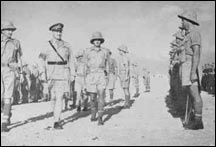
Bernard Cyril Freyberg, warrior-dentist.
|
A New Zealander Commanding
Major General B. C. Freyberg, V.C., D.S.O.,
was appointed commander of 2 NZEF on 23 November.
Unlike the First World War where the New Zealand
Division was commanded by British regular
army officers, the 2 NZEF was to be commanded
by a New Zealander. Freyberg was so highly
regarded that the Chief of the Imperial Staff
had intended to offer him command of a British
division. During the Great War, Freyberg had
joined the British Royal Naval Division as
an officer in 1914 and later a number of British
Army brigades, ending the war, at age 29,
as an acting major general commanding the
British 29th Infantry Division. He had been
awarded the Victoria Cross, the Distinguished
Service Cross three times, been wounded nine
times and risen in the rank to major-general
in the interwar British Army before being
medically retired in 1937 under unusual circumstances
by a cost-cutting British government.
As 2 NZEF commander, Freyberg insisted on
and was granted a unique set of responsibilities
beyond those of a combat unit commander. The
force represented a significant percentage
of the nation's male population between the
ages of 21 and 35 and Freyberg and the government
believed recourse beyond the British chain
of command, which the unit would become part
of, was necessary to ensure the unit was employed
appropriately and administered as a New Zealand
unit rather than a British one (Australia,
South Africa and Canada did likewise). In
this case “appropriately” employed
meant what General Freyberg and the New Zealand
government considered it did.
The 2nd New Zealand Division was organized
and battalion-level and below units numbered
so as to continue the numbering system used
in the 1st New Zealand Expeditionary Force
(a convention also used by the Australians,
except that they carried it to the numbering
of brigades and divisions as well). Brigades
were numbered 4th, 5th and 6th as the first
three were to be in the 1st Division. Infantry
battalion numbering began with 18 as there
had been 17 in 1 NZEF, artillery battalions
began with the 4th, engineer companies began
with the 5th and so on.
As might be expected of a nation with as
small a regular army as New Zealand, the commanders
of the 4th Brigade and the 4th Field Regiment
were regular Army officers, but all other
battalion and company commanders were territorial
officers, with two of the infantry battalions
commanded by lawyers. In almost every case,
units were commanded by men with experience
in 1 NZEF, even if they had not remained in
the Army between the wars.
The plan was for the First Echelon to depart
for the Middle East in January 1940 so it
could equip and train in far better conditions
than could be found in New Zealand. With the
addition of the next two echelons of units,
the expectation was that the division would
complete training in August and be ready for
deployment in September 1940. A base in England
was to be established and the division be
made available for use in Europe.
During the first nine months of the war
almost 20,000 men embarked for overseas service
in 2 NZEF. The First Echelon began training
of officers and senior noncommissioned officers
(NCO) on 27 September with the main draft
of enlisted men being mustered in on 3 October.
This was to be followed by the Second two
months later and the Third two months after
that.
| 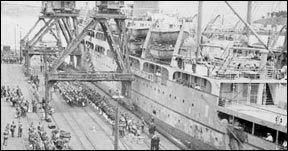
27th Machine Gun Battalion boards
the troop transport Sobieski. Lyttleton,
N.Z., January 1940.
|
First Echelon
The First Echelon, numbering 6,529 of all
ranks and composed of 2 NZEF divisional HQ,
some administrative and supply units deemed
necessary for the establishment of a base
force in Egypt, the 4th Infantry Brigade (18th,
19th and 20th Battalions), 27 Machinegun Battalion,
A and B Squadrons (companies) of the divisional
cavalry (reconnaissance) battalion, 5th Field
Park (engineer) Company and 4th Field (artillery)
Regiment, departed Lyttelton and Wellington
harbors on 5 and 6 January 1940.
The convoy arrived at Port Tewfik, 100 miles
from Cairo, on 12 February, completing disembarkation
on the 15th. Camp was established 8 miles
outside Cairo and training and equipping begun.
The divisional reconnaissance squadrons received
Bren carriers and Mark VIb light tanks and
4th Field Regiment an allotment of 18 pounders
and 4.5-inch howitzers. By late April, the
34th Battery, 7th Anti-tank Regiment had joined
the First Echelon in Egypt.
Second Echelon
The Second Echelon and attached companies
mustered on 12 January 1940 and began the
process of training and preparation. It totaled
6,838 all ranks and was made up of 5th Infantry
Brigade (21st, 22nd, 23rd and 28th [Maori]
Infantry Battalions), 5th Field Regiment,
7th Anti-tank Regiment (31 and 32 Batteries),
C Squadron of the divisional cavalry, elements
of 6th Brigade HQ (being sent out to prepare
training programs for the Third Echelon) and
7th Field (engineer) Company.
The 11 Forestry Company (loggers) and 9 Railway
Survey and 10 Railway Construction Companies
joined the group for passage to England instead
of the Middle East. Second Echelon and the
forestry and railway companies departed Lyttelton
and Wellington on 2 May and sailed first to
Australia, where they joined a larger convoy
carrying Australian troops to the Middle East
(50 members of the railway companies left
in an earlier convoy).
This journey did not have the air of carefree
adventure of the First Echelon. Germany had
invaded Norway and Denmark and plans were
made to divert the convoy to England in the
event it should prove necessary. On the 12th
of May Germany invaded Belgium, the Netherlands
and Luxembourg. Two days later British Prime
Minister Neville Chamberlain resigned and
Winston Churchill was sworn in.
Due to increased concern over German raiders
and the potential for Italy entering the war,
the convoy was diverted to Capetown, South
Africa. After a week’s stay at Capetown,
the convoy set sail for England on 31 May.
During the first ten days of June, the astonished
soldiers heard of the Dunkirk evacuation,
panzers advancing across France and finally,
on the 10th, of Italy's declaration of war.
Although sinking ships from other convoys
were spotted, the convoy itself was not attacked,
arriving at the Clyde on the 16th of June.
With the surrender of France the situation
changed dramatically. General Freyberg flew
to England to take command of the Second Echelon.
After conferring with the New Zealand government,
he was given total control of the force in
England and reported it ready to assume its
place in the British defense scheme without
regard to many of the restrictions placed
on the use of the division. Thus it became
part of the GHQ reserve and slowly began to
receive equipment, the first issue arriving
on 28 June.
The force was divided into 5th Brigade and
a mixed brigade composed of 28th (Maori) Battalion
and 29th (composite) Battalion. Both were
assigned to VII Corps (along with the 1st
Canadian Infantry Division and 1st Armoured
Division) and given buses for transport. Numerous
exercises were conducted and in two months
the force was considered trained and ready.
| 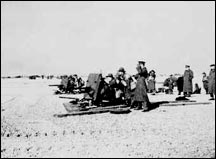
New Zealand anti-tank gunners training
in England, March 1940.
|
When the expected German invasion did not
occur, the units in England made ready to
depart on the 15th of September for the Middle
East to join the rest of the division. Increased
German air attacks and evidence pointing to
invasion resulted in a request by the British
government to delay the force’s movement
to Egypt. General Freyberg agreed.
With the 14 September Italian invasion of
Egypt, Freyberg faced the choice of staying
in England or joining the units in Egypt in
what was clearly going to be a battleground.
Convinced of the ability of the forces in
England to defeat an invasion, he and his
chief of staff took a flight on the evening
of 22-23 September and arrived on 25 September,
despite a crash landing on Malta. In the last
months of the year small parties managed to
find passage on the convoys to the Middle
East, but is was not until December that a
large unit sailed, in this case 5th Field
Regiment. The remainder left in two convoys
in early January, arriving in the Middle East
on 3 and 4 March and completing disembarkation
on 8 March. Twentieth (Composite) Battalion
was disbanded and the personnel spread among
other units of the division.
Third Echelon
The Third Echelon, numbering 6,434 all ranks
and composed of administrative and supply
units, the 6th Infantry Brigade (24th, 25th
and 26th Battalions), 34rd Battery, 7th Anti-tank
Regiment, 8th Field (engineer) Company, 6th
Field (artillery) Regiment and 3,050 replacements
assembled for training on 15-17 May, 1940.
With lessons learned from the two previous
groups, things proceeded swiftly as events
in Europe made even more urgent the dispatch
of the units.
The drastic turn of events that left the
Commonwealth alone facing Germany and Italy
after the surrender of France made for dramatic
changes in the New Zealand political climate,
to the point of enacting compulsive service
on 23 July 1940. Additional requests for logging,
railway and engineering support from England
led to the formation of 14 and 15 Forestry
Companies, 16 and 17 Railway Operating Companies,
13 Railway Construction Company and 18 and
19 Army Troops Companies, the last two coming
from and effectively resulting in the disbanding
of 8 Field Company.
As the time approached for the units to sail
for the Middle East to complete training and
be equipped, questions arose regarding the
need for them to remain in New Zealand. A
rapidly declining political situation in the
Pacific seemed to increase the likelihood
of Japanese aggression, particularly after
the Royal Navy reduced its strength in the
region following the fall of France. After
careful consideration and dialog with the
British government, the New Zealand government
agreed to the dispatch of the Third Echelon
to the Middle East, after which the New Zealand
Division would be formed and retained for
operation in the Middle East in lieu of England.
It was decided that the 3,050 replacements
would be retained for formation of a Fiji
Island garrison.
The Third Echelon sailed on 27 August, reaching
Bombay on 15 September where the group was
rearranged to allow the forestry companies
to proceed to England. The remainder continued
to the Middle East, arriving at Tewfik on
29 September. Sixth Field Ambulance and 500
reinforcements were forced to remain in India
until transport could be found, finally sailing
on 9 October. This group had the most exciting
voyage — they were attacked at sea and
in port by Italian aircraft, and the convoy
escort engaged in a surface action with Italian
destroyers from Italian East Africa. They
finally reached Port Said, Egypt without loss.
The 5th Brigade and a number of other units
were in England and the two brigades in the
desert were not concentrated, and it would
take several more months for these issues
to be resolved. But finally the whole of the
2nd New Zealand Division was overseas.
By late April 1940 the First Echelon, hereafter
referred to as the 4th Brigade Group, had
begun training and equipping in the Middle
East. The diversion of the Second Echelon
to England meant that until the beginning
of October it was the only significant New
Zealand formation in Egypt.
While the 4th Brigade Group was obviously
not ready for deployment, the urgency of the
situation led to it being designated as a
reserve element of the Western Desert Force.
And as the threat of Italian entry into the
war grew, the three infantry battalions (18th,
19th and 20th) were assigned rear area security,
ultimately being assigned to secure the city
of Cairo. Other units of the brigade were
gradually dispersed to support communications,
signals and railway operation. In short order
a group of 129 men became responsible for
British Army communications in Egypt.
The New Zealand Division would become one
of the hardest-fighting formations in the
Western Desert. That makes it very important
in our upcoming Alamein game. But the war started slowly for the Kiwis.
Italy's entry into the war was anticlimactic.
Italian nationals were rounded up and life
went on. The Italian Army in Libya made no
immediate moves against the British, although
this was not expected to last for long. General
Freyberg and the New Zealand Government concluded
that the Second Echelon, already diverted
to England, was more likely to be in action,
and he flew to England to take command of
5th Brigade and attached units. On 18 June,
18th and 19th Battalions were transported
to Mersa Matruh where they combined training
with defensive preparations. In early July
they were replaced by 20th Battalion and a
number of artillerymen; in late July, 18th
Battalion returned to replace them.
.jpg)
18th Battalion lands in Egypt.
|
While the major units of the brigade pulled
garrison and defensive construction duties,
the 4th Reserve Mechanical Transport Company
(RMT) was released to drive transport for
the Western Desert Force (including moving
units of the Brigade to and from Mersa Matruh).
In this capacity the company became the first
unit of the division to suffer casualties,
when an Italian air attack wounded a corporal
on 12 July. The one attempt by Gen. Wavell
to combine elements of 6th Australian and
2nd New Zealand Divisions and designate other
units as Army formations was rejected by Freyberg,
who sent a message from England reminding
Wavell of his charter to operate the New Zealand
forces as a formation and not as dispersed
subunits.
Other units of the group worked on construction
projects, and some from the divisional cavalry
were recruited by the Long Range Desert Patrol.
Small groups were attached to units in the
field to gain operational experience.
By July, the British position was serious.
With a hostile Italian Libya to the west,
a neutral but German-conquered Vichy French
Syria to the east and an aggressive Italian
East Africa to the south, every British unit
in the Middle East had to be incorporated
into the defensive plan.
Fourth Brigade, despite having not completed
training and being only partially equipped,
was to secure the line of communications between
the Delta and Mersa Matruh, the position to
which Gen. Wavell intended to retreat when
the Italians in Egypt advanced. The 4th RMT
Company remained deployed as part of the frontline
British forces and continuously carried units
and supplies forward. Nondivisional railway
units assisted in the management and running
of the Egyptian railroad system in the desert.
By the time the Third Echelon — hereafter
the 6th Brigade Group — arrived in late
August, a 2 NZEF base had been established
near Cairo to manage affairs behind the lines.
When Gen. Freyberg returned from England,
he asked for the return of the many small
units loaned all over the Middle East. Wavell
replied that most could not be returned until
1941. Again Freyberg had to explain the New
Zealand Government's position on the matter,
and all units were placed under the command
of 4th Brigade in the short term. Freyberg
requested that the New Zealand division be
assigned an armoured brigade, but was denied.
It was not long, however, before the 4th Field
Regiment was re-equipped with the new 25-pounder
field gun.
.jpg)
Mail call.
|
In September the Italians crossed the Egyptian
border and advanced only as far as Sidi Barrani
before halting. There they prepared a series
of fortified camps and began work on an extension
of the water pipeline and an upgrade of the
coastal road, presumably preparing to continue
the advance. By December, no signs of a further
move had appeared and Gen. Wavell began planning
a counterattack. Operation Compass, as it
came to be named, did not include the New
Zealanders because of their insistence on
the whole division being committed as a unit.
Those New Zealand units not integral to
the division itself were involved in the offensive.
Engineering and signals personnel already
in the field took a bigger share of the load.
Most directly involved of all was the 4th
RMT, assigned to transport 5th Indian Brigade
in the infiltration of the Italian positions.
After an unobserved approach on 7 and 8 December,
the entire 4th Indian Division moved through
the Bir Enba gap in the early hours of 9 December.
The drivers of 4th RMT were to carry the three
infantry battalions of 5th Indian Brigade
to the rear of the Italian fortified camps
named Tummar West and Tummar East as part
of the sweeping maneuver behind the Italian
lines of the 4th Indian Infantry and 7th Armoured
Divisions.
The huge dust clouds raised by the passage
of so many vehicles made navigation difficult
and resulted in a short halt. Once positions
were fixed, the attack was launched, the New
Zealand drivers bringing their charges to
within 150 yards of the Tummar West fort walls.
In the excitement of the day, many of the
drivers picked up their rifles and joined
the attack. One battalion had been allocated
to attack Tummar East and the trucks carried
the battalion to the walls of the fort only
to be counterattacked. In the confusion many
of the drivers joined the attack, one sergeant
capturing an Italian machinegun post. As the
remaining Italians were attacked or forced
to retreat, 4th RMT Company was everywhere,
moving fighting units forward or prisoners
of war back.
.jpg)
New Zealand’s fighting truckers.
|
The transport company continued to support
the advance of the Western Desert Force as
Operation Compass grew into the pursuit of
the Italians into Egypt. Casualties were light
for the company, the heaviest of the period
being sox killed and six wounded on the 24th
of December in a bombing attack against Sollum.
Engineering assets of the division were brought
forward to repair services and restore roads
and equipment in the ports captured from the
Italians. Except for engineering and signal
support, no New Zealand units took part in
the eventual destruction of the Italian Tenth
Army.
In February 1941, division-level training
instructions were drawn up and begun in earnest
with the expectation that operations would
begin in March. The composition of the division
was solidified with the 27th (MG) Battalion
joined to the division (it had been a separate
unit) and the artillery re-equipment completed
with 25-pounders.
On the 16th of February the 5th Brigade advance
elements arrived from England, followed on
the 3rd of March by the remainder of the brigade.
On the 17th General Freyberg was told that
the division was to be the first formation
of a corps being dispatched to the assistance
of Greece, then at war with Italy and soon
to be at war with Germany. On the 28th of
February the advance elements of the division
sailed for Greece, followed by the 4th Brigade,
then the 6th and, after hurried training and
re-equipment, finally the 5th.
Click here to order Alamein and send the Kiwis into battle! |