| Advanced
Zeppelin Leader
By Mike Bennighof, Ph.D.
July 2019
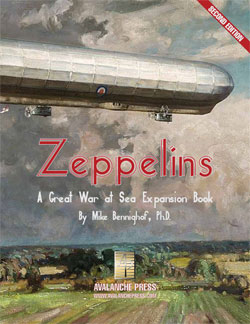 Our Zeppelins book
for Great War at Sea had its roots in our line of
role-playing games, long ago sold off to another publisher. I've always been fascinated by airships,
and we had good success with our historical supplements for
the d20 role-playing system. The Zeppelins RPG book never came to pass, but the Great War at Sea version echoes its original concept with its a relatively large section of Advanced Airship Rules that
we took to calling Advanced Zeppelin Leader, playing
on the standard internal insult we apply to any overly complex
rules. They are glorious in their complexity, as crunchy as
any gamer could possibly want. Our Zeppelins book
for Great War at Sea had its roots in our line of
role-playing games, long ago sold off to another publisher. I've always been fascinated by airships,
and we had good success with our historical supplements for
the d20 role-playing system. The Zeppelins RPG book never came to pass, but the Great War at Sea version echoes its original concept with its a relatively large section of Advanced Airship Rules that
we took to calling Advanced Zeppelin Leader, playing
on the standard internal insult we apply to any overly complex
rules. They are glorious in their complexity, as crunchy as
any gamer could possibly want.
It's a lot harder to design a game with simple rules than
one with complex ones. You always want to let units, ships
or aircraft do special things and rather than fight through
the hard work of fitting those special things into the context
of the standard game rules, you just write a special rule.
The Advanced Airship Rules are, by themselves, longer than
the rules for many of our stand-alone games.
Players don't need to use them — the huge new pieces
provided with the book work just fine without them —
but we know the hard core of players will want to. And because
weather is even more limiting on airship operations than in
the standard rules, many of these new abilities will rarely
come into play. But the possibility is there.
Airship Missions
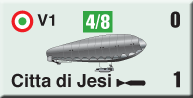
The new airship pieces are rated for both range and endurance,
similar to aircraft in the Second World War at Sea series.
Instead of standard values for all airships, each airship
is individually rated for how many zones it may move in a
turn, and how many turns it may remain in the air. Range can
be lowered by bad weather, and by bomb load. Damaged airships
also find their range and endurance reduced (and may not be
able to get home).
 Just
like fleets, airships now have missions. Scout missions let
them seek out enemy forces, and Shadow missions let them follow
the enemy once they're found. Ground Attack missions allow
them to bomb enemy targets (not all airships have bomb factors).
Naval Strikes let them attack enemy ships, though an airship's
capacity to do damage is not very great. Escort is a very
useful mission, allowing the airship to assist the fleet in
contacting enemy fleets and helping to look for enemy submarines
and mines. A handful of very large airships can undertake
Transport missions. And finally, there's Airship Strike — you can send out airships
to attack enemy airships. Just
like fleets, airships now have missions. Scout missions let
them seek out enemy forces, and Shadow missions let them follow
the enemy once they're found. Ground Attack missions allow
them to bomb enemy targets (not all airships have bomb factors).
Naval Strikes let them attack enemy ships, though an airship's
capacity to do damage is not very great. Escort is a very
useful mission, allowing the airship to assist the fleet in
contacting enemy fleets and helping to look for enemy submarines
and mines. A handful of very large airships can undertake
Transport missions. And finally, there's Airship Strike — you can send out airships
to attack enemy airships.
The first edition of Mediterranean,
the original Great War at Sea game, was designed
without a tactical combat system — the basic combat
rules were all that was there. We added more detail, though
still far less extensive than miniatures rules, because we
knew players would want to see the beautiful ship pieces spread
out on the map instead of stacked up on the edge of the table.
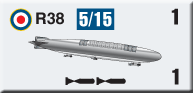
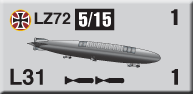 So
it is with the Zeppelins. The new pieces are even
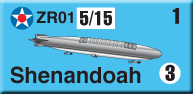
more impressive than the ships. For one thing, the artwork
is outstanding, with original new drawings of the actual airships. For another, they're huge: 1 and 1/3
inch long and 2/3 of an inch wide. They do just fit on the Great War at Sea tactical map, and so we felt they
needed to be used there. So
it is with the Zeppelins. The new pieces are even
more impressive than the ships. For one thing, the artwork
is outstanding, with original new drawings of the actual airships. For another, they're huge: 1 and 1/3
inch long and 2/3 of an inch wide. They do just fit on the Great War at Sea tactical map, and so we felt they
needed to be used there.
During naval combat, airships can now fly around and try to
help their side by spotting enemy ships and can drop bombs
on them. Ships can fire at them with their nominal anti-aircraft
values. Only once did an airship actually take part in a naval
battle (the German L.5 in the last stages of the Battle of
Dogger Bank in 1915) so a lot of the rules had to be extrapolated.
And we extrapolated toward maximum airship utility.
If both sides have airships, the airships can shoot at each
other. They can also try to ram one another, or they may just run into one another accidentally.
On a more mundane level, they help the side that has one gain
the initiative.
Mines and More
Some airships are tougher than others; early airships do not
have a "damaged" side and are destroyed by a single
hit. Some are able to climb quickly to greater heights and
thus are harder to hit. These airships also have the option
to bomb or spot from high altitude, where they are harder
to damage but also much less effective in carrying out their
missions. American airships, filled with helium, are less
capable than identical German machines (as helium provides
less lift) but are much, much harder to bring down —
they will not explode, no matter how many bullets are pumped
into them.
 The
largest airships can also carry troops — a rule that
only has an impact in U.S.
Navy Plan Gold. They can't carry very many, and only
the very largest can do so, but Great War at Sea fan
Jay Steiger begged for them, for many years, so now it's
in there. It's a rule way up there on the gonzo scale. The
largest airships can also carry troops — a rule that
only has an impact in U.S.
Navy Plan Gold. They can't carry very many, and only
the very largest can do so, but Great War at Sea fan
Jay Steiger begged for them, for many years, so now it's
in there. It's a rule way up there on the gonzo scale.
Much less strange and deeply rooted in reality are new abilities
for airships to hunt for mines (assisting minesweepers in
finding them, though they have no ability to destroy minefields
themselves) and in anti-submarine warfare. Airships can not
only protect surface ships from submarine attack, they can
also hunt for enemy submarines — the only means in the Great War at Sea series by which submarines can be
found without revealing themselves in an attack. And once
found, airships with bomb factors can attack the submarines
— just like the Royal Navy's rigid airship R.29 did
in 1918, sinking UB.115.
 But
airships have some enemies. Chiefly, the weather. The game
with the most scenarios involving airships, Jutland,
is also the one with the worst weather. Airships only operate
at full capacity in Clear weather. Their capacity steadily
erodes as the weather worsens, until in Gale weather (the
game's worst) all airships out on missions crash, and there's
a one-in-six chance that even those safely in their hangars
might suffer damage, too. Even the mighty American airships
with their helium-based invulnerability in battle crash like
all the others before the storm gods. But
airships have some enemies. Chiefly, the weather. The game
with the most scenarios involving airships, Jutland,
is also the one with the worst weather. Airships only operate
at full capacity in Clear weather. Their capacity steadily
erodes as the weather worsens, until in Gale weather (the
game's worst) all airships out on missions crash, and there's
a one-in-six chance that even those safely in their hangars
might suffer damage, too. Even the mighty American airships
with their helium-based invulnerability in battle crash like
all the others before the storm gods.
Click
here to buy Zeppelins now!
Mike Bennighof is president of Avalanche Press and holds a doctorate in history from Emory University. A Fulbright Scholar and award-winning journalist, he has published over 100 books, games and articles on historical subjects.
He lives in Birmingham, Alabama with his wife, three children and his dog, Leopold.
|