| Air Pollution:
The Waffen SS Parachute Battalion
By Mike Bennighof, Ph.D.
August 2015
Though lauded for its “efficiency” by
some post-war apologists, Nazi Germany resembled
nothing more closely than a brutal feudal
system in which barons jockeyed for power and the
approval of their master. This yielded several
competing military institutions, all of
them trying to adopt the trappings of modernity.
In 1937, the Waffen SS, then a relatively
small organization, attempted to form a
parachute battalion. This effort foundered
under opposition from the larger and better-organized
Luftwaffe, as one Nazi baron outplayed another.
But by 1943, things had changed. Herman
Goering, the Luftwaffe chief, had steadily
lost power and influence as drug addiction
sapped his personal strength and several
signal failures of his Air Force (chiefly,
the failures to re-supply Stalingrad or
to stop the Allied strategic bombing offensive)
eroded his political standing. Now Heinrich
Himmler could form a parachute battalion
in the Waffen SS as part of its huge expansion,
and even force the Luftwaffe to train and
equip his butchers from the sky.
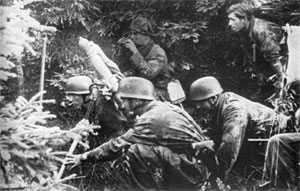
SS paratroopers on the Eastern Front, June 1944.
While the SS was a criminal organization dedicated to mass
murder, Parachute Battalion 500 began as a pack of criminal’s
criminals. Unable to find enough volunteers among regular
SS formations, the battalion made up its numbers from SS prisons:
members of the SS who had been convicted and imprisoned for
military offenses or other crimes. By good service in the
battalion, they had the opportunity to have their records
wiped clean. And if they died doing so, as must have seemed
likely, their death benefits would be restored whereas their
families would receive nothing if they expired behind bars.
With 1,000 recruits, training began at Chlum in occupied Czechoslovakia
and moved to Madanrushka-Banja in Yugoslavia, where the Luftwaffe
operated one of its jump schools. Luftwaffe instructors conducted
the jump training there and at Papa in Hungary, where a Luftwaffe
mission was assisting the Hungarians in expanding their own
parachute unit.
Herbert Gilhofer’s battalion went into action in February
in Yugoslavia, fighting partisans. In April they returned
to base to receive a new commander, Kurt Rybka, and a new
mission. They would play the key role in Operation Knight’s
Jump, an attempt to capture or kill Josip Broz Tito.
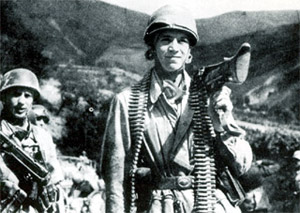
Two members of SS Parachute Battalion 500
on their way to attack Tito.
The battalion would jump onto Tito’s headquarters in
a cave complex located among the hills above Drvar in western
Bosnia, a fortified area known as “The Citadel.”
The 7th SS Mountain Division, a German-Croatian infantry division,
some collaborationist units and a smattering of independent
German units would follow up and relieve the paratroopers
after they had achieved their objective.
The landing took place on the morning of
25 May 1944. Planning for the operation
ran into a problem immediately: The Luftwaffe
had lost hundreds of Ju52 transport planes
in the attempt to re-supply Stalingrad
by air during the winter of 1942-43, and
the losses had never been made good. Only
enough planes and gliders could be assembled
to land part of the battalion, so the
SS men would attack in two waves: one at
7 a.m., and the second at noon. Three
hundred men would jump in the morning
wave plus another 300 landing in gliders;
the final 300 would jump in the second
wave.
As soon as the paratroopers landed, Tito and his staff escaped.
The remaining partisans resisted fiercely, shooting up the
assault team detailed to seize Tito. Fierce fighting raged
all morning, and though Rybka had not secured the drop zone
he failed to abort the second landing. The partisans greeted
the drifting troopers with intense machine-gun fire, killing
most of them before they hit the ground. Rybka pulled his
men back to the town cemetery, and the next day troops from
7th SS Mountain Division relieved them. Of the nearly 1,000
men who participated, over 800 were killed or wounded.
After the Knight’s Jump.
After another anti-partisan operation in Yugoslavia, the company-sized
remnant fought on the Eastern Front during the summer of 1944
and gradually regained its strength. On November the battalion
received a new number, 600, to designate that it “no
longer had criminals within its ranks” (at least by
SS standards; all of the former convicts had been killed or
wounded).
Two companies were attached to the SS
Panzer Brigade 150 during the German offensive in the
Ardennes known as the Battle of the Bulge. No airborne role
for them in the operation appears to have been contemplated:
apparently the replacements received since the Drvar disaster
apparently were not jump-trained, and anyway the Luftwaffe
could not supply transport planes.

Reunited after the offensive’s failure, the battalion
fought on the Eastern Front for the remainder of the war as
an independent unit and surrendered to the Americans in May
1945.
Though the battalion stood no chance of
actually performing an airborne operation,
we’re not bound by the dictates
of reality in our Daily Content. The SS Parachute
Battalion 600, available here as a
free download, appears as a 1 January
reinforcement in either America
Triumphant or Alsace
1945.
It may land on either map under the Paratrooper
rule from America Triumphant, or enter as
a normal reinforcement. If the latter course
is chosen by the German player, it may not
later attempt an airborne landing.
Order
now to drop criminals from the sky over Alsace 1945.
Mike Bennighof is president of Avalanche Press and holds a doctorate in history from Emory University. A Fulbright Scholar and award-winning journalist, he has published over 100 books, games and articles on historical subjects.
He lives in Birmingham, Alabama with his wife, three children and his dog, Leopold.
|