| Bomb Alley Returns
By Mike Bennighof, Ph.D.
June 2013
For a while, we were steadily taking games out of print. With our new production methods we’re steadily bringing the old favorites back, and it feels really good to revive Second
World War at Sea: Bomb Alley.
 Bomb Alley set a record for single-month sales
that still stands a decade later. Bomb Alley became a staple of our game
line, and is my personal favorite of all our naval games. In terms of game design, it's a very satisfying achievement because it met
my expectations. Previous games in the series, like Midway, had taken place
over wide stretches of open water. In comparison, the Mediterranean is a
bathtub, with enemy ports and airbases within easy striking distance of all
the vital sea routes. In most scenarios, contact between opposing forces
would be relatively easy to make (except if I'm the one rolling the dice). Bomb Alley set a record for single-month sales
that still stands a decade later. Bomb Alley became a staple of our game
line, and is my personal favorite of all our naval games. In terms of game design, it's a very satisfying achievement because it met
my expectations. Previous games in the series, like Midway, had taken place
over wide stretches of open water. In comparison, the Mediterranean is a
bathtub, with enemy ports and airbases within easy striking distance of all
the vital sea routes. In most scenarios, contact between opposing forces
would be relatively easy to make (except if I'm the one rolling the dice).
 As a historical subject, the Mediterranean campaign is almost perfect as a
game setting. Both players are trying to force convoys across contested
waters, sometimes at the same time. Thanks to the furious ground campaign
going on in North Africa, these have to go forward at whatever cost, and in
a fairly constant stream. That yielded fifty scenarios, with both the
Italian and the British player acting as the aggressor. As a historical subject, the Mediterranean campaign is almost perfect as a
game setting. Both players are trying to force convoys across contested
waters, sometimes at the same time. Thanks to the furious ground campaign
going on in North Africa, these have to go forward at whatever cost, and in
a fairly constant stream. That yielded fifty scenarios, with both the
Italian and the British player acting as the aggressor.
 I was pleased with the scenarios, mostly thanks to what was then a sharp
break in Second World War at Sea design practice. In Bomb Alley, neither
player has a discreet order of battle for air units. Instead, they roll dice
and consult tables that yield a varying number of aircraft. That way,
neither player knows what the enemy might have, and cannot be assured of his
or her own air strength. Additionally, thanks to service rivalries the
Italian Air Force might refuse to carry out naval missions, while the
Germans are even more reluctant to help out. These game systems yield
results very much in keeping with the sort of chaos facing the players'
historical counterparts, and make for a great deal of historical validity (I
dislike calling a game "historically accurate," as getting all the right
units and such into your game design should be a given). I was pleased with the scenarios, mostly thanks to what was then a sharp
break in Second World War at Sea design practice. In Bomb Alley, neither
player has a discreet order of battle for air units. Instead, they roll dice
and consult tables that yield a varying number of aircraft. That way,
neither player knows what the enemy might have, and cannot be assured of his
or her own air strength. Additionally, thanks to service rivalries the
Italian Air Force might refuse to carry out naval missions, while the
Germans are even more reluctant to help out. These game systems yield
results very much in keeping with the sort of chaos facing the players'
historical counterparts, and make for a great deal of historical validity (I
dislike calling a game "historically accurate," as getting all the right
units and such into your game design should be a given).
 And finally, the game has lots of toys, something I consider vital in a game
like Bomb Alley. There are scads and scads of aircraft pieces, including
some wonderfully odd ones. The Italians get their P.108 heavy bomber and a
range of aircraft from the hopeless Cr.32 biplane fighter to the deadly
Mc.205. The Germans have the expected squadrons of Stukas and
Messerschmitts, plus a helicopter (and helicopter carrier). British aircraft
are better than most of the Italian machines, but usually not as good as the
Germans. But unlike the Germans, the Brits won't suddenly pretend not to
understand Italian just to duck out of a fight. And finally, the game has lots of toys, something I consider vital in a game
like Bomb Alley. There are scads and scads of aircraft pieces, including
some wonderfully odd ones. The Italians get their P.108 heavy bomber and a
range of aircraft from the hopeless Cr.32 biplane fighter to the deadly
Mc.205. The Germans have the expected squadrons of Stukas and
Messerschmitts, plus a helicopter (and helicopter carrier). British aircraft
are better than most of the Italian machines, but usually not as good as the
Germans. But unlike the Germans, the Brits won't suddenly pretend not to
understand Italian just to duck out of a fight.
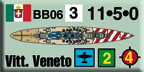
At sea, the orders of battle are pretty comprehensive. I had to cut things
off after the summer of 1942, as Italian fuel shortages pretty much ended
the naval campaign. The Royal Italian Navy still fields a pair of aircraft
carriers plus an impressive fleet of destroyers, cruisers and battleships.
It's theoretically a match for Britain's Royal Navy — but the fuel to get
all of those ships into action at once is rarely available, so the Italians
are often at a disadvantage at sea while most of their fleet swings at
anchor. Still, we have a number of unusual vessels in Italian green:
captured Yugoslav destroyers, anti-aircraft cruisers originally built for
Thailand, an ancient pre-Great War armored cruiser and the heroic torpedo
boat Lupo.
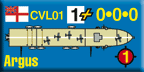
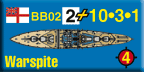
 Britain counters with a fleet built around reconditioned battleships from
the First World War, plus a large number of modern light cruisers and
sometimes an aircraft carrier or two. They get some odd vessels as well: the
old target ship Centurion (dressed up as the new battleship Anson),
high-speed minelayers and the world's first aircraft carrier, the aged HMS
Argus. Britain counters with a fleet built around reconditioned battleships from
the First World War, plus a large number of modern light cruisers and
sometimes an aircraft carrier or two. They get some odd vessels as well: the
old target ship Centurion (dressed up as the new battleship Anson),
high-speed minelayers and the world's first aircraft carrier, the aged HMS
Argus.
And then there are the other fleets: France has a pair of battle cruisers, a
couple of old battleships, a bevy a cruisers and best of all, the super-fast
super-destroyers Mogador and Volta. There are also Greeks, Americans,
Romanians, Dutch, Poles and Soviets.
I don't know how what comes next for Bomb Alley. Games of this size
are difficult to produce at the New Avalanche Press. But for now, thanks to the existing parts, it's back.
Order Bomb Alley while you still can! |