| Bismarck:
Scenarios, Stories and History, Part 1
By Mike Bennighof, Ph.D.
May 2026
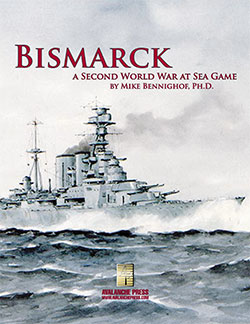 Second World War at Sea: Bismarck has been an extremely popular game since its initial release in 2006, and we brought out a Second Edition in 2021 that included the Second Edition series rules. I took that opportunity to craft a completely new set of scenarios, along a completely different concept than most other historical wargames: to use a wargame’s scenario set as a story-telling device in the same way that role-playing games are structured. Second World War at Sea: Bismarck has been an extremely popular game since its initial release in 2006, and we brought out a Second Edition in 2021 that included the Second Edition series rules. I took that opportunity to craft a completely new set of scenarios, along a completely different concept than most other historical wargames: to use a wargame’s scenario set as a story-telling device in the same way that role-playing games are structured.
That meant that the game would have to include a great many more scenarios, in order to tell its story. You don’t have to play them all to follow along; you can pick out the key moments and put yourself in command.
The game’s main event is the famous breakout of the German battleship Bismarck into the North Atlantic. With the help of her consort, the heavy cruiser Prinz Eugen, she sank the British battle cruiser Hood. And then things went wrong, as rather than turn back for Norway she pressed on toward occupied France to repair her battle damage. The British found her, damaged her some more with aerial torpedoes, and sank her with a tremendous volume of gunfire.
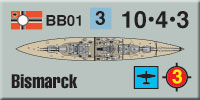 An old-style wargame would give you just one operational scenario (using the big map of the North Atlantc, where task forces seek each other, or try to hide) based on the Bismarck’s breakout, one battle scenario (wher eyou go straight to the shooting part) for the Battle of the Denmark Strait (the one where Hood was sunk) and maybe one more battle scenario covering the end of the damaged Bismarck under the guns of two British battleships. An old-style wargame would give you just one operational scenario (using the big map of the North Atlantc, where task forces seek each other, or try to hide) based on the Bismarck’s breakout, one battle scenario (wher eyou go straight to the shooting part) for the Battle of the Denmark Strait (the one where Hood was sunk) and maybe one more battle scenario covering the end of the damaged Bismarck under the guns of two British battleships.
That sort of scenario selection reflecta a pretty common view in wargame design, that a historical game should reflect what happened and not what could have happened. But if you’re going to try to tell a story with a game’s scenarios, then the scenarios have to be centered on choices, because that’s what a story’s all about. What choices face the characters (in this case, the admirals) and what are the likely outcomes of those choices?
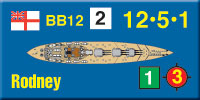 So I wanted the new edition to focus on choices. The cruise of the Bismarck is represented by eleven scenarios. There’s a qute long operational scenario covering the Bismarck operation (called Rhine Exercise by the German Navy command). That one starts out with Bismarck having just left Norway and about to break out into the Atlantic; it’s up to the player to take it from there. And that’s fine, as the game needs a fairly free-form scenario like that. But the players’ choices later in the game are highly likely to be very different from those actually faced by the admirals involved, Jack Tovey for the British and Günther Lütjens for the Germans. So I wanted the new edition to focus on choices. The cruise of the Bismarck is represented by eleven scenarios. There’s a qute long operational scenario covering the Bismarck operation (called Rhine Exercise by the German Navy command). That one starts out with Bismarck having just left Norway and about to break out into the Atlantic; it’s up to the player to take it from there. And that’s fine, as the game needs a fairly free-form scenario like that. But the players’ choices later in the game are highly likely to be very different from those actually faced by the admirals involved, Jack Tovey for the British and Günther Lütjens for the Germans.
Each operational scenario is accompanied by at least one battle scenario, to highlight the key actions that happened, or could have happened, during the operation. The historical Denmark Strait battle is there, and another battle scenario with the British player making use of all the forces potentially at Vice Admiral Lancelot Holland’s command (two heavy cruisers and four destroyers, in addition to Hood and Prince of Wales).
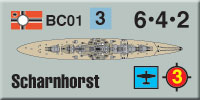 Another operational scenario picks up the action just after Hood has been sunk and both sides face a lot of choices. Will the Germans plunge ahead into the Atlantic or turn back for home with their wounded battleship? Will the British fall on Bismarck with what they have close at hand, or try to bring their material superiority to bear? Another operational scenario picks up the action just after Hood has been sunk and both sides face a lot of choices. Will the Germans plunge ahead into the Atlantic or turn back for home with their wounded battleship? Will the British fall on Bismarck with what they have close at hand, or try to bring their material superiority to bear?
To illustrate that, we have three battle scenarios. In one, Rear Admiral Frederic Wake-Walker takes on Bismarck and Prinz Eugen with one damaged, inefficient battleship and two heavy cruisers. Tovey, an admiral who believed his place was at sea and so was charging forward aboard King George V, was under radio silence and could only scream in frustration as Winston Churchill (via First Sea Lord Sir Dudley Pound) fired off message after message demanding that Wake-Walker attack Bismarck immediately and implying that he had not yet done so solely due to cowardice. Tovey was on the brink of breaking in to silence Churchill, a move that likely would have driven Bismarck back to Norway had his message been intercepted, when Wake-Walker courageously refused the Admiralty’s orders, citing the extensive damage to Prince of Wales.
Tovey instead hoped to intercept Bismarck with his flagship King George V and the battle cruiser Repulse, and we have a scenario for that. It’s a pretty ballsy move, as Bismarck at that point still could make good speed and had shown excellent gunnery in the engagement with Hood. King George V was somewhat more efficient than her sister Prince of Wales, but Repulse was little more than a floating gunnery target.
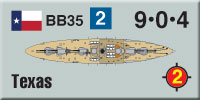 And then we have a the nighttime encounter with the American battleship Texas. Texas was an old tub by this point and no match for Bismarck in a straight-up fight, but this is not a straight-up fight. The American ship is crewed by long-service battleship sailors and only has to damage the German ship to assure her destruction. In the actual event, neither side opened fire. But where is the fun in that? And then we have a the nighttime encounter with the American battleship Texas. Texas was an old tub by this point and no match for Bismarck in a straight-up fight, but this is not a straight-up fight. The American ship is crewed by long-service battleship sailors and only has to damage the German ship to assure her destruction. In the actual event, neither side opened fire. But where is the fun in that?
Next we have the third stage of the hunt for Bismarck, when she’s running for France and has separated from Prinz Eugen (which went on to cruise the North Atlantic and achieve absolutely nothing). Now the German player has to get the ship home, and the British player has to find her and sink her. At this point she’s still pretty fast and she’s eluded her pursuers (in game terms, her task force marker has been taken back off the map). The Home Fleet is coming down from the north, Force H from Gibraltar is approaching from the south, and various convoy escorts have broken away from their charges to join the hunt (leaving those convoys vulnerable to that missing heavy cruiser; no one sang songs about “Sink the Prinz Eugen,” but the British player can’t be so sure she’ll be operated in the same lackluster fashion her captain Helmuth Brinkmann displayed).
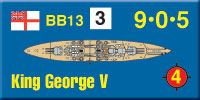 We flesh out this segment of the story with three battle scenarios. In the first of them, Vice Admiral James Somerville of Force H challenges Bismarck with his flagship Renown, a light cruiser and some destroyers. Renown, a rebuilt battle cruiser of Great War vintage, hadn’t been fit to stand up to German dreadnoughts when she was new and certainly was not now. Both Tovey and the Admiralty radioed direct orders to Somerville to stay away from Bismarck. He ignored them and pressed on, laying plans to engage Bismarck from astern to force her to turn and fight and thereby delay her advance toward France. He did not expect to sink her, and neither did he apparently expect to survive the encounter. We flesh out this segment of the story with three battle scenarios. In the first of them, Vice Admiral James Somerville of Force H challenges Bismarck with his flagship Renown, a light cruiser and some destroyers. Renown, a rebuilt battle cruiser of Great War vintage, hadn’t been fit to stand up to German dreadnoughts when she was new and certainly was not now. Both Tovey and the Admiralty radioed direct orders to Somerville to stay away from Bismarck. He ignored them and pressed on, laying plans to engage Bismarck from astern to force her to turn and fight and thereby delay her advance toward France. He did not expect to sink her, and neither did he apparently expect to survive the encounter.
So why did a British admiral defy his orders and press forward on such a suicidal course, along with 953 sailors? Once again, we have to turn to one figure, Winston Churchill. After the Battle of Cape Spartivento in November 1940, Somerville (and his cruiser commander, Lancelot Holland) did not pursue Inigo Campioni’s Italian fleet. Campioni’s flagship, Vittorio Veneto, was an even more formidable fighting ship than Bismarck and he had a second, less powerful battleship in company where Somerville only had Renown. Churchill demanded a court of inquiry, which cleared Somerville but the accusation remained. And so having failed to lead his command to slaughter against the Italians, Somerville would now do so against the Germans six months later, and attempt to do so against the Japanese a year after that.
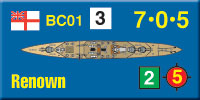 Somerville embodied the best of the Royal Navy: thoughtful, insanely brave, and possessed of a deep sense of personal honor. He had spoken out against the attack on the neutral French at Mers-el-Kebir in June 1940, and Churchill had never forgiven that impertinence even though Somerville had carried out the orders he found repugnant. Somerville embodied the best of the Royal Navy: thoughtful, insanely brave, and possessed of a deep sense of personal honor. He had spoken out against the attack on the neutral French at Mers-el-Kebir in June 1940, and Churchill had never forgiven that impertinence even though Somerville had carried out the orders he found repugnant.
Next up, we have another insanely brave British commander, Philip Vian of Fourth Destroyer Flotilla, challenging Bismarck with five destroyers. His night attack failed to slow the German battleship, even though his crews pressed it to point-blank range and his one Polish-manned destroyer stuck around to blaze away at the hated Germans with her 4.7-inch popguns.
And finally, there’s the end game, where Tovey’s battleships show up and shell the German battleship into oblivion. She’s still dangerous, and Tovey did well to sink her with no loss to his own forces.
The Royal Navy performed exceedingly well when presented with a strong challenge. That’s due in large part to the clear operational thinking and sound leadership of Jack Tovey, commander of the Home Fleet, and despite the constant, fumbling meddling of Prime Minister Winston Churchill.
I’ve excoriated Churchill’s amateur micro-managing many times, most recently in the Jutland: North Sea 1914. And yet with every subject I study that’s related to Britain in either world war, I continually encounter more deadly idiocy traceable to one man’s overweening ego.
And so that’s the core of Bismarck’s centerpiece chapter. I’ve come to doubt that there’s much of a market for history in wargames any more, if there ever was, but still I saddle up Rosinante and persist. Later we’ll look at the stories the other 44 scenarios have to tell.
Order Bismarck Here.
Order Bismarck (Anarchy) Here.
No rules! You’ll need the Second Edition rules from another Second World War at Sea game. Earlier edition rules will not work with this game.
Bismarck: Downloadable Upgrade
You can transform your old boxed copy of Bismarck into the splendid 2023 Playbook Edition. It’s $39.99, but if you’re a Gold Club member, you can download for $27.99 using your Gold Club link (That’s the only way to claim your Gold Club discount). And the download includes Force de Raid at no extra charge!
Sign up for our newsletter right here. Your info will never be sold or transferred; we'll just use it to update you on new games and new offers.
Mike Bennighof is president of Avalanche Press and holds a doctorate in history from Emory University. A Fulbright Scholar and NASA Journalist in Space finalist, he has published a great many books, games and articles on historical subjects; people are saying that some of them are actually good.
He lives in Birmingham, Alabama with his wife and three children.
Daily Content includes no AI-generated content or third-party ads. We work hard to keep it that way, and that’s a lot of work. You can help us keep things that way with your gift through this link right here.
|