Bitter Victory:
Publisher’s Preview
by Mike Bennighof, Ph.D.
August 2016
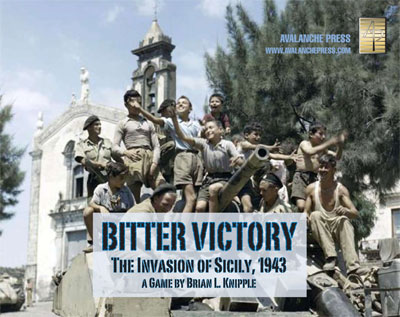 Bitter Victory, our game of the 1943 Allied invasion of Sicily, began as a tiny part of a much larger game: Brian Knipple’s grand sweeping simulation of the entire Italian campaign from the beaches of Gela to the mountains of Riva di Garda, all at six miles (a little less than 10 kilometers) per hex. It had many maps and over a thousand pieces. Bitter Victory, our game of the 1943 Allied invasion of Sicily, began as a tiny part of a much larger game: Brian Knipple’s grand sweeping simulation of the entire Italian campaign from the beaches of Gela to the mountains of Riva di Garda, all at six miles (a little less than 10 kilometers) per hex. It had many maps and over a thousand pieces.
Bitter Victory is much smaller: a single map at 22x17 inches in size and 180 playing pieces. We originally sold it in one of the small boxes from our Quick-Play line (like Alsace 1945 and Gazala 1942) but sold out of those boxes so a while back we moved it into one of our standard flat sleeved boxes with new artwork on the wrapper. We still have a good supply of pieces and maps, so we dropped the price to $19.99 (from $29.99) to get them moving off our shelves and onto your tables. Because they belong there.
Bitter Victory sold the best of all our Quick-Play games other than the record-setting Defiant Russia. It has American forces involved (and Brits and Canadians, too) and covers a reasonably well-known campaign. And it’s an attractive package, with a nice little map and colorful pieces. But most important to its success has been its play.
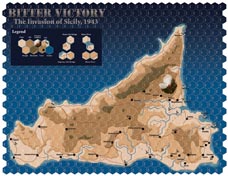 Bitter Victory takes place solely on the island of Sicily, a fairly large landmass situated pretty much in the dead center of the Mediterranean Sea. That location makes its possession vital for both sides, and presents a few unusual aspects for a wargame. The island is large enough for modern mechanized operations, but the terrain is so rugged that these are limited to only some locations (and least in terms of rapid movement). But most importantly, it’s an island: the game has no “edge of the world” rules, because all three edges of the playing area (Sicily is roughly triangle-shaped) end on the shoreline. There’s no feeling of artificial limitations, since the whole world (in terms of the campaign) is right there and part of the playing area. Bitter Victory takes place solely on the island of Sicily, a fairly large landmass situated pretty much in the dead center of the Mediterranean Sea. That location makes its possession vital for both sides, and presents a few unusual aspects for a wargame. The island is large enough for modern mechanized operations, but the terrain is so rugged that these are limited to only some locations (and least in terms of rapid movement). But most importantly, it’s an island: the game has no “edge of the world” rules, because all three edges of the playing area (Sicily is roughly triangle-shaped) end on the shoreline. There’s no feeling of artificial limitations, since the whole world (in terms of the campaign) is right there and part of the playing area.
Yet the island is not isolated. The Allies have sea control around Sicily, and thus the ability to land fresh troops and supplies (and a limited option to conduct additional landings elsewhere on the island). The Axis is not cut off, either. They can still bring in additional troops, replacements and supplies from mainland Italy using the high-volume railroad ferry over the narrow Strait of Messina.
The Allied task is to conquer the island, which really means its ports: Augusta and Syracuse side-by-side on the eastern shore, Messina at the top right corner, Palermo on the north coast and Trapani at the far left corner. The island is going to fall eventually; the game is won or lost depending on how long this takes and how thoroughly the Axis manages to wreck the island’s infrastructure before departing (with some other variables, like summoning more reinforcing divisions to either side).
The game system is standard hex-and-counter wargame fare, the same as that found in Alsace 1945 and Red God of War, and very similar to that of Gazala 1942. Units are mostly regiments and brigades with a smattering of important battalions and some fairly impotent Italian coastal-defense divisions. Corps headquarters keep these units supplied and are important to activate them so they can move and fight; each corps headquarters has a corresponding chit placed in a container. When the chit is drawn, units within its command radius may operate.
An odds-based combat results table, modified by a number of conditions (air support, terrain, weather, combined arms, naval gunfire and so on), yields two results from each roll of the die, one for the defender and one for the attacker. The results indicate the “hits” suffered by the attacker, satisfied by a combination of step losses (each unit has two “steps” of strength) and hexes retreated. It all moves pretty swiftly.
As a Brian Knipple game design, Bitter Victory of course includes amphibious and airborne landings. Only the Allied player may conduct these; though the Axis order of battle includes both German and Italian parachute regiments, airborne landings can only take place during a special impulse that’s only available to the Allies. Both types of landing must be planned ahead of time, and there’s lots that can go wrong with both. But without them, the Allies aren’t going to get ashore on the island. At least in most of the scenarios.
There are five scenarios in Bitter Victory, starting with an introductory scenario that has no amphibious or parachute landings, called “The Withdrawal.” The Axis are trying to hang onto their last bridgehead on the island, while the Allies are eager to boot them off. It’s just a short game, serving to familiarize players with the game system.
The others all involve Operation Husky, the July 1943 Allied invasion of Sicily. In the Operation Husky scenario, the Allies come ashore as they did in the historical operation with the British landing on the southeastern coast near Catania and the Americans on the southwest around Gela. The 141 Plan studies the American proposal to land their Seventh Army near Palermo on the north-west coast, pretty much as far as possible from the British. It could have been launched earlier than Operation Husky, so the Axis garrison is somewhat smaller, but was considered too risky a proposition. You get to try out that thesis.
The Tunisian Follow-Up scenario posits a quick dash across the Sicilian Channel from Tunis immediately after that city’s fall, as proposed by the American Gen. George C. Marshall. It’s even riskier than the 141 Plan, but the Axis is even weaker, too. Once again, you get to see if Marshall was correct, or if Dwight Eisenhower was right to be more cautious. And then finally there’s a Free Set Up scenario that lets you plan your own invasion, but also lets the Axis player plan his or her own defense.
Bitter Victory has sort of confounded our marketing plans over the years: we haven’t given it much Daily Content love (just two small variants), yet it outsold Gazala 1942, the darling of Daily Content (at least among the line of small “quick-play” games). The reasons are pretty obvious: it’s a very solid game, easy to play with very clear victory conditions. Gazala 1942 has all those things, but Bitter Victory has General Patton and a very well-known campaign. You’ll slap yourself – and you’ll deserve it - if you pass it up at this new low price.
Click right here and order Bitter Victory right now.
Mike Bennighof is president of Avalanche Press and holds a doctorate in history from Emory University. A Fulbright Scholar and award-winning journalist, he has published over 100 books, games and articles on historical subjects.
He lives in Birmingham, Alabama with his wife, three children and his dog, Leopold.
|