Jutland: The Baltic Sea
Russian Battle Cruisers
by Mike Bennighof, Ph.D.
May 2025
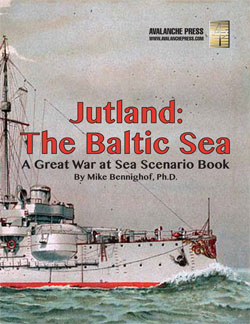 Jutland: Baltic Sea is an expansion book for Great War at Sea: Jutland, adding German, Swedish and Russian ships planned but not completed. It’s all brand new, making use of those Swedish and Russian ships in Jutland 2e plus 70 new pieces. Jutland: Baltic Sea is an expansion book for Great War at Sea: Jutland, adding German, Swedish and Russian ships planned but not completed. It’s all brand new, making use of those Swedish and Russian ships in Jutland 2e plus 70 new pieces.
Defeat in the Russo-Japanese War, followed by social revolution in Russian cities, had profound effects on the Imperial Russian Navy. The war’s lessons would be rigorously studied, and applied to tactics, operational plans and warship design.
In one of the few Russian successes at sea, the squadron of armored cruisers based at Vladivostok had steamed around Japan, preying on merchant shipping in waters the Japanese had believed utterly safe, thereby sparking panic among both government and civilians. The Japanese armored cruiser squadron, meanwhile, had stood in the battle line alongside the actual battleships and used their speed to help bring the Russian fleet to battle on terms of Admiral Heihachiro Togo’s choosing.
Starting in 1907, the Russian Naval General Staff developed its 1909-1919 fleet program with priority given to a squadron of four armored cruisers for the Baltic Fleet. These ships should have the range to operate deep in enemy waters on independent missions, the speed to screen the battle fleet and the heavy guns and armor to allow them to fight alongside the newly-ordered dreadnoughts.
The Marine Technical Committee issued its initial requirements in May 1910: a speed of at least 28 knots and armament of at least eight 305mm (12-inch) guns, on a ship 204 meters long powered by turbines able to develop 80,000 horsepower. A great deal of discussion and modification included an increase in armament to at least nine 305mm guns in three triple turrets and a silhouette similar to that of the Gangut-class battleships. The requests for proposals went out to six Russian and seventeen foreign shipyards in August 1911: affirming the words of V.I. Lenin, the firms invited to bid on the project included the German shipyards A.G. Vulkan and Blohm und Voss, both of which provided detailed proposals.

Izmail prepares for launch.
Three British firms entered the fray, with John Brown offering three designs and Vickers and Beardmore one each. Vickers’ entry caught the Russians’ attention, for meeting the letter of their requirements (it had four triple turrets with 305mm guns) and then exceeding them (adding a pair of twin turrets amidships in the “waist” positions, one on either side of the ship, offset fore and aft). She would also carry a secondary battery of twenty-four 120mm (4.7-inch) guns in an armored casemate battery, and four torpedo tubes below the waterline.
Design 474 would have been enormous by the standards of the day, 700 feet long and displacing 33,000 tons; her contemporary, the Royal Navy’s battle cruiser Tiger, came in just slightly longer (704 feet) but displaced “only” 28,000 tons, still making her the most expensive warship built in Britain up to that moment.
Design 474 broke with the design specifications in several areas, hinting that she was a “stock” draft not prepared specifically for the Russians. Her triple turrets were in super-firing positions, paired fore and aft. She did not meet the speed specified by the Russians, coming in at 26 knots rather than the preferred 28, as she made “only” 58,000 horsepower, likely because of all the internal space given over to her six turrets’ armored barbettes, magazines, and shell rooms. Tiger, again in comparison, produced 85,000 horsepower and made 28 knots.
Design 474 would have had eight inches of armor on her belt and turrets, only slightly less than Tiger. Her impressive size implied great fighting power, but the 305mm gun was already giving way to larger weapons everywhere outside Germany. Two examples of Design 474 appear in Jutland: Baltic Sea; she had her advocates, but failure to meet the design specs doomed the Vickers bid.

Izmail hits the water.
She would re-surface a few years later, when Nikolai von Essen, commander of the Baltic Fleet, sought British designs that could be built in British shipyards. This would be both faster and cheaper than building major warships at home. War came before Essen could muster the political backing for his project, and Design 474 was three years older, a lifetime in the progression of dreadnought capabilities in the years just before the Great War.
Along with Design 474, the Committee rejected all proposals that included super-firing turrets, strongly preferring that all turrets be sited on the main-deck level in the same “Cuniberti” arrangement as the Gangut class battleships. Blohm und Voss included a proposal for four turrets with 356mm (14-inch) guns that the committee liked so much that they apparently leaked the concept to two of the Russian competitors. The committee then chose a design by St. Petersburg’s New Admiralty shipyard.
The Navy Ministry desperately wanted this ship, but she did not fall within the budgetary guidelines laid down by the Duma in June 1912. Modifications ensued, shaving off some armor and reducing the maximum speed by a knot to 27 knots. Estimates still came in over budget, so with the aid of some bureaucratic subterfuge the missing amount came from money already approved for the Svetlana-class light cruisers, which now became significantly slower and smaller.
With that settled, the Ministry placed formal orders in September 1912: two ships from New Admiralty (eventually named Borodino and Navarin) and two from rival Baltic (Izmail and Kinburn). Delivery was set for July 1916 for the first two ships (one from each yard) and September 1916 for the remaining pair. Work began on all four in the spring of 1913.
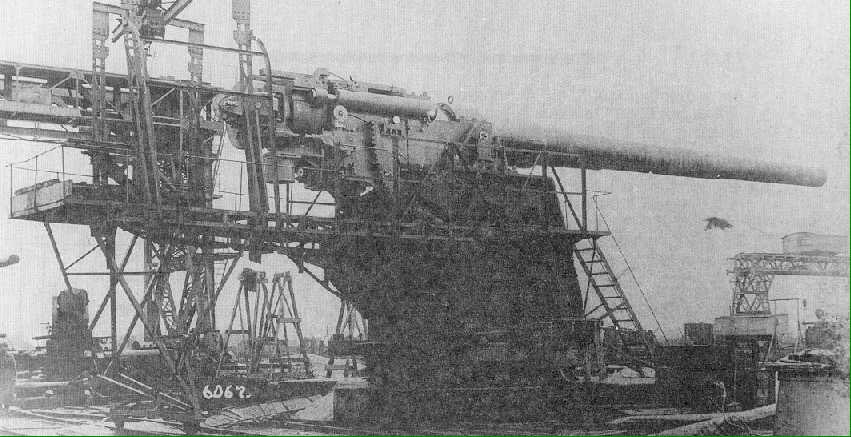
A 356mm gun, likely the lone weapon completed by Obukhov, on a test-firing stand.
Problems cropped up almost immediately. Testing showed that 305mm armor-piercing rounds could easily punch through the proposed armor plate; even shots that did not penetrate shattered the backing and collapsed the upper deck. The armor would have to be thickened and its fittings reinforced, increasing the ship’s weight. The new test basin turned out to have a defective engine (to generate waves) and a design team was sent to Germany along with their model of the ship’s hull. The Germans found that the hull did not actually match its theoretical dimensions, dropping the ships’ speed still further to 26.5 knots. The New Admiralty yard management blamed the German test engineers, but Russian Navy experts confirmed the findings.
After many additional meetings, the Navy Ministry issued directives that alternations could be made to the hull form and the armor scheme, particularly the backing of the armor plates, as long as these changes did not impact either the cost of the ships or their delivery dates. And so, construction proceeded on what was now known to be a flawed design. And more problems piled up.
Franco-Russian Works, contracted to provide the turbines for the two New Admiralty-built ships, could not supply some of the components: casings and rotor blades. These came from Germany’s AG Vulkan and arrived before the war broke out; both New Admiralty ships would have their turbines installed, though the ships themselves were never completed. At least one other ship’s propeller shafts had been ordered in Germany as well.

A Russian 305mm triple turret. The 356mm mount would have been very similar.
An oft-repeated legend holds that New Admiralty ordered the entire set of turbines for Navarin from AG Vulkan, which would later be used to power the fast minelaying cruisers Brummer and Bremse. This does not appear to be true. There seems to be no proof of such an order, much less of any huge turbines having been constructed and then confiscated.
The Russians did, however, order sets of turbines for two Svetlana-class light cruisers (probably Svetlana and Admiral Greig) from AG Vulkan. This appears to be the machinery seized by the Germans at the outbreak of war, and later fitted to Brummer and Bremse; the turbines would be of the right size and their horsepower output matches up.
The Obukov Works, contracted to supply the heavy guns, could not meet its delivery dates and sub-contracted 36 of the guns (from an order of 76 total, including spares and 18 guns intended for coast-defense batteries) to Vickers in England. Vickers in turn experienced delays in setting up production – these were Russian-designed weapons, not an off-the-shelf Vickers type – and then further delays as war broke out and orders for the British armed forces exploded while transport to Russia became exceedingly difficult. Ten Vickers-made guns finally arrived in May 1917; Obukhov only managed to produce one of their allotted 40.
Had the ships been completed, they would have been large, heavily-armed, but only moderately fast, closer to fast battleships than actual battle cruisers. In addition to the dozen 14-inch guns, they would have had twenty-four 130mm (5.1-inch) guns in an unusual double-decked casemate battery. They had good armor protection on their turrets and decks: their armored belt was significantly thinner than that of German battle cruisers but about the same as the later British battle cruisers (Lion and Tiger classes).

Navarin and Borodino under construction at New Admiralty shipyard.
The inability of Russian industry to supply key components in a timely manner meant that these ships would never have been completed during the course of the Great War. Even so, work continued as did design modifications based on experience with the new Gangut-class battleships, resulting in increased funnel heights. Three ships were launched in 1915, with Navarin finally hitting the water in November 1916. Despite the pressing needs of the war effort, the shipyards received special dispensations for labor and materials to continue the battle cruiser projects even though the impossibility of actually completing them had become obvious.
By the time the war ended, the Russian Empire had faded away as well. The Workers’ Councils demanded that construction continue in order to protect the shipyard workers’ jobs, but it moved only slowly. Work finally stopped on all four by the end of 1917.
Over the following years the Bolshevik regime studied various proposals for completing the ships as designed, with twin turrets for 16-inch (406mm) guns, or finishing one of them (Izmail) as an aircraft carrier. None of those projects went forward – Soviet Russia was in much worse economic condition than Imperial Russia had been – and three of the hulls were sold to a German scrap dealer in 1923 with Izmail, the abortive aircraft carrier, hitting the breakers in 1931.
Pieces for all four ships appear in our Jutland 2e game, but they get no action in the scenarios (the game is tightly focused on the Battle of Jutland). They get their moment in the sun, along with Design 474, in Jutland: Baltic Sea.
You can order The Baltic Sea right here.
Sign up for our newsletter right here. Your info will never be sold or transferred; we'll just use it to update you on new games and new offers.
Mike Bennighof is president of Avalanche Press and holds a doctorate in history from Emory University. A Fulbright Scholar and NASA Journalist in Space finalist, he has published a great many books, games and articles on historical subjects; people are saying that some of them are actually good.
He lives in Birmingham, Alabama with his wife and three children. He misses his lizard-hunting Iron Dog, Leopold.
Daily Content includes no AI-generated content or third-party ads. We work hard to keep it that way, and that’s a lot of work. You can help us keep things that way with your gift through this link right here.
|