| Cone
of Fire:
The Last Days
By Mike Bennighof, Ph.D.
December 2017
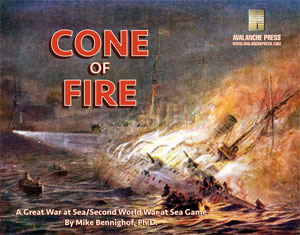 Our only hybrid game covering two game systems, Cone
of Fire is an odd duck in our game line. Now that we’re down to the last copies, we won’t repeat the experiment, even for two closely-related game systems like Great War at Sea and Second World War at Sea. Cone of Fire really is two complete games in one box, but it’s been really difficult to market it that way. Our only hybrid game covering two game systems, Cone
of Fire is an odd duck in our game line. Now that we’re down to the last copies, we won’t repeat the experiment, even for two closely-related game systems like Great War at Sea and Second World War at Sea. Cone of Fire really is two complete games in one box, but it’s been really difficult to market it that way.
The games (and it really is two games inside one box) were interesting to design, but Cone of Fire was always a little disappointing to me as a game designer. I felt I’d stretched the concept too far, without yielding the sort of rich scenario mix the game should have had. It has plenty of scenarios - 42 total, 21 for each of the two games in the box - but it could have been better. For some reason I was determined not to include any pieces duplicated elsewhere in the series, except for those needed in the game's historical situations, and I believe that decision weakened the game. There should have been British, Americans, Germans and such in there to fight alongside or against the Argentines, Chileans and Brazilians.
 I solved that problem with the new Tropic of Capricorn, which is set in our Second Great War alternative-history story arc. The concept of a full story-arc hadn’t occurred to me when I designed Cone of Fire (though role-playing and collectible card game designers had been using it for years). So each of the 42 scenarios pretty much stands alone as its own singular story. That works in wargame design; we certainly published many successful games in that format and other publishers continue to use it (though usually with far fewer scenarios). I solved that problem with the new Tropic of Capricorn, which is set in our Second Great War alternative-history story arc. The concept of a full story-arc hadn’t occurred to me when I designed Cone of Fire (though role-playing and collectible card game designers had been using it for years). So each of the 42 scenarios pretty much stands alone as its own singular story. That works in wargame design; we certainly published many successful games in that format and other publishers continue to use it (though usually with far fewer scenarios).
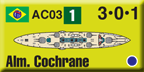 None of that makes Cone of Fire a bad, or even outdated, game. I do like seeing the development of South America’s navies. Though Cone of Fire is billed as two games in one box, it's really more than that. In the Great War at Sea game, the ships and scenarios are divided into distinct eras: the Beagle Channel dispute at the turn of the century, the 1914 Battle of the Falklands and possible variations, and the great dreadnought race. You can see the fleets and their missions evolve. Likewise, the Second World War at Sea segment presents the fleets in distinct eras, including a post-war phase with helicopters and jets - some of the most advanced ships and planes in the entire series appear in this game. None of that makes Cone of Fire a bad, or even outdated, game. I do like seeing the development of South America’s navies. Though Cone of Fire is billed as two games in one box, it's really more than that. In the Great War at Sea game, the ships and scenarios are divided into distinct eras: the Beagle Channel dispute at the turn of the century, the 1914 Battle of the Falklands and possible variations, and the great dreadnought race. You can see the fleets and their missions evolve. Likewise, the Second World War at Sea segment presents the fleets in distinct eras, including a post-war phase with helicopters and jets - some of the most advanced ships and planes in the entire series appear in this game.
Those scenarios come together to make up a pretty comprehensive look at Latin American
naval history from the 1890s to the 1950s.
I wanted to have similar scenarios
in each time frame to show the developing
technology, and also to get across the point
that Latin America's political conflicts changed
so little over six decades.
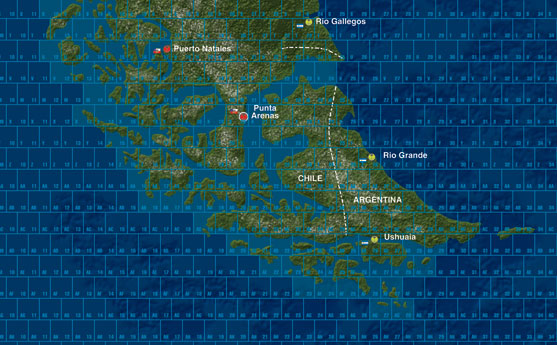
One prime location is the Cone of Fire itself,
Tierra del Fuego. The three small islands
at the eastern end of the Beagle
Channel represented a serious challenge
to Chilean and Argentine manhood from the
late 1800s until very recently (and I am not
convinced that current mutterings of friendship
are all that heartfelt). Scenarios range from
a struggle between two fleets of armored cruisers
in 1899 on through a potential carrier battle
in 1955 with Argentina fielding several squadrons
of jets. There are troop landings, commerce
raiding and terror bombardments. Chile has
a major port right on the Strait of Magellan,
while Argentina has a large base at Ushuaia
on the southern shore of Tierra del Fuego.
The Strait itself, and the many channels
nearby, create the most intricate terrain
we've used in either naval game series. Fleets
can play cat-and-mouse games in the channels,
with coast-watchers constantly spotting them
and the danger of becoming trapped in the
maze always present.
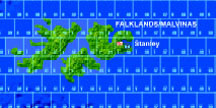 The
next hot spot is the Falkland Islands, another
prime target of Argentine nationalism. Scenarios
include Argentine attempts to take them, British
attempts to take them back, and the efforts
of both to supply their garrisons there. No
actual invasions of the Falklands took place
during this time frame, though both sides
considered the question very seriously and
made plans to take or defend them. The British
at one point, in the panic that followed Pearl
Harbor, even feared that the Japanese might
sail around South America and grab the islands. The
next hot spot is the Falkland Islands, another
prime target of Argentine nationalism. Scenarios
include Argentine attempts to take them, British
attempts to take them back, and the efforts
of both to supply their garrisons there. No
actual invasions of the Falklands took place
during this time frame, though both sides
considered the question very seriously and
made plans to take or defend them. The British
at one point, in the panic that followed Pearl
Harbor, even feared that the Japanese might
sail around South America and grab the islands.
The third prime location is the Rio de la
Plata estuary. During the first half of this
century, it rivaled the waters off New York
as the most heavily-trafficked destination
for merchant shipping thanks to Argentina's
booming agricultural exports. The Argentines
get to defend their trade from Brazilians
and British.
 Along
with the expected time frames (turn of the
century, World War I, World War II, post-war),
there's also a series of scenarios set around
1930. While I selected this as a period of
Anglo-Argentine diplomatic rupture (Argentine
nationalization of British oil firms was the
catalyst, but the economic conflict ran much
deeper than that), I also wanted to see some
of the Royal Navy's older ships in Second
World War at Sea garb. Along
with the expected time frames (turn of the
century, World War I, World War II, post-war),
there's also a series of scenarios set around
1930. While I selected this as a period of
Anglo-Argentine diplomatic rupture (Argentine
nationalization of British oil firms was the
catalyst, but the economic conflict ran much
deeper than that), I also wanted to see some
of the Royal Navy's older ships in Second
World War at Sea garb.
There are some nice historical scenarios in each of the two games.
For Great War at Sea, we have the hunt
for Admiral Graf Spee's squadron, the
Chilean hunt for the secret Royal Navy base
in their southern archipelago, and the British
hunt for the cruiser Dresden after
the Battle of the Falklands. For Second
World War at Sea there are the adventures of the German leader's namesake cruiser Admiral
Graf Spee.
Cone of Fire is a fine game with a lot of unusual stuff inside the box. I regret not putting even more unusual stuff into two boxes instead; considering what developer Jim Stear did with Horn of Africa, each separate game would no doubt have had 60 or more scenarios. But what we did put in the box is still pretty cool.
Click here to order Cone of Fire right now!
Mike Bennighof is president of Avalanche Press and holds a doctorate in history from Emory University. A Fulbright Scholar and award-winning journalist, he has published over 100 books, games and articles on historical subjects.
He lives in Birmingham, Alabama with his wife, three children his dog Leopold and his pet turkey, Egbert.
|