Korean War: Counter Attack
Playbook Edition, First Look
by Mike Bennighof, Ph.D.
August 2025
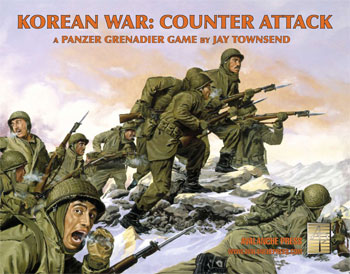 We are returning to Korea! We are returning to Korea!
Some time back, we published two Panzer Grenadier series games set in the Korean War. Pusan Perimeter focused on the initial North Korean attack across the 38th Parallel in June 1950, up to the retreat behind the Naktong River in early August 1950.
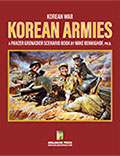
Korean War: Counter Attack picks up where Pusan Perimeter leaves off. In its new Playbook edition, it adds another 52 (!) scenarios to the tale, plus 13 more in the accompanying Campaign Study, 38th Parallel. We’ll expand it soon with Chosin Reservoir, which introduces the Chinese People’s Volunteer Army to Panzer Grenadier and tells the story of the U.S. 1st Marine Division’s epic retreat during the winter of 1950.
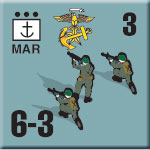
Counter Attack’s scenario set opens with the American counter attack at Chinju in August 1950, a few days after the retreat across the Naktong River. By the second scenario the North Koreans have to face the war’s newest participant: the United States Marine Corps. The fighting swings back and forth through the middle of August and is pretty intense all along the line (multiple scenarios per day, in Panzer Grenadier terms).
The fighting rages into September, now with both sides attacking and a new force entering the fray, the British Army. The North Koreans make one final attempt to crack the United Nations lines around Pusan with their Great Naktong Offensive, but their starving and ragged troops are at the end of their endurance and are eventually pushed back despite their great valor.
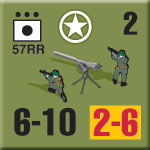 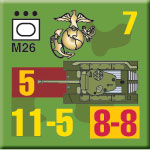 
The landings at Inchon come next, fully explored in Panzer Grenadier format with all the finely-honed techniques of amphibious warfare mastered by the U.S. Navy and Marines in the Pacific. The Marines come ashore in LVT’s and LCVP’s, backed by Sherman tanks with bulldozer blades and flamethrowers, plus Marine M26 Pershing tanks.
That’s where the scenarios wrap up for Counter Attack: 52 of them, in eight chapters, seven of those chapters including a battle game to link the scenarios together so you can play them all with an operational objective (the other one is too short for a battle game). That’s all that would fit inside the Playbook, and even then it stretches the upper limit of what we like to put inside a single game. But Counter Attack had to have Inchon, and that’s Chapter Eight.
38th Parallel (a Campaign Study sold separately) resumes the story back on the Pusan Perimeter, where the United Nations forces (British Army, U.S. Army, and ROK Army) began an offensive as well, expecting the North Koreans to fall back after the Inchon landings and recapture of Seoul. The North Koreans responded with bitter resistance, and about half of their troops holding the Perimeter line were killed or captured.
The 38th Parallel scenarios wrap up with the United Nations crossing the 38th Parallel (the pre-war boundary between North and South Korea) followed by the fall of the North Korean capital Pyongyang, and the parachute landing by the 187th north of the capital that attempted to cut off the retreating North Koreans. They did manage to stop some of them, but not all, and the North Koreans would regroup on the opposite side of the Yalu River, the border between North Korea and China, to return in a few weeks along with a few hundred thousand of their new friends. But that’s a story for another game.
Counter Attack, much like Pusan Perimeter before it, uses the standard Panzer Grenadier Fourth Edition rules with only minimal adjustments (no more than the typical series game; in this case the special rules include helicopters, parachute landings, bulldozer tanks, bazooka teams, and recoilless rifles). It has four new maps and, like Pusan Perimeter, all of them are river boards (Korea has a lot of rivers; in many scenarios, these rivers dry up and turn into creeks, which have minimal game impact). There’s also a coastal board (including a river), so those Marines can storm ashore at Inchon. In a new twist, one of the boards has a steep river gorge. All are of course fully compatible with maps from other Panzer Grenadier games (plus those from Panzer Grenadier (Modern) and Infantry Attacks).

The U.S. Army is back, somewhat improved in quality from its harsh re-introduction to modern war in Pusan Perimeter, with its Pershing tanks and even a couple of M46 Pattons, a much-improved version of the Pershing with a more powerful gun, better armor, and better speed. The North Korean T34/85 tanks that blew apart the hapless Shermans of Pusan Perimeter are no match for this armored beast.
The U.S. Marines also have M26 Pershings (only because they hid them from the Army once the invasion of Japan had been cancelled), and for the first time in Panzer Grenadier they get M3 halftracks of their own in which to ride into battle. The Marines have better intrinsic firepower than the Army, but they don’t get the awesome M46. The Marines have widespread combat experience, earned just a few years earlier in the Pacific; in game terms that translates to high morale, copious leaders, and good initiative.
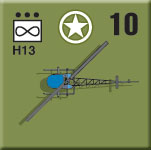
Both Army and Marines do each get a helicopter. These are very early helicopters: a Sikorsky H5 “Eggbeater” for the Marines, and a Bell H13 “Sioux” (also known as the Bell 47, or “the M*A*S*H helicopter”) for the Army. They have no weapons; they can only spot for artillery or naval gunfire. And since American artillery has the VT fuse, that sort of spotting ability can be deadly. But helicopters make games cooler: this is scientifically proven.
The British contingent is not large, but it is feisty. The Brits bring no armor in this game, just hard-fighting infantry. Likewise, the ROK Army (the South Koreans) have no tanks of their own, and are little different from their appearance in Pusan Perimeter. They play a smaller role in this game than in the first volume, but many of the “American” units have been fleshed out by KATUSAs (“Korean Augmentation To U.S. Army” - Korean conscripts, willing or not, added directly to American infantry squads).
The South Korean contingent does include a new element: the ROK Marines. A battalion’s worth of these tough bastards, better-armed than their Army comrades (though not quite as awesome as the U.S. Marines), with the high morale and strong leadership one would expect. The “Ghost Killers” already had extensive combat experience against the North Koreans before landing at Inchon under the command of the U.S. 1st Marine Division; they had also conducted frightful massacres of civilians on Jeju Island.
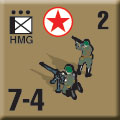
The North Koreans are about the same as they were in Pusan Perimeter, but their infantry is better-armed now. The T-34/85 still outclasses the Sherman, but now there are better American tanks on the battlefield.
Counter Attack’s Playbook edition marks the series’ return to the Korean War in a big way. There are a myriad of stories to tell about the so-called Forgotten War. We’re just getting started.
Join the Gold Club Here.
See your Gold Club Insider newsletter for ordering information.
Sign up for our newsletter right here. Your info will never be sold or transferred; we'll just use it to update you on new games and new offers.
Mike Bennighof is president of Avalanche Press and holds a doctorate in history from Emory University. A Fulbright Scholar and NASA Journalist in Space finalist, he has published a great many books, games and articles on historical subjects; people are saying that some of them are actually good.
He lives in Birmingham, Alabama with his wife and three children. He misses his lizard-hunting Iron Dog, Leopold.
Daily Content includes no AI-generated content or third-party ads. We work hard to keep it that way, and that’s a lot of work. You can help us keep things that way with your gift through this link right here.
|