Far Side of the World:
Publisher’s Preview
by Mike Bennighof, Ph.D.
April 2026
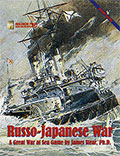
 The German East Asia Squadron’s hopeless attempt to voyage from China to Germany, past the entire Royal Navy plus its allies, is one of the stranger stories of the First World War, and one that’s deeply tempting to tell in wargame format. And so we did, with Far Side of the World. The German East Asia Squadron’s hopeless attempt to voyage from China to Germany, past the entire Royal Navy plus its allies, is one of the stranger stories of the First World War, and one that’s deeply tempting to tell in wargame format. And so we did, with Far Side of the World.
Far Side of the World is a Great War at Sea game, but it’s not like other Great War at Sea games. To start with, it has a world-wide map, rather than the theater maps used in other series games. We used the map from our old Cruiser Warfare game’s Final Edition, since it’s a good map and we still had cartons of them (we ran out of pieces for that game long before we ran out of maps). That’s the only part of the old game that got re-used.
The world is divided into 66 sea areas, each of them rated for merchant density, the likelihood of storms, and the presence of coal stocks. Fleets move between areas; the Central Powers can search for merchants, while the Allies can search for the Central Powers. Everyone needs coal to keep moving, and there are only so many places where the Central Powers can refuel (the Allies can get more black diamonds just about anywhere).
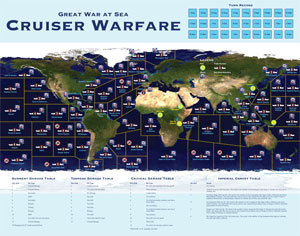 That world-wide map calls for different rules, since there’s no operational game like others in the series. Instead, fleets move between regions on the world-wide map and seek each other there. They may or may not find them, and they may encounter storms. Central Powers ships (almost all German, but Austrians or an Italian might join them, depending on the game’s special events) can raid Allied commerce (taking prizes). Taking prizes and sinking enemy warships garners victory points for the Central Powers player, as does getting any of the East Asia Squadron’s ships back home. The Allied player wins by sinking the German cruisers and preventing their raiding (sinking being the best form of prevention). That world-wide map calls for different rules, since there’s no operational game like others in the series. Instead, fleets move between regions on the world-wide map and seek each other there. They may or may not find them, and they may encounter storms. Central Powers ships (almost all German, but Austrians or an Italian might join them, depending on the game’s special events) can raid Allied commerce (taking prizes). Taking prizes and sinking enemy warships garners victory points for the Central Powers player, as does getting any of the East Asia Squadron’s ships back home. The Allied player wins by sinking the German cruisers and preventing their raiding (sinking being the best form of prevention).
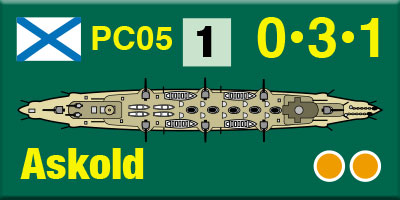
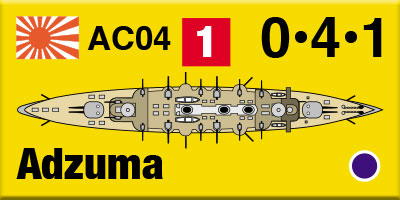
In addition to the East Asia Squadron, the Central Powers also has a handful of German cruisers caught at their colonial posts with the outbreak of war: off East Africa, in the Caribbean and on the West Coast of Mexico. Allied power rests in the Royal Navy, which has stationed cruisers around the globe to enforce its colonial rule, show the flag in distant waters, and most of all to keep watch on the Germans. The British greatly out-gun the Germans, but they have a lot of ocean to cover. They do have some hep, from the powerful Imperial Japanese Navy (which for the most part stays in the Pacific) and the French (who also have an extensive colonial empire and have stationed their own cruisers in far-flung ports). Plus, a couple of Russians.
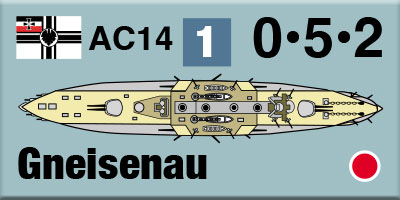
When the fleets meet and fight, that’s when the game falls into line with the rest of Great War at Sea. Combat is resolved through the same process: there’s a Tactical Map, where ships move and shoot at each other with guns and torpedoes. Ships have three sizes of guns (primary, secondary, tertiary), and three classes of armor that might stop them (heavy, light, and none). Torpedoes are far more destructive than guns, but harder to deliver. They’re the same tactical rules as in other Great War at Sea Second Edition games; if you’ve played one of those, you’re good to go.
There’s just one airplane in Far Side of the World (a Japanese seaplane) that won’t have much effect. This game is decided by guns and armor and torpedoes.
Just before the outbreak of war, Rear Admiral Maximilian Graf von Spee took his squadron into the Pacific islands ruled by Germany, disappearing from British and Allied notice. The German cruiser captains stationed at other colonies likewise left port. The British had some idea of where the Germans might be, but little hard information, and were additionally hamstrung by First Lord of the Admiralty Winston Churchill’s amateurish attempts to meddle with operational deployments from his office in London.
That’s the situation at the start of Far Side of the World. The Central Powers player has one reasonably powerful force somewhere in the Pacific, and a handful of individual cruisers scattered all around the globe. The Allied player has many more ships but doesn’t know where the Germans might strike next. The Central Powers player hopes to destroy enemy merchant shipping and, if things go really, really well, bring his or her ships and crews back to Germany for a triumphal return.
Storms hit randomly, though some areas are more likely to see poor weather than are others (there’s a reason the map has 66 areas). In addition to searching for lone merchants, the Central Powers also can attack the huge prizes steaming slowly across the globe: very large Imperial Convoys, carrying troops (usually) from one far-flung location to another. Allowing the East Asia Squadron to get among a couple dozen helpless troop transports would be a war-altering disaster that the Allied player cannot allow. The Central Powers player can win the game without locating such a convoy, but shooting one up definitely aids his or her chances of victory.
Or you can just play out the battles: there are nine Battle Scenarios that take place only on the Tactical Map, including historical battles like the Falklands and Coronel as well as some others that never actually happened, but could have, and make for good gameplay. These resolve pretty quickly (almost all of the ships in Far Side of the World are cruisers) and give you lots of play options.
And then there are the options for the strategic game. The German Admiralty handed its cruiser commanders multiple war plans, depending on what combination of enemies they would be called upon to face. Graf Spee and his staff hoped for Plan B, in which Britain (and by extension, Japan) remained neutral and he only had to face the French and Russians. In game terms things are completely reversed: the Germans can hunt down enemy warships with a good hope of success, but there are far fewer defenseless merchants to be harvested and no Imperial Convoys crossing the oceans.
Plus, you get additional warship options:
● The Germans might have deployed their finest armored cruiser, Blücher, to the Far East, or the East Asia Squadron’s long-time (and mostly useless) flagship Fürst Bismarck, still under repair at home in August 1914.

● The United States might feel the need to defend her neutrality. So we get to play with the armored cruisers of both the Asiatic and Pacific Squadrons.
● The Germans might send the battle cruiser Goeben and her consort Breslau into the wide Atlantic Ocean.
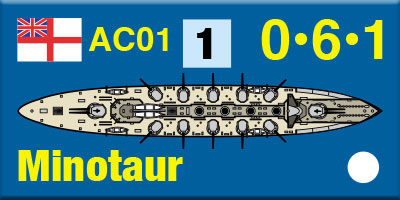
● The Royal Navy might decide to detach battle cruisers to help hunt down the enemy squadron, or the powerful First Cruiser Squadron of four late-model armored cruisers.

● The High Seas Fleet could follow through on their plans to send the battle cruiser Moltke from the North Sea into the Atlantic to provide a diversion for Graf Spee’s hotly-pursued ships.
● The Netherlands, with its East Indies Squadron, could become involved in the Great War following a German invasion.
● The Germans could build another overseas base at Dar es Salaam in Tanganyika and support it with a full-sized cruiser squadron instead of a single ship.
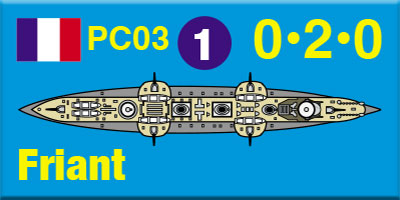
● The French could beef up their naval forces in Indochina.
● The German armored cruisers Scharnhorst and Gneisenau might meet their designed speed (this makes a bigger difference than you might think).
● The battle cruiser New Zealand, paid for but not crewed by New Zealand, might be detached to her homeland as requested.

● Austria-Hungary might have two cruisers on the China Station, not just one.
● The Japanese might agree to send their fleet deeper into the Pacific, or even beyond.
● The German battle cruiser Moltke might show up with the East Asia Squadron, an option discussed in the German Admiralty but not acted upon.
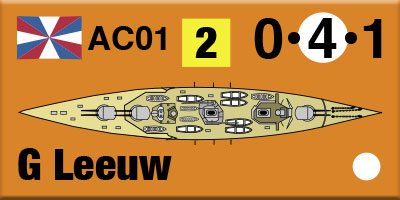
● The Dutch might follow through on their plans to build a new, modern fleet to protect the East Indies.
● Two German dreadnoughts, accompanied by two cruisers, visited South American ports just before the war broke out. Had they still been overseas when the balloon went up, the strategic situation would look very different from Whitehall and Berlin. You can play this out!
● The Russians might take delivery of the new, modern light cruisers ordered in German yards and intended for service in the Far East.
That should keep the game from ever growing stale.
Order Far Side of the World Here.
Sign up for our newsletter right here. Your info will never be sold or transferred; we'll just use it to update you on new games and new offers.
Mike Bennighof is president of Avalanche Press and holds a doctorate in history from Emory University. A Fulbright Scholar and NASA Journalist in Space finalist, he has published a great many books, games and articles on historical subjects; people are saying that some of them are actually good.
He lives in Birmingham, Alabama with his wife and three children.
Daily Content includes no AI-generated content or third-party ads. We work hard to keep it that way, and that’s a lot of work. You can help us keep things that way with your gift through this link right here.
|