| The King’s Ships
Dutch Battle Cruisers
By Mike Bennighof, Ph.D.
July 2022
 One of the defining words of Twentieth Century power politics was “autarky” - a nation’s total economic independence. To be truly powerful, a nation had to control not only its own industries, but the raw materials to feed them and the markets in which to sell their products. By the late 1930’s, that brought a number of the old empires that controlled such resources onto a collision course with the revisionist powers (Germany, Italy, Japan) that wanted them. One of the defining words of Twentieth Century power politics was “autarky” - a nation’s total economic independence. To be truly powerful, a nation had to control not only its own industries, but the raw materials to feed them and the markets in which to sell their products. By the late 1930’s, that brought a number of the old empires that controlled such resources onto a collision course with the revisionist powers (Germany, Italy, Japan) that wanted them.
In 1938, the Netherlands authorized a large re-armament program to defend its interests, especially in the East Indies (the modern Indonesia). Japanese industry needed the oil and other raw materials from the islands, and the aggressive words coming out of Tokyo made it clear that a buy-and-sell relationship was not going to be enough.
In the 1890’s and early 1900’s, the Royal Netherlands Navy had patrolled the East Indies with a flotilla of armored ships, sort of a cross between a slow armored cruiser and a long-range coast-defense ship. These had heavy guns to deter enemy cruisers, but their low speed made them clearly defensive and no threat to other European powers or the Japanese. But the experience of the First World War showed them to be no match for modern cruisers, and so during the war years the Dutch laid down three large, modern light cruisers for the East Indies station. One of the three was cancelled and later replaced by the more modern but ultimately less capable De Ruyter.
Three cruisers remained the Dutch standard, but in the mid-1930s the Navy’s leaders became convinced these needed to be the sort of “super cruisers” discussed in many naval journals of the time. Naval limitations treaties kept cruisers at 10,000 tons displacement and a main armament of 8-inch and later 6-inch guns.
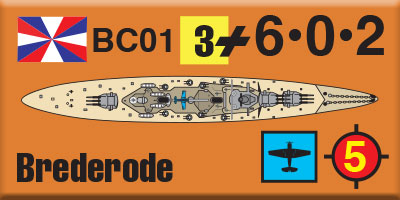
The Dutch had not been asked to sign the treaties, and so had no legal barrier to creating a “Treaty Cruiser Killer.” In the event of war with Japan, the Dutch did not expect to meet the main Japanese battle fleet - that force would be tied down by either direct confrontation with the Americans and British, or at least the threat of such a clash. A Japanese invasion of the East Indies would be spearheaded, they believed, by several squadrons of the Imperial Navy’s “Type A” (that is, heavy) cruisers.
The Japanese had laid down a dozen cruisers with 8-inch guns, and secretly converted six more “light cruisers” to carry the heavier guns as well. These squadrons rarely exercised with the battle fleet, and Dutch naval intelligence believed these would operate independently and thus be their main opponents in wartime. The Dutch also noted that the big seaplane carriers usually worked with the cruiser squadrons and not the full-deck carriers. Therefore, Dutch surface ships would not be exposed to overwhelming carrier-based air attack.
Against even two or three of the Japanese heavy cruisers, the three Dutch light cruisers on the East Indies station (two of them usually on patrol and one undergoing refit at home) would have no chance. But the threat of a Cruiser Killer lurking among the archipelago would force the Japanese to hold off an actual invasion until it was eliminated. The greater range of the Cruiser Killer’s guns would allow her to sink the Japanese ships from well outside a range at which the cruisers could hurt the bigger ship. Three of these big cruisers could paralyze Japanese invasion plans.
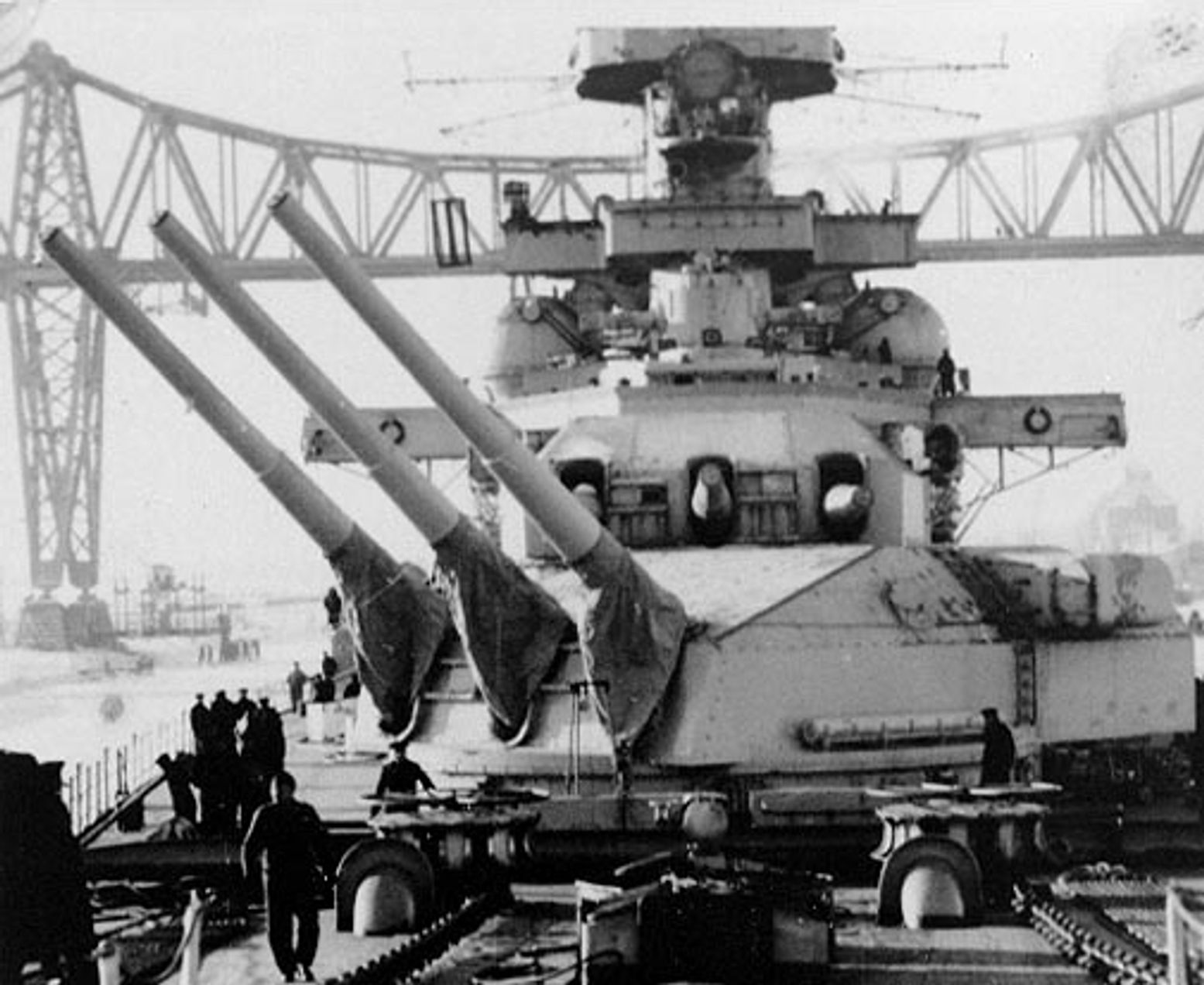
Forward turrets of the Dutch battle cruiser Brederode.
The 1938 plan therefore centered on a trio of battle cruisers, with guns heavy enough to smash a treaty cruiser and enough speed to engage it. There would also be two more light cruisers with six-inch guns, to replace the aging Java and Sumatra, two flotilla leaders to give the Dutch destroyers some gunfire support against the more heavily-armed Japanese “special type” destroyers, as well as destroyers, submarines and assorted light craft.
A 40,000-ton floating dock for the Soerabaya naval yard, plus new shore batteries and airfield improvements for Soerabaya, indicated another policy shift. Refits would in the future take place in the East Indies, meaning that all three units would be available for operations in times of crisis.
The Netherlands possessed a highly competent shipbuilding industry, but the Navy had lost confidence in native engineers with the poorly-designed light cruiser De Ruyter. The Dutch firm Ingenieurskantoor voor Scheepsbouw (I.v.S), a front for the German shipyards AG Vulkan and Krupp-Germaniawerft, provided a battle cruiser design based on the German Scharnhorst class, which were then fitting out in German yards.
Scharnhorst had been designed to political, not military, specifications and never truly met German needs. The main armament of nine 283mm (11.1-inch) guns had been fitted to appease British fears, and the Germans hoped to replace them with six 380mm (15-inch) guns as soon as possible. The ships were not fitted for commerce raiding, with steam turbines rather than long-range diesels like the “pocket battleships,” yet lacked the firepower to challenge enemy battleships. While they certainly could shoot up British treaty cruisers, this was not a mission the Germans really needed to fill.
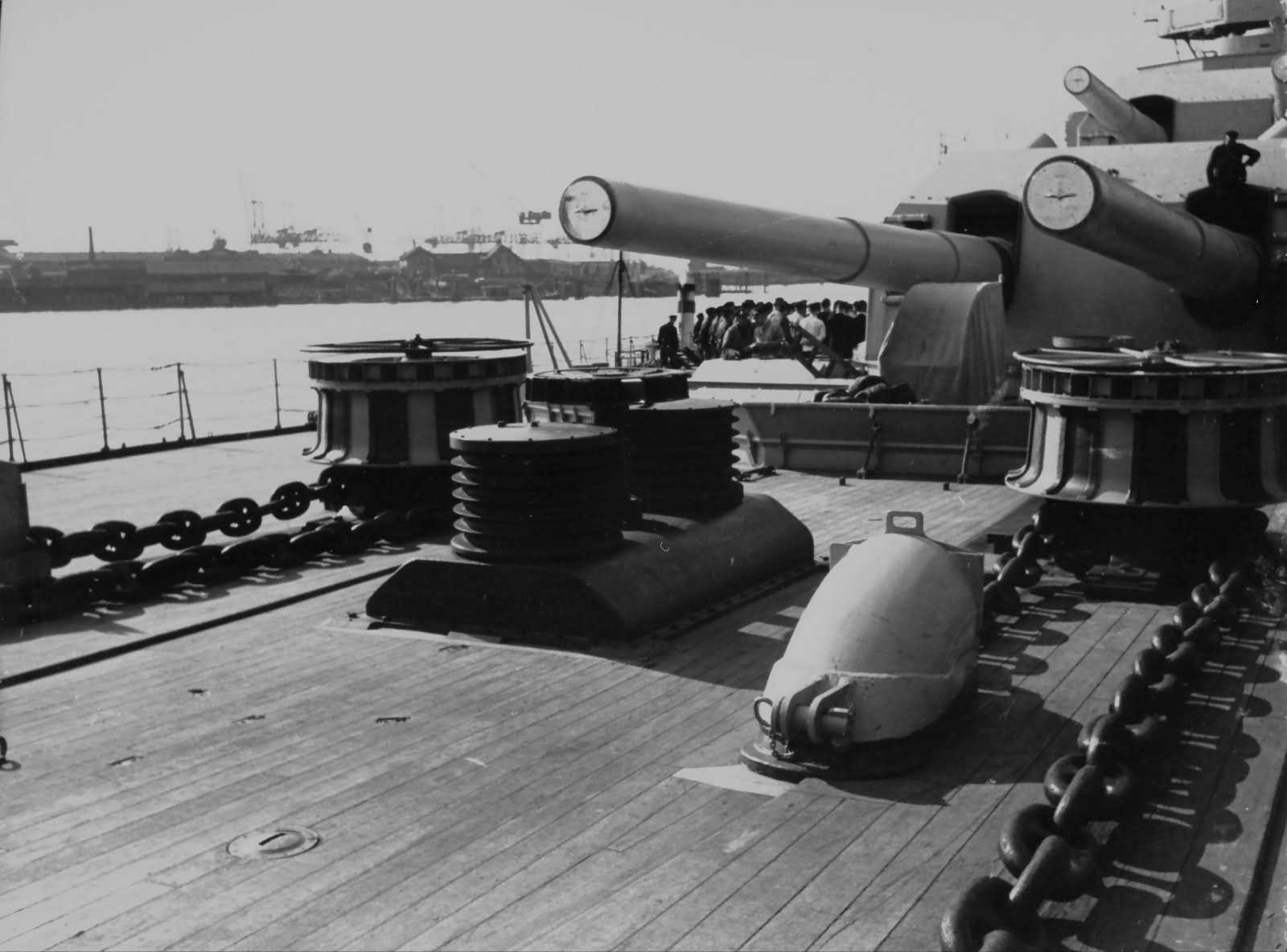
Forward turrets of the Dutch battle cruiser Floriszoon.
But the basic premise did meet Dutch requirements. The Dutch battle cruiser that emerged from the IvS drawing boards looked very much like the German ships, with some key improvements. The Dutch ships would have been faster (34 knots vs. 32 for Scharnhorst) and had more range but slightly thinner armor (but proof against 8-inch shellfire). Outwardly they would look very much like Scharnhorst, but with two funnels rather than the German ship’s one.
They also would have had substantially better anti-aircraft armament. Scharnhorst carried a dozen 150mm (5.9-inch) guns as secondary armament and fourteen 105mm (4.1-inch) anti-aircraft guns because Germany lacked a medium-caliber dual-purpose weapon. The Dutch gave their Cruiser Killer a dozen very effective 120mm (4.7-inch) dual-purpose weapons in six dual mounts, plus 16 40mm automatic weapons, all tied together by a sophisticated fire-control system whose like would not be seen until after World War II.
What the Dutch lacked was a scheme for underwater protection; the Germans refused to share the details of Scharnhorst’s armor below the water line. With no experience in building heavy warships, having skipped the dreadnought age, the Dutch cast about helplessly for assistance, finally scoring a technical visit to Italy’s Ansaldo yards. The Italians refused the plans of the Pugliese system used in Vittorio Veneto or a tour of the ship, but did allow the Dutch to interview a number of engineers familiar with the scheme. They were allowed to give the Dutch any verbal information they requested, but no technical drawings.
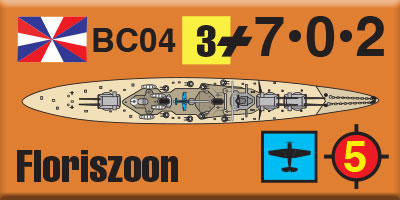
After much delay caused by the hunt for underwater protection, the Dutch engineers finally sketched a modified Pugliese scheme for the battle cruisers. Contracts had been let to four yards for the ships, although only three units had been authorized, hinting that the navy hoped to fund an extra ship. But construction had not begun when the Germans invaded the Netherlands and ended the project.
Dutch naval intelligence estimates were remarkably prescient: they did indeed face Japan’s cruiser squadrons, but supported by the four rebuilt battle cruisers of the Kongo class. These would have been formidable opponents for the Dutch Cruiser Killers. The Dutch, like all other foreign navies, also were not aware of the Japanese 24-inch oxygen-fueled “Long Lance” torpedo. Though a weapon whose effectiveness has been greatly overrated by later amateur writers, it did give the Japanese cruisers a means of striking at Dutch battle cruisers well before the Dutch would have realized the danger. But had the Cruiser Killers been crewed and handled in the same manner as the Dutch cruisers and destroyers that faced the Japanese in 1942, the battle cruisers would have been deadly opponents.
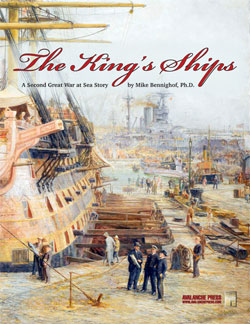
In the world of the Second Great War, the Royal Netherlands Navy - much better funded in this reality - has built two classes of battle cruisers: the first with nine 280mm (11-inch) guns in three triple turrets, and the second with six 380mm (15-inch) guns in three twin turrets, the same upgrade proposed for Scharnhorst. Two of each class appear in the massive expansion set The King’s Ships; two more of each class are stationed in the Netherlands East Indies.
Click here to join the Gold Club.
See your Gold Club Insider newsletter for ordering information.
Sign up for our newsletter right here. Your info will never be sold or transferred; we'll just use it to update you on new games and new offers.
Mike Bennighof is president of Avalanche Press and holds a doctorate in history from Emory University. A Fulbright Scholar and NASA Journalist in Space finalist, he has published a great many books, games and articles on historical subjects; people are saying that some of them are actually good.
He lives in Birmingham, Alabama with his wife and three children. He misses his Iron Dog, Leopold.
Want to keep Daily Content free of third-party ads? You can send us some love (and cash) through this link right here.
|