| War on the Equator:
Pieces of the Equator
By Mike Bennighof, Ph.D.
November 2021
I like to make games on historical topics known to but a few people. It’s a weakness, probably founded in some desperate need to show off arcane knowledge, and I’ve been working hard to overcome it.
The Peru-Ecuador War of 1941 certainly falls under that umbrella, but it’s a fascinating conflict all the same. Peru had spent several years and large sums of money to prepare for war with Ecuador, and had the continent's most modern armed forces when war broke out in August 1941. Italian artillery and bombers, Czech tanks and artillery tractors, American fighter planes and French cannon all made for a war machine capable of overrunning Ecuador's comparatively primitive bayonet army. Here's a look at the forces each side brings to the game table in War on the Equator.
Foot Soldiers
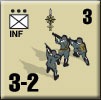 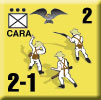  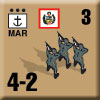
Peruvian infantry wore a collection of surplus European gear, mostly the French Adrian helmet and their blue-gray woolen uniform. The front-line forces carried French Lebel rifles, and they trained with the aid of a French military mission. Though not up to the standards of most European armies, they were considerably more efficient and battle-ready than any other South American force in 1941. Several battalions rode to war in Fiat-made trucks and had practiced with them extensively, giving Peru an enormous mobility advantage.
Ecuador's army remained typical of Latin American armed forces, trained (barely) and deployed to maintain civil order rather than face another state in armed conflict. Well aware of Peru's preparations, the Ecuadorians did little to build up their own forces and even reduced their military budget in 1941. Infantrymen carried Austrian-made Mannlicher rifles bought from Italy after the First World War, as well as a smattering of small arms from all over the world.
With most of the regulars held back from the front, the Ecuadorians resorted to sending their militarized police against the Peruvians, with predictably disastrous results.
Both armies fielded cavalry, though Peru now counted on its newly motorized infantry battalions for battlefield mobility while Ecuador held its regiments back near the capital to help overawe angry civilians. Neither side's horsemen distinguished themselves in the war.
Peru had the continent's only parachute force, a company of soldiers although not all were jump-trained when the war with Ecuador broke out. They executed the first airborne assault outside of Europe, with somewhat mixed results as seen in War on the Equator scenario three. The Peruvian Navy also maintained a well-trained battalion of marines, who saw action in an amphibious assault against Ecuador.
Armor

Only Peru fielded tanks in 1941, giving them yet another enormous battlefield advantage. A Peruvian mission went to Europe in 1935, scouting tanks at the Vickers, Renault and Fiat plants. While Italy offered better financing, Fiat-Ansaldo had only the L33 machine-gun carrier to offer, which did not meet Peruvian requirements.
The Peruvians chose a Czech-made light tank, the LTL from the CKD firm. Latvia, Lithuania, Switzerland, Iran and Sweden all ordered the tank or some variation of it, and Slovakia and Germany used them as well. Peru bought two dozen of them, organizing them in a two-company battalion. The motorized infantry trained alongside the tanks, and Peru's French military mission instructed them in tactics derived from France's Great War experience. Though the LTL tanks were fast and very mobile, Franco-Peruvian doctrine tied them directly to the infantry and in combat they were expected to support the advance of the foot soldiers rather than surge into enemy rear areas.
The LTL tanks performed extremely well in the 1941 war and remained in front-line service for more than 50 years.
Artillery
Peru purchased several batteries of the excellent Italian 75/32 light field gun, a well-designed and very modern weapon capable of rapid deployment. It also had outstanding anti-tank performance, though this would not be an issue in the War of the Equator. The Italian Army desperately wanted these guns, but Benito Mussolini ruled that the need for hard currency trumped military necessity and Peru's ability to pay in gold gave their needs priority. The Peruvians also obtained the very good French-made Schneider 105mm howitzer, a weapon also used by the French and Italian armies. To keep these modern weapons at the front, Peru also bought 95 Czech-made CKD prime movers, tracked vehicles widely considered the best of their type in the late 1930s.
In addition, Peru still had a number of older French-made 75mm field guns purchased right after the First World War, still considered front-line pieces as was the case in many other armies.
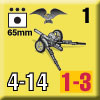
Ecuador, once again, stood at least a generation behind the Peruvians. Much of the artillery dated from the previous century, and all of it was pulled by horses. The most modern batteries were Italian 65mm mountain guns purchased in the 1930's as part of the same Fascist push to sell arms abroad that netted much better weapons for Peru. And like just about every other army on the face of the planet, the Ecuadorians also bought some surplus "French 75" Schneider field guns after the Great War.
About the only modern weaponry Ecuador did manage to obtain in the run up to war were some anti-aircraft guns in the vain hope of countering Peru's enormous advantage in air power. Peru likewise had bought Breda 20mm anti-aircraft batteries from Italy under the same easy credit terms that brought in the 75mm artillery pieces.
The War on the Equator expansion is free to Gold Club members.
Click here to join the Gold Club right now!
Sign up for our newsletter right here. Your info will never be sold or transferred; we'll just use it to update you on new games and new offers.
Mike Bennighof is president of Avalanche Press and holds a doctorate in history from Emory University. A Fulbright Scholar and NASA Journalist in Space finalist, he has published a great many books, games and articles on historical subjects; people are saying that some of them are actually good.
He lives in Birmingham, Alabama with his wife, three children, and his Iron Dog, Leopold.
Want to keep Daily Content free of third-party ads? You can send us some love (and cash) through this link right here.
|