| Fire in the Steppe:
German
Infantry Guns
By Mike Bennighof, Ph.D.
December 2020
 Hard experience in the First World War taught
most European armies the need to support infantry
with light artillery under their own control.
These took the form of trench mortars and
small cannon known as “infantry guns,”
ranging from 37mm to 75mm caliber. They usually
had only direct-fire capability, not being
designed to lob shells over long ranges. Hard experience in the First World War taught
most European armies the need to support infantry
with light artillery under their own control.
These took the form of trench mortars and
small cannon known as “infantry guns,”
ranging from 37mm to 75mm caliber. They usually
had only direct-fire capability, not being
designed to lob shells over long ranges.
Afterward, the German Reichswehr placed
light artillery in the infantry order of battle.
In 1927, Germany’s leading artillery
maker, Rheinmetall, received an order for
a new, lightweight 75mm gun for the infantry.
It had pneumatic tires and was intended to
be drawn by a truck or half-track prime mover.
A lightweight splinter shield protected the
four-man gun crew. An unusual “shotgun”
breech action allowed the crew to huddle tightly
behind the shield while re-loading: after
firing, the barrel would slide back over the
breech block, with the muzzle pointed toward
the ground and the breech end pointing upwards.
The crew could then easily slide the next
shell into the barrel and lock it back into
position to fire again.
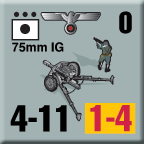 At less then 900 pounds, the gun could easily
be manhandled into position, and this feature
made it very popular within the Army. With
its short barrel, range was not great —
3,900 yards — but more than enough to
provide direct support to the infantry. Initially
it had only high-explosive shells, much smaller
than the standard load for a 75mm piece (about
5 kilograms). During the war the guns would
also receive hollow-charge anti-tank rounds. At less then 900 pounds, the gun could easily
be manhandled into position, and this feature
made it very popular within the Army. With
its short barrel, range was not great —
3,900 yards — but more than enough to
provide direct support to the infantry. Initially
it had only high-explosive shells, much smaller
than the standard load for a 75mm piece (about
5 kilograms). During the war the guns would
also receive hollow-charge anti-tank rounds.
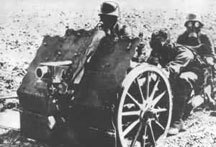
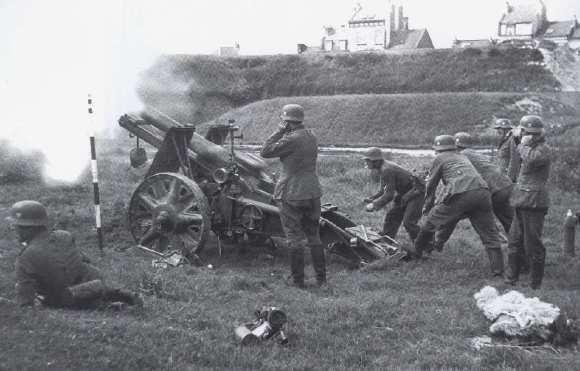
A 75mm leIG 18 infantry gun during pre-war
maneuvers; note the gas masks.
|
For mountain troops, a variant with large
spoked wooden wheels could be broken into
six to 10 pack loads, allowing it to be carried
by a train of mules or even very strong men.
The gun had the same barrel and breech, but
a lighter trail and no splinter shield. A
similar gun was provided for airborne troops.
Crews preferred the mountain gun variant:
despite the anachronistic appearance of its
wooden wheels, these were much larger than
the tires on the standard gun and made it
much easier to handle in action.
Issue of the weapons varied throughout the
war, but almost every formation had some of
them. Standard regimental tables called for
a company of six 75mm guns in three two-gun
platoons, plus a platoon with two heavy 150mm
infantry guns. Late in the war, many battalions
had their own two-gun platoon. Mountain battalions
always had two mountain guns in their organization.
The heavy 150mm infantry gun.
|
In 1933, the newly renamed Wehrmacht issued
specifications for a heavy 150mm infantry
gun. Rheinmetall once again obliged, but the
result would be much less popular with the
troops. The sIG 33 150mm gun weighed more
than four times as much as the lightweight
gun and could not be broken down for transport.
While it certainly provided greater firepower,
with a shell weight also about four times
that of the 75mm gun and a greater range,
it could not be moved by its crew or, apparently,
by just about any number of infantrymen sweating
at its wheels. Requiring motor transport or
a horse team to move the gun took away most
of the advantages of a true infantry gun;
it also required a larger crew (seven men).
The heavier shell did give it some capability
against armor, but it did not receive a 150mm
counterpart to the light gun’s hollow-charge
shell. Instead crews received a large stick
bomb to be inserted into the muzzle and fired
like a giant rifle grenade. The weapon required very
steady nerves to use in action, and accuracy
appears to have been random at best. Instead
the stick bomb came to be used only against
fixed targets like bunkers, and in the time-honored
tradition of military contractors and purchasing
departments this became its official purpose.
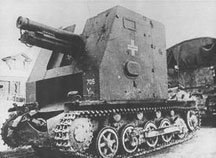
The designers feigned surprise when
it tipped over. ...
|
Despite the big gun’s lack of mobility
it would be issued until the end of the war.
To overcome this deficit, it was fitted on
chassis of PzKpfw I light tanks, wheels and
all, but the gun’s massive recoil often
caused the vehicle to flip onto its side.
This early assault gun saw action in Poland
and France in 1939 and 1940, but performed
poorly and would soon be withdrawn. Later
vehicles would carry the sIG 33 with more
success, including the Brummbar assault gun.
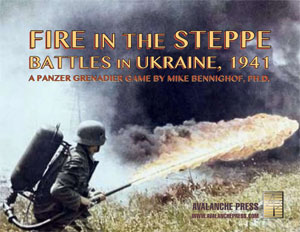
Both types of infantry gun appear in most Panzer Grenadier games featuring German forces.
You can order Fire in the Steppe right here.
Sign up for our newsletter right here. Your info will never be sold or transferred; we'll just use it to update you on new games and new offers.
Mike Bennighof is president of Avalanche Press and holds a doctorate in history from Emory University. A Fulbright Scholar and NASA Journalist in Space finalist, he has published countless books, games and articles on historical subjects.
He lives in Birmingham, Alabama with his wife, three children and his dog, Leopold.
Want to keep Daily Content free of third-party ads? You can send us some love (and cash) through this link right here. You don’t have to, but Leopold would like it if you did.
|