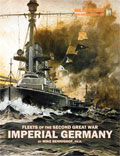
The Second Great War:
A Primer
by Mike Bennighof, Ph.D.
June 2023
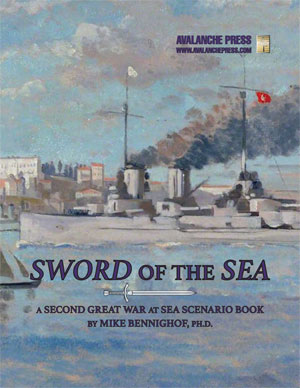 Note: Our Second Great War at Sea: Sword of the Sea is an expansion for Second World War at Sea: Horn of Africa, and it tells the story of this conflict that never happened in Middle Eastern waters. Note: Our Second Great War at Sea: Sword of the Sea is an expansion for Second World War at Sea: Horn of Africa, and it tells the story of this conflict that never happened in Middle Eastern waters.
The Second Great War is our alternative-history story arc, one in which the First World War (the Great War) ends in a negotiated peace at the close of 1916 and war returns around the globe a generation later.
By November 1916, the United Kingdom had run out of cash and could no longer fund its war effort. In the United States, the newly-established Federal Reserve warned that a British default could trigger a financial crisis. American investors, led by J.P. Morgan, had poured billions into British debt that could be vaporized overnight.
A week after the U.S. government warned the public, Britain’s Chancellor of the Exchequer Reginald McKenna told Prime Minister H.H. Asquith that the kingdom faced imminent financial collapse; he recommended that His Majesty’s government make peace as quickly as possible. On 18 December 1916, two weeks after McKenna’s warning, U.S. President Woodrow Wilson made a formal offer to all of the warring states to mediate a peace between them.
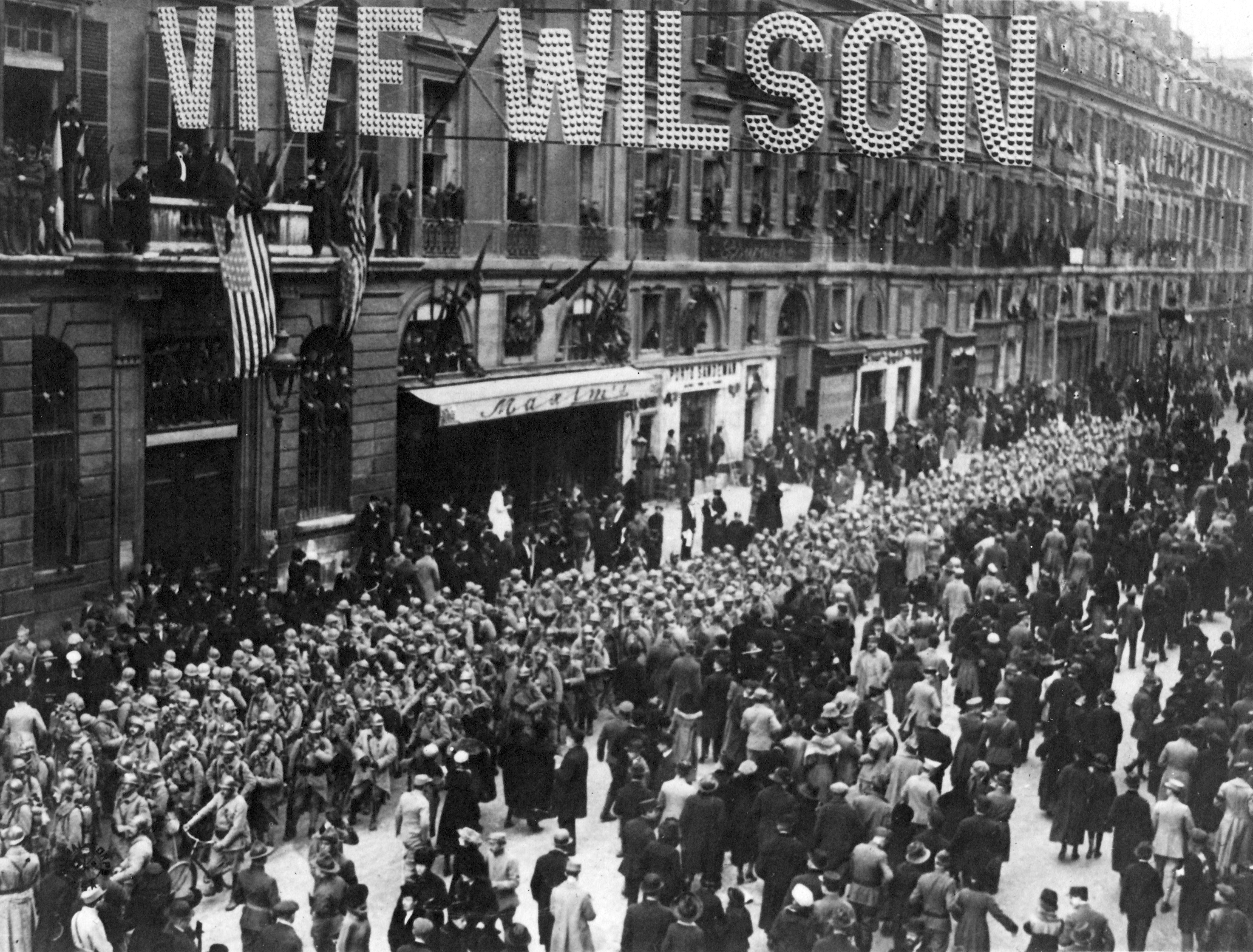
Woodrow Wilson is greeted in France.
Germany initially rebuffed his request for terms. Under pressure from their chief ally Austria-Hungary, desperately needing peace, the Germans relented a few days later and presented a huge list of demands, ranging from the annexation of Belgium to the acquisition of Madagascar.
Austria-Hungary presented a far more modest list, needing an end to combat operations almost as much as the defeated Russians. Italy would make a handful of minor border corrections along the Alpine frontier and pay a war indemnity. Serbia would be placed under a protectorate, allowed only police forces under strict supervision, with the parts of Macedonia seized by the Serbs during the Balkan wars going to Bulgaria. Albania would receive similar treatment, but noticeably more relaxed. Romania would yield up the southern exits of the Carpathian passes to Austria-Hungary and grant 99-year leases on the Romanian oil fields to Austrian firms. Montenegro would be annexed outright.
Wilson strove mightily to craft acceptable peace accords. Having made his offer just as Germany prepared to unleash unrestricted submarine warfare (which all knew would end any hope of a negotiated settlement), he had but one opportunity. American banks had lent heavily to the British and French governments, and now faced catastrophic losses should the Allies be defeated. As would be the case a century later, the federal government believed that bank failures – even those brought on by foolish actions of the banks themselves – would endanger the American economy and must be prevented by government action (and as would also be the case a century later, bank profits would remain with the banks). If Wilson could not extricate the borrowers from defeat by diplomacy, he would have to do so by intervention. And Woodrow Wilson, who had just won re-election a month earlier on an anti-war platform, did not wish to take his country to war.
All of the above is true. And in our own reality, it quickly unraveled. Despite pressure from Austria-Hungary to accept Wilson’s terms, the German government refused to state its war aims, only later coming back with a fanciful list of demands including the annexation of Madagascar. During the two weeks between McKenna’s recommendations and Wilson’s note, the Asquith government in Britain fell. David Lloyd George, determined to see the war through to its conclusion no matter the cost in blood or treasure, replaced Asquith as prime minister. The moment had been lost. In January 1917, Germany declared unrestricted submarine warfare. A month later, the United States broke off diplomatic relations and in April declared war on Germany.
Woodrow Wilson actually made the offer up above on the date cited, but in the actual case Germany refused to even reveal her demands. The German government had put together a list in November, but chose to believe the Navy's assurances that unrestricted submarine warfare would bring outright victory. Wilson, taking the refusal as personal insult, became hardened toward the Central Powers and led his country into war as soon as Germany gave him a reason. Numerous historians have pointed to this moment as one of the most tragic in human history, a real chance to end the war before millions more died, even more destruction ensued and power politics became hardened into the pattern that would lead to Depression, Holocaust and tens of millions more killed.
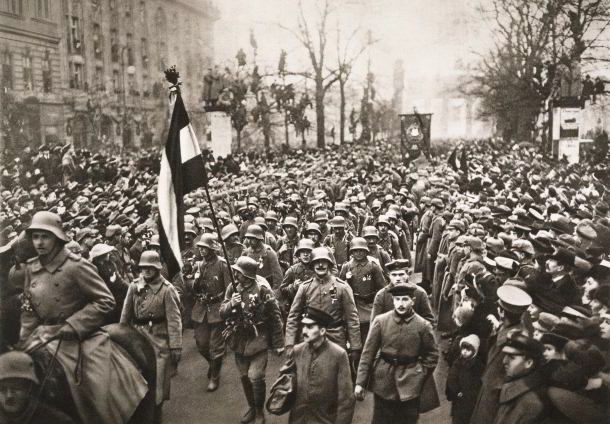
The German Army returns home, Spring 1917.
Things work out more positively in our alternative history (in a manner that was, at the time, probably more likely to happen than the actual events). An armistice goes into effect on New Year's Day 1917, and by springtime, Wilson had a set of treaties to offer that left everyone vaguely dissatisfied. Grudgingly, all belligerents put their signatures to paper. The war was over.
Though touted as a “peace without victory,” a few outright annexations resulted. Japan acquired the German colony at Tsingtao in China. Britain refused to return the Turkish vilayets of Basra and Baghdad in Iraq. Austria-Hungary picked up some sparsely-inhabited woodlands at the southern exits of the passes through the Carpathian Mountains in Romania, while Germany added the uninhabited Svalbard archipelago in the Arctic and received Zanzibar and the Solomon Islands from Britain.
Otherwise, territorial change is the result of plebiscites – votes by inhabitants of the affected areas. Most of Alsace-Lorraine remains with Germany, while Luxembourg joins the Reich as well. Russia loses Poland, the Baltic areas and the Trans-Caucasus. Italy fails to gain any former Austro-Hungarian lands, while Serbia loses Macedonia and Kosovo. Ottoman Turkey loses Armenian lands in eastern Anatolia. But Europe’s old empires – German, Austro-Hungarian, Russian and Ottoman – survive their existential crises.
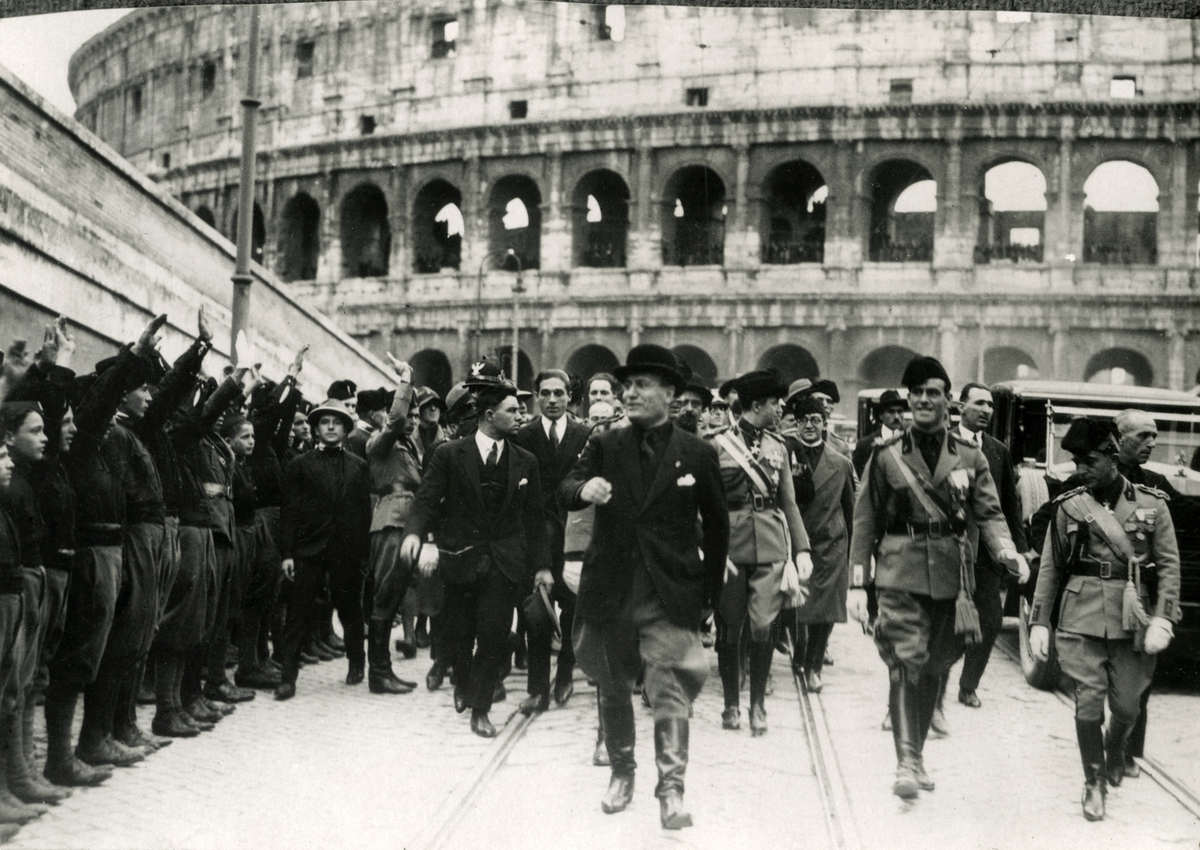
Making Italy great again.
Over the next two decades, the Central Powers become a powerful economic bloc. The Great Depression, lacking the precursors of German reparations and Weimar hyper-inflation, is only a serious recession. This is a much richer world than the one we know, though economic disparities build resentment all the same. Right-wing politicians in France, Italy, and Russia seethe with bitter anger over their “stolen victory.” Fascist regimes in Italy and France, as well as Russia’s Tsar Alexei, prepare for a new war to overturn Wilson’s Peace, turning to new technologies and tactics to make the difference.
War returns in August 1940, with Russia, France and Italy launching an unprovoked war of aggression against Germany, Austria and their European allies. It spreads with a Russian attack on the Ottoman Empire in January 1941, and further still in April when Great Britain intervenes alongside the Allied Powers.
The world of Wilson’s Peace is in many ways a happier place than our own. But it’s not a peaceful one. Ambitious politicians would still find in armed conflict a powerful means by which to excite and inflame their populations. And once war began, a government would then have the excuse to arrogate even more power to itself. War would not – and will not – end as a means of state policy until the reasons not to fight outweigh the reasons to fight.
You can order Sword of the Sea right here.
Sign up for our newsletter right here. Your info will never be sold or transferred; we'll just use it to update you on new games and new offers.
Mike Bennighof is president of Avalanche Press and holds a doctorate in history from Emory University. A Fulbright Scholar and NASA Journalist in Space finalist, he has published a great many books, games and articles on historical subjects; people are saying that some of them are actually good.
He lives in Birmingham, Alabama with his wife, three children, and new puppy. He misses his lizard-hunting Iron Dog, Leopold.
Want to keep Daily Content free of third-party ads? You can send us some love (and cash) through this link right here.
|