| Hyderabad 1948:
Armies of the Nizam
By Mike Bennighof, Ph.D.
May 2026
Panzer Grenadier: Hyderabad 1948 is a downloadable expansion based on Operation Polo, the 1948 Hundred-Hour-War between India and Hyderabad, the would-be state of South Pakistan. Though an important conflict for the time and one which still has much to say about more recent conflicts, the war definitely fits the definition of “obscure” for our overwhelmingly Western audience. Yet there are themes present that echo strongly almost eight decades later: a powerful state crushing a much smaller one on the pretext of preventing Muslim extremism, and even justifying it by stoking fears that said Muslims might somehow obtain and use nuclear weapons on Indian cities.
The fighting itself ended relatively quickly; Indian accounts point to their army’s training and professionalism, while post-war writings of Hyderabadi politicians hint at treachery. Even so, there were fiercely contested battles during the four days of active operations, enough to provide a good set of Panzer Grenadier scenarios.
It was satisfying to research and design, and made for a nice package. The scenarios are good, and Susan Robinson designed some very nice Hyderabadi pieces. I always wanted Panzer Grenadier to include lesser-known conflicts and armies, and this finely-made expansion is a perfect example. Thanks to that “obscure” tag, Hyderabad 1948 is a downloadable expansion (you have to assemble the pieces yourself).
So here’s a look at the army of Mis Osman Ali Khan, the last Nizam of Hyderabad, as shown in Hyderabad 1948:
Hyderabad’s Army
Infantry
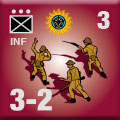 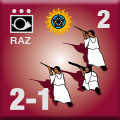 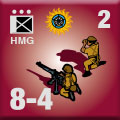
Hyderabad, like the other Princely States, maintained its troops in accordance with the British “State Forces Scheme” issued after the First World War. Hyderabadi forces were organized, trained and equipped under the same guidelines as regular Indian Army units.
Hyderabad’s foot soldiers carried a variety of small arms in 1948, thanks to an embargo placed on the kingdom by the Indian state. When Hyderabad State Forces troops returned from overseas duty, like returning troops in just about every nation they turned in their arms to Army quartermasters. The Indian Army, however, refused to transfer these weapons to Hyderabad’s depots after the war. The Nizam and his government managed to smuggle in sufficient rifles and machine guns for their regulars thanks to the efforts of Australian Sidney Cotton, the “Lord of War” of the late 1940s.
A Hyderabadi infantry platoon therefore, was organizationally identical to one from the Indian Army, but due to the armaments problems and generally lower level of training these units are not as good in game terms as their enemies. Likewise, Hyderabad’s machine-gunners follow the same organization and doctrine as the Indians, but are not as well-trained and have only recently received their weapons – some of them standard-issue Vickers just like the Indians, but many of them assorted makes and models delivered by Cotton’s night flights to Hyderabad.
The Hyderabadis apparently lacked mortars of any description, and their engineering branch was very small. What they did have was a huge mass of Muslim militiamen, the Razakars. Just how many of these men took the field is hard to determine now, as the Indians won and wrote the histories, but 200,000 seems to be the standard cited number. What is clear is that large numbers of irregulars flocked to support the Hyderabadi regulars, who readily incorporated them into the front lines. Thanks to Cotton’s smuggling efforts a fair number of them had been provided with modern arms while the remainder relied on whatever weapons they could scrounge, including spears and swords. The Razakars don’t seem to have concentrated their firepower, but spread it out among their followers, so all of the RAZ units have the same ratings in the game. They have no special power like some other irregulars in the Panzer Grenadier system, but often have fanatically high morale when defending their homes and villages.
Artillery
   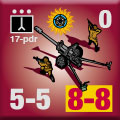
The Nizam’s men don’t have much – if Sidney Cotton couldn’t fly it in using his fleet of converted bombers, the Indian embargo hurt badly. What they do field is standard issue for the British Indian Army, in this case, pieces held by Hyderabad before and during the Second World War, and thus never subject to Indian seizure. There are some of the excellent British 25-pounders in Hyderabad’s service, along with some of the older 18-pounders – Hyderabad sent individual gunners but no complete artillery units overseas, and so its relative handful of big guns was not exposed to Indian larceny on their return.
A variety of British-made anti-tank guns were on hand, ranging from nearly useless 2-pounders through the awesome 17-pounder. While the former could only annoy the crews of Indian Sherman tanks, the latter could shred them just as effectively as any German 88mm gun. Hyderabad did not have enough of these excellent guns, however, and was thwarted in its attempts to acquire more of them.
Armored Cars
 
The Nizam of Hyderabad desperately wanted tanks for his armored regiments, but could not get any through the Indian embargo. Instead the Hyderabadis had to rely on armored cars imported at the end of World War II. The Hyderabadi cavalry had not seen combat in the Second World War, but both of their regiments had gone out of the country for garrison service and undergone fairly intensive training. Both the Hyderabadis and their enemies considered their armored car units the army’s elite, but they were no match for the Sherman tanks of the Indian First Armored Division.
Hyderabad operated two types of armored car: the British-built Humber and the American-made Staghound. Only the Staghound had an anti-tank capability, and that was extremely weak even against the Indian Shermans. Both cars are good for their intended purpose, but they were not built to substitute for actual tanks, the use to which the Hyderabadis found themselves forced to put them. The Lancers were a very good unit, with high morale, good leadership and hard training behind them, but they could not be expected to defeat Indian Shermans. And they did not.
Cavalry

Hyderabadi cavalry made important contributions to the Allied side in the First World War; the Hyderabad Lancers, when still a horsed unit, captured Haifa from the Turks in 1918. The Nizam’s army converted two of its three regiments to armored cars in 1939, but one horsed regiment remained in active service in 1948. The Golconda Lancers were a palace guard unit, usually deployed on parades and other ceremonial functions, but considered an elite unit nonetheless by Hyderabadi standards. They certainly rode to war with great spirit, already knowing their cause to be lost when the order to deploy arrived, but their bravery was no match for the Indian Air Force’s Hawker Tempest fighter-bombers.
Tanks
   
Hyderabad had no tanks, but desperately wanted them, and I really wanted a tank battle scenario in the set. Since Sidney Cotton failed to obtain any actual hardware, I settled on four types in good supply in the world at large: many nations purchased the Stuart light tank, and Hyderabadi veterans would have been very familiar with it. I didn’t want to give Hyderabad the exact same tank park as India, even though the Sherman would have been a likely acquisition, and settled on other vehicles available in large numbers and familiar to Indian tankers. The Valentine IX was never actually issued to any Indian units, but nearly 700 of them had been built and I wanted to set a British-made tank against an American-made one, and I wanted one armed with the 6-pounder (57mm) gun just because few of them saw much combat. The Valentine actually has little chance against India’s Shermans, so we ended up choosing a Stuart-equipped unit for the Indians in our tank battle scenario. The Cromwell cruiser tank equipped the Polish 1st Armoured Division and several British units in 1944 and 1945, and remained in servce into the 1950’s with many sold to other nations. The awesome Centurion entered service just after World War II’s end, and the British sold it to a number of armies within their sphere including India and Egypt: Indian Centurions would fill the “Patton Graveyard” with American-made M47 and M48 tanks during the 1965 war. Obtaining some for Hyderabad would have been a major coup for Sidney Cotton, but not impossible. The Centurion gives Hyderabad a tank to more than counter the Indian Shermans.
Download Hyderabad 1948 Here.
It’s $25.99, but if you’re a Gold Club member, you can download for $18.19 using your Gold Club link (That’s the only way to claim your Gold Club discount).
You can order the set of eight maps here:. These are hardcopy maps on rigid cardstock, just like those in Panzer Grenadier games
Order Hyderabad Maps Here.
Sign up for our newsletter right here. Your info will never be sold or transferred; we'll just use it to update you on new games and new offers.
Mike Bennighof is president of Avalanche Press and holds a doctorate in history from Emory University. A Fulbright Scholar and NASA Journalist in Space finalist, he has published an unknowable number of books, games and articles on historical subjects.
He lives in Birmingham, Alabama with his wife and three children.
Want to keep Daily Content free of third-party ads? You can send us some love (and cash) through this link right here.
|