The Kaiser's Ships, Part One
By Mike Bennighof, Ph.D.
September 2014
In a world . . . where the Great War ended with the Christmas Day Armistice of 1916, Kaiser Wilhelm II’s High Seas Fleet still steams the North Sea a generation later.
That’s the basic premise of The Kaiser's Navy, the first book in our Second Great War alternate history setting for Second World War at Sea. The best dreadnoughts and battle cruisers of the old High Seas Fleet have been modernized to fight in a new war, while new battleships, aircraft carriers and cruisers have joined them. With no Versailles Treaty and its crippling reparations, the Great Depression is much less great and naval spending is consequently greater among all the naval powers. Here's a look at the battleships and cruisers of The Kaiser's Navy; battle cruisers, carriers and destroyers come later.
Battleships
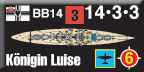 
The High Seas Fleet of 1940 is a very conservative force, built around its battleships. And there are a lot of battleships. Heading the list are four examples of the original design proposal for what became the Nazi battleships Bismarck and Tirpitz. In this guise they have 16-inch guns initially specified rather than the 15-inch main batteries of Bismarck, but with a very similar armor scheme and high speed. As pointed out in an earlier Daily Content piece, Bismarck's design was far from revolutionary, simply following the practice of the Imperial Navy's designers. And so using this Bismarck variant for an alternate Imperial ship has some logic behind it.
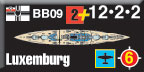
The other Imperial German battleships in the set are re-conditioned older ships in keeping with the naval limitations treaties posited for this alternative reality. The four powerful ships of the Luxemburg class represent the GK4251 design seen in their 1922 form in our long out-of-print Great War at Sea: U.S. Navy Plan Black and the book supplement Black Waters, which uses the same set of counters. They would have been very large ships, as big as the modern ships "built" two decades later, with high speed and an armament of eight 16.2-inch (410mm) guns in four turrets. Contrary to usual German design practice, whatever the regime in Berlin, protection would have been sacrificed for speed and firepower. By 1940, with modernization sometime in the 1930s, they would have still been very potent warships.
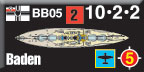
Still formidable but not quite as powerful, the four battleships of the Baden class would have emerged from modernization in very similar form to the Royal Navy's Queen Elizabeth class. New oil-fired machinery would have improved their speed, but their broad hull form would not allow them to become truly fast battleships. With eight 15-inch guns they would carry a very respectable main armament, and like the Luxemburg class their secondary armament would have been moved from casemates and placed in far more useful (but also more vulnerable) turrets.
Actual German battleships and cruisers of the Second World War lacked a dual-purpose secondary weapon; they carried 150mm (5.9-inch) guns in turrets to engage surface targets, and 105mm (4.1-inch) guns in dual mounts as their heavy anti-aircraft gun. There's no reason to think that the Imperial Navy would have been any less blind, and so these ships have to carry both types of weapon just like the battleships built by the Nazi regime.
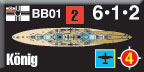
The final battleships retained by the High Seas Fleet are four ships of the König class, well-protected ships for their day but carrying only 12-inch (305mm) guns as their main battery. Their central turret has been removed to make way for oil-fired machinery, with the deck space supporting a pair of seaplane catapults and hangar for a large number of planes — very useful for escort work. Their speed is not great, and their main armament is weak, making them best suited for duty as convoy escorts and in home waters.
All of the older German battleships have a surprisingly limited deck area — a corollary to their restricted living quarters, as crews lived ashore in barracks in the old High Seas Fleet and slept in hammocks during their brief deployments at sea. That in turn limits the number of heavy anti-aircraft weapons that can be fitted, as some of the space must be given over to the 150mm gun turrets (which can't fire at high angles); though like all battleships they have ample space for small-caliber automatic guns.
Cruisers
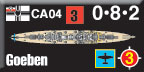 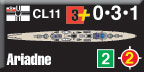
The big heavy cruisers of the Lützow class, like the Königin Luise class battleships, represent a design proposed for their Nazi equivalents but rejected for political reasons. The Hipper-class heavy cruisers built by the Nazi regime were very large ships, displacing more than half again the tonnage allowed by solemn naval armaments treaties. As designed, the class could also have been completed as light cruisers with a dozen 6-inch (150mm) gun in triple turrets if political needs dictated such a course, but their broad beam also would have allowed the fitting of wider barbettes for triple turrets bearing 8-inch (203mm) guns. That would have created a very powerful cruiser, even more if Imperial conservatism led to a less innovative but more reliable power plant than that carried by the Hipper class.
There are also some Great War veterans present in the cruiser force, though these would not have been completed before the Wilson peace offer that ended the First World War in our projected history. The hull numbers aren't in sequence as some class member would have been stationed overseas in the Kaiser's colonial dominions; maybe someday we'll get to cover those is gamers like this approach. Anyway, these ships are modernized versions of the Cöln class light cruisers, rebuilt similarly to contemporary British D-class cruisers.
And then there are the modern light cruisers, large ships with a long cruising range in keeping with Germany's imperial ambitions. And in keeping the German design practice (consistent across the Imperial, Weimar and Nazi periods) these ships have a relatively light main armament compared to foreign ships of their type and size. As with the older light cruisers there are some missing hull numbers in the sequence, as others are assumed to be stationed at colonial bases to show the Imperial flag. These are based on the M-class design proposed by the Kriegsmarine but never actually constructed.
And that's it for this installment; we'll cover the rest soon.
Add these ships to your collection! Order The Kaisers's Navy today!
Mike Bennighof is president of Avalanche Press and holds a doctorate in history from Emory University. A Fulbright Scholar and award-winning journalist, he has published over 100 books, games and articles on historical subjects.
He lives in Birmingham, Alabama with his wife, three children and his dog, Leopold.
|


