| South Pacific:
Seaplane Tenders, Part One
By Mike Bennighof, Ph.D.
February 2023
 During the 1930's, both Japan and the United States looked to the seaplane as a vital component of their Pacific war plans. Naval limitations treaties, as well as expense, limited the number of aircraft carriers that either navy could field in a potential conflict. The performance gap between seaplanes and land-based aircraft had not yet widened as it would within a decade. While the Japanese built a series of sophisticated seaplane carriers to launch and recover seaplanes, the Americans favored much simpler tenders that would set up advanced bases in lagoons and inlets and service aircraft there. During the 1930's, both Japan and the United States looked to the seaplane as a vital component of their Pacific war plans. Naval limitations treaties, as well as expense, limited the number of aircraft carriers that either navy could field in a potential conflict. The performance gap between seaplanes and land-based aircraft had not yet widened as it would within a decade. While the Japanese built a series of sophisticated seaplane carriers to launch and recover seaplanes, the Americans favored much simpler tenders that would set up advanced bases in lagoons and inlets and service aircraft there.
A seaplane tender housed the aircrew aboard and included service and repair facilities (workshops, fueling stations etc.) but unlike a seaplane carrier it could not launch the seaplanes. These would take off from the water and would only be hoisted aboard the ship for servicing. American seaplane tenders did not have catapults, but did usually have large cranes and the larger vessels were intended to transport seaplanes to their forward operating areas.
The U.S. Navy's first seaplane tenders were a pair of minelayers, Shawmut and Aroostook, converted in 1919 and 1920 to support seaplanes. They provided mobile repair facilities, and Shawmut could usually be found at Guantanamo Bay. In 1920 the Navy acquired the incomplete troop transport Somme (originally named Skaneateles, but no one can pronounce ‘Skinny Atlas”) and converted her into the balloon tender Wright.
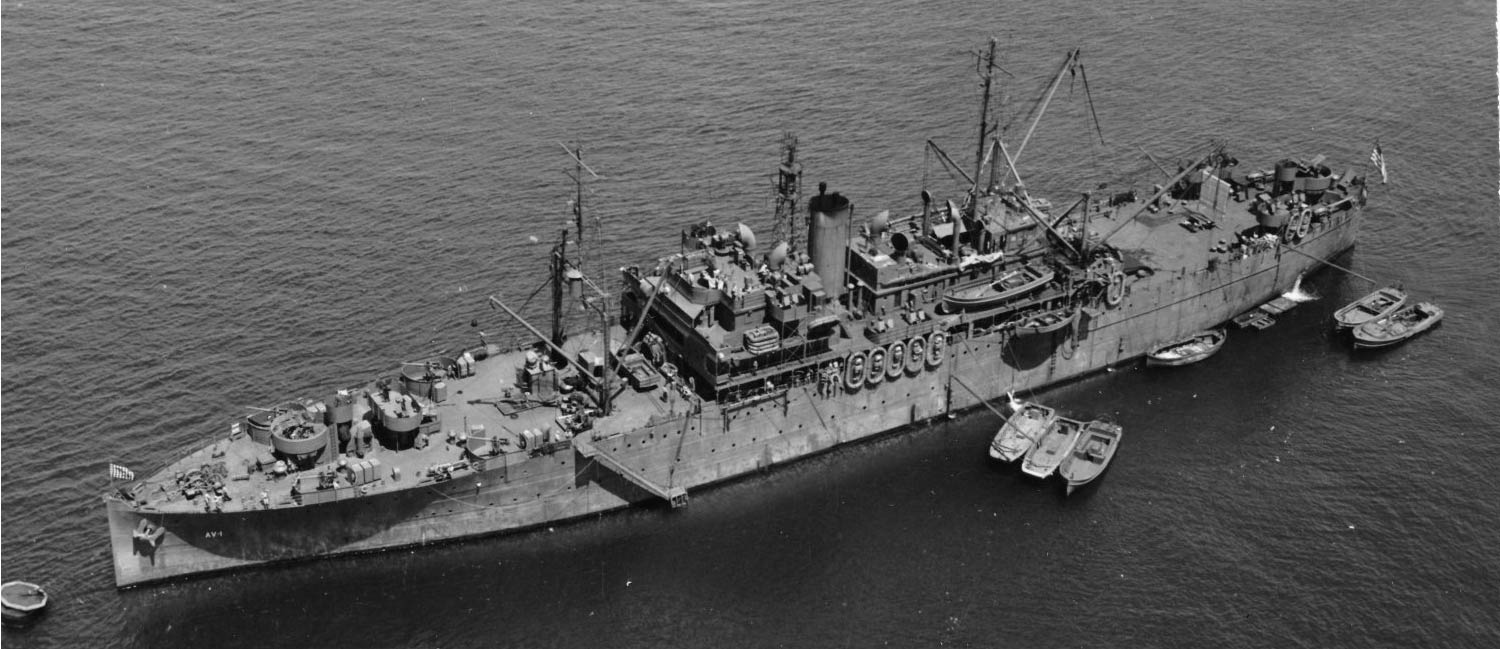
Wright seen at Espiritu Santo, September 1943.
Wright had a well deck aft for her large kite balloon, along with a tether and winch so it could be easily raised and lowered. The U.S. Navy had operated kite balloons from cruisers and destroyers during the Great War, using them to spot enemy submarines and minefields, and trained its balloonists at Goodyear Tire & Rubber’s Akron facility, where the balloons were also manufactured.
Wright commissioned in December 1921, and steamed to Guantanamo Bay for experiments with her balloon. Those didn’t provide good results, and even before she lofted her balloon the was tasked with tending seaplanes at Key West and Guantanamo Bay. In May 1922 she returned to Philadelphia Navy Yard to have her balloon gear removed; the balloon itself remained aboard until July.
Though quite slow, at just over 12,000 tons’ displacement, Wright’s size made her a very useful tender; she could service over 30 seaplanes. She spent the 1920’s and early 1930’s working with Atlantic Fleet seaplane squadrons before moving to the California coast in 1934. In the months before the Pearl Harbor attack Wright saw extensive use as a transport, bringing fuel, equipment and personnel to the string of outposts at Wake, Johnston and Midway Islands. She spent the war on similar duty, with a few breaks to tend seaplanes, before her size and comparatively comfortable accommodations led to her reclassification as a headquarters ship. After helping to bring home American troops from the Pacific theater after the war, she met the cutting torches in 1948.
During the 1930’s, Wright operated alongside a pair of Bird-class minesweepers (also called the Lapwing class) that also tended seaplanes. That experiment worked well, and nine ships (out of the class of 49) underwent conversion, their sweeping gear removed to make way for aviation gear but few changes to their armament.
As converted, the former minesweepers lacked the space to provide all the facilities a seaplane squadron required. The retained their armament (a pair of three-inch guns) and like all American warships added additional 20mm light anti-aircraft guns during the course of the war. One of these small ships, Heron, appears in South Pacific.
The approach of war with Japan, and the Navy's relative lack of aircraft carriers, sparked a program of small seaplane tenders in the mid-1930's. In addition to the minesweeper conversions, the Navy converted fourteen flush-deck destroyers, most of them laid down during the First World War but having seen limited use during and after that war. They still had a good deal of service in their hulls and machinery, even if their design and armament wasn’t up to modern standards. That made them very attractive for conversions; other hulls became destroyer-transports, destroyer-minelayers and destroyer-minesweepers.

Destroyer-Tender Ballard seen in December 1943.
The former destroyers lost their two forward stacks (leaving two still intact), their two forward boilers with the associated fuel tanks, their torpedo tubes, the two 4-inch guns mounted at the waist and their 3-inch anti-aircraft gun. The former boiler room became stowage for 50,000 of aviation fuel, and the forward superstructure was extended aftward to provide accommodations for the additional personnel assigned to aircraft maintenance and operations. They also received additional ships’ boats, mounted on davits, to help service seaplanes. Finally, a crane was added to lift seaplanes onto the aft deck.
They could make 23 knots on their reduced engine power, and retained an anti-submarine capability with a depth-charge track and a pair of projectors. Though often used for escort duty, that massive store of avgas probably made this a bad idea. Ballard was present at Midway, on picket duty, and rescued 35 Japanese sailors; Ballard and Thornton frustrated Japanese attempts to use French Frigate Shoals as a refueling point for their own seaplanes. Hulbert was present at Pearl Harbor and shot down a Japanese torpedo bomber.
The Navy also converted its first aircraft carrier, Langley, in a seaplane tender in 1936. That would allow the United States to build another carrier, Wasp, and remain under naval limitations treaty limits. Those limits would be abandoned within weeks of Langley’s re-commissioning in her new role, but there seem to have been few regrets over taking the “Covered Wagon” out of service as a carrier, even in the training mission.
Langley, too slow for operations even with the fleet’s battleships, thrived in her new role. The large former flight deck provided ample work space for the maintenance crew, which made her popular with aircrew. She could tend up to 55 seaplanes (she’d carried a maximum air group of 36 planes in her old guise) and provide much more in the way of spare parts, stores and fuel. She went to the Philippines in September 1939, and would be sunk by the Japanese during their assault on the Netherlands East Indies.
Converting old ships gave the Navy some seaplane capability, but not nearly as much as it desired. For that, new ships would be needed both large and small. We’ll look at those next time.
You can order South Pacific right here.
Sign up for our newsletter right here. Your info will never be sold or transferred; we'll just use it to update you on new games and new offers.
Mike Bennighof is president of Avalanche Press and holds a doctorate in history from Emory University. A Fulbright Scholar and NASA Journalist in Space finalist, he has published a great many books, games and articles on historical subjects; people are saying that some of them are actually good.
He lives in Birmingham, Alabama with his wife and three children.
Want to keep Daily Content free of third-party ads? You can send us some love (and cash) through this link right here.
|