The Emperor’s Sword:
The War Begins
by Mike Bennighof, Ph.D.
December 2025
 The Long War in the Pacific broke out in December 1943, the almost inevitable culmination of five decades of imperial competition between the United States and the Japanese Empire. The quasi-religious fervor of Manifest Destiny brought the American republic to the western shores of the Pacific Ocean. Alaska would be the last territory acquired, purchased from the Russian Empire in 1867. But American missionaries and traders foresaw the Pacific not as a barrier, but a highway. The American dream would cross the broad ocean. The Long War in the Pacific broke out in December 1943, the almost inevitable culmination of five decades of imperial competition between the United States and the Japanese Empire. The quasi-religious fervor of Manifest Destiny brought the American republic to the western shores of the Pacific Ocean. Alaska would be the last territory acquired, purchased from the Russian Empire in 1867. But American missionaries and traders foresaw the Pacific not as a barrier, but a highway. The American dream would cross the broad ocean.
Across the Pacific, the newly-revived Japanese Empire had its own imperial dreams. Okinawa came under Imperial rule in 1879, the start of a relentless expansion. In 1893, Queen Liliu’okolani of Hawai’I placed her kingdom under Japanese protection to forestall an American-backed coup attempt. The islands became a destination for Japanese emigrants, and the Imperial Navy erected a large base in the wide estuary of the Pearl River.
Note: In our own history, the queen did not act fast enough to obtain the protection she sought. Another crisis in 1897 likewise failed to bring Hawaii under the Rising Sun, and the islands would be annexed by the United States in 1898. This was probably the more unlikely outcome, but it’s the one that happened.
Japan gained Taiwan in 1895 as a result of the Sino-Japanese War, and three years later extended a protectorate over the newly-declared Philippine Republic at the request of its president, Eduardo Aguinaldo. Japan paid an indemnity to Spain, officially as compensation for Spanish military installations taken over by the Japanese, and extended free trading rights and missionary access in the islands to the United States to ease hurt feelings there. Afterwards, the Japanese purchased the remaining Spanish possessions in the Pacific: the Mariana, Caroline, and Marshall island chains.
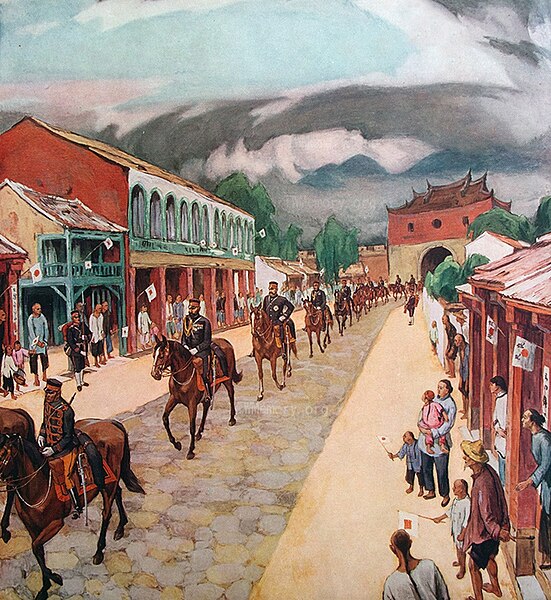
Japanese troops occupy Taipei, Taiwan.
7 June 1895. |
Growing Japanese power helped bring about the Anglo-Japanese Alliance of 1902. The accord brought enormous prestige to the Empire. Britain also ceded the colonies of Borneo and Brunei to Japan, and agreed to Japanese annexation of the independent state of Sarawak, then ruled by the “White Rajahs” of the Brooke family. The Japanese for their part opened their rapidly-growing shipbuilding industry to British investment, and secretly undertook not to purchase warships from rival nations.
The Russo-Japanese War ended in 1905 with Japan firmly in control of Korea. The Russians paid a large cash indemnity, and also turned over all of their assets in Manchuria including their naval base at Port Arthur, the Chinese Eastern Railway and the South Manchurian Railway. Japan also acquired all of the large island of Sakhalin immediately north of Japan and the Kamchatka Peninsula, a desolate and empty region holding strategic significance in case of conflict with the United States.
Note: Except for Kamchatka, these were the Japanese delegation’s war aims during the conference that led to the Treaty of Portsmouth ending the Russo-Japanese War. The Russian team out-maneuvered the Japanese, who only achieved some of their goals. In our new reality, the Japanese get what they want and then some.
Japan poured the Russian reparations into a renewed naval building program, part of an arms race in the Far East as the Chinese Empire sought to rebuild its own naval strength and the Russians built new ships as well. The outbreak of the First World War saw Japan occupy the German colony at Tsingtao in 1914, and a year later the Japanese presented their Twenty-One Demands to the Chinese. With the European powers distracted by war, Japan's leaders hoped to gain virtual control over Chinese communications and the Chinese economy without sparking antagonism with other foreign powers. They did not expect such a strong military response from the Chinese.
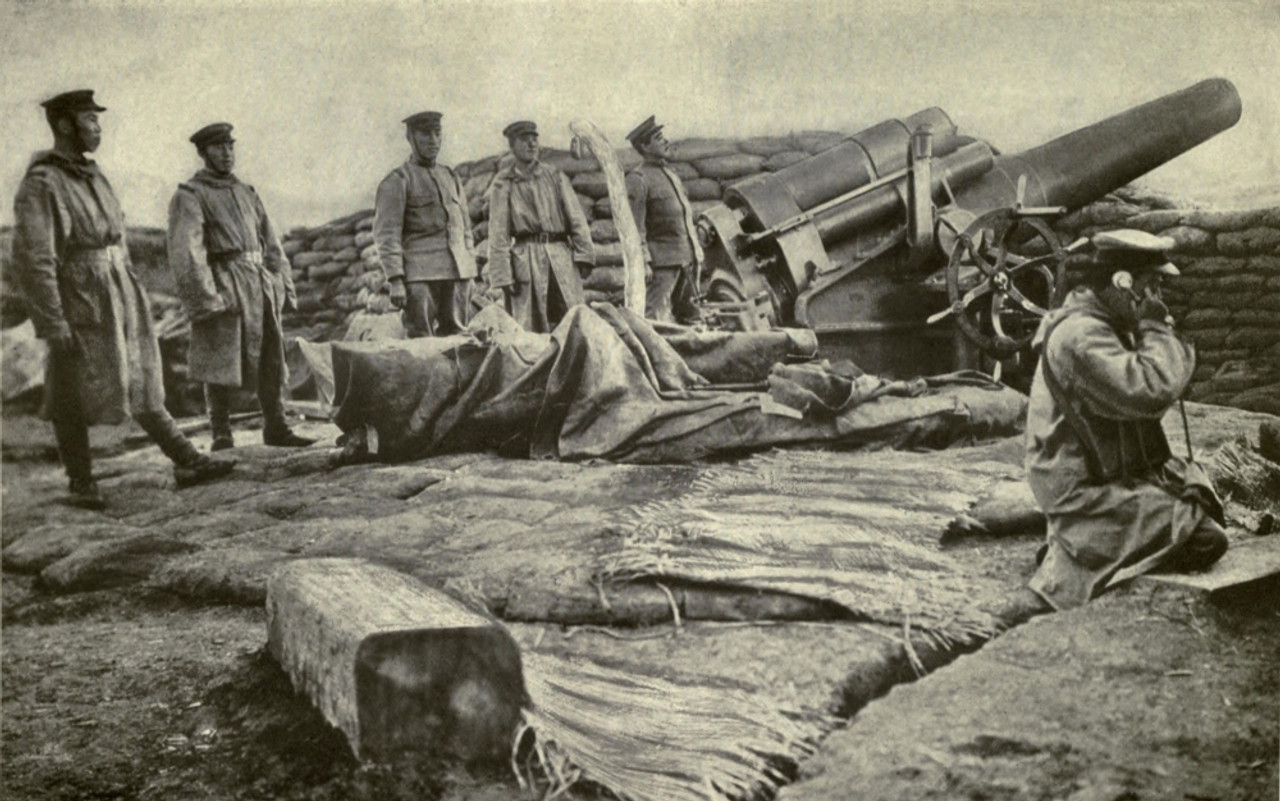
Japanese heavy artillery outside Tsingtao. November 1914.
The Chinese fought resolutely in the so-called War of the Dragon, but lacked the industrial infrastructure to supply a modern army and navy. With all of their traditional suppliers’ output of arms and ammunition going to their own forces, China could not obtain desperately-needed military supplies. Valor was no substitute for bullets, and eventually the Chinese Empire had to make peace.
Note: In our reality, the Japanese wasted much of their reparation haul in rebuilding captured Russian battleships; the Chinese plans to build a modern dreadnought fleet ran hard aground on the shoals of corruption. We tell the story of the War of the Dragon in our Great War at Sea: Rise of the Dragon book. That tale includes a second chapter involving American intervention, but that does not happen here.
Japan annexed Manchuria and Shandong outright and took over the surviving ships of the Imperial Chinese Navy. The Japanese also gained enormous leverage over the Chinese economy, including the police force, railroads and ports. A brief naval war with the revived Russian Far Eastern Fleet followed, resulting in the defeat of the Russians and a British-brokered cease-fire. Japan’s gains were confirmed, and a large Japanese expeditionary army as well as a squadron of modern battle cruisers were dispatched to the European theater in exchange.
Japanese aid did not hasten the end of the Great War; the eight Japanese divisions and their supporting units were diverted to Salonika in northern Greece, where they spent the remainder of the war staring at the besieging Bulgarians and waiting for the Allied joint command to take decisive action. At the peace table the Allies confirmed Japanese possession of the German colony in Shandong and, to the great consternation of Australia and New Zealand, German New Guinea and Samoa as well. Britain and France desired large-scale Japanese participation in their planned intervention in the ongoing Russian Civil War, and they got it.
Japanese troops occupied all of the Russian Far East as far west as Lake Baikal, but this did not save the White movement. At the end of the intervention the Japanese refused to depart from the Russian Maritime Province, known to the Chinese as Outer Manchuria and ruled by the Chinese Empire until 1860. Prompted by their Japanese masters, the Chinese Republic denounced the Peking Convention which had ceded the territory to Russia, and transferred the area to the Japanese instead.
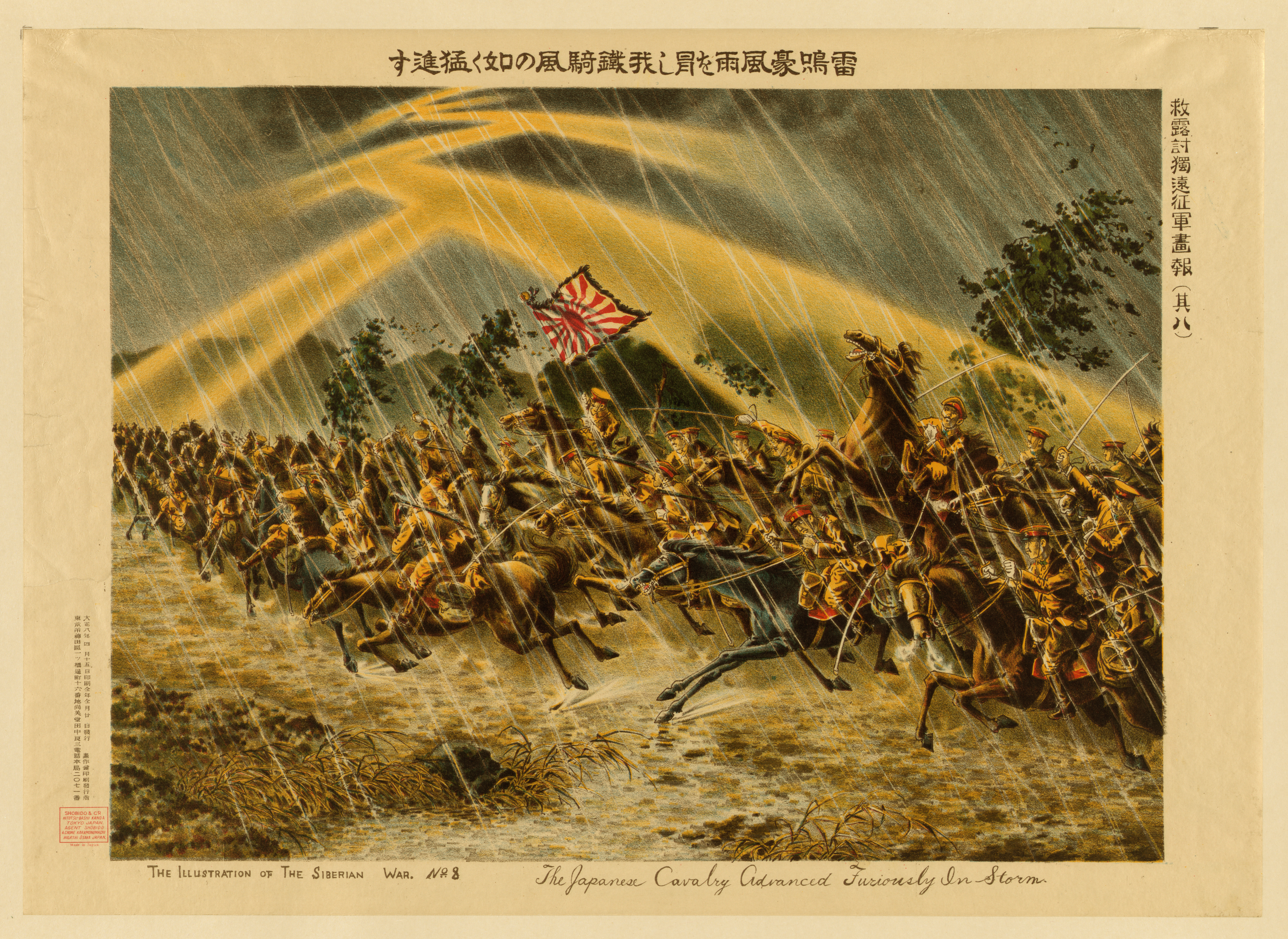
Japanese cavalry advances in Siberia, 1919.
Note: The Japanese did occupy Siberia as described here and a few extremists had hopes of retaining the Maritime Province, but Japanese forces withdrew in 1922, having suffered over 5,000 casualties from the 12,000 men deployed there.
By 1922 the Japanese Empire stretched from the northern border of Kamchatka southward to the northern coastline of Borneo. On the Asian mainland both Manchuria (including Outer Manchuria) and Korea had been fully incorporated into the Empire, as had Taiwan and Hawai'i. The Philippines, Marianas and the territories on Borneo followed in 1931. Russia, and its successor state the Soviet Union, no longer rated as a Pacific power, retaining only the isolated port of Magadan on the oft-frozen Sea of Okhotsk.
Within these new territories, the Japanese followed a program of assimilation modeled on that undertaken by France at the end of the previous century. Schools taught only in Japanese, and universal conscription introduced young men to the Japanese language and to Japanese culture, and taught reverence for the Emperor.
Note: This did not become Japanese policy until the very eve of World War II, by which time it was much too late to make any difference in the attitudes of Japan’s subject peoples toward the Empire.
By 1940, the Japanese Empire had a population of 153 million people: 73 million in Japan itself including Okinawa and Sakhalin, 24 million in Korea, 33 million in Manchuria including Outer Manchuria, 16 million in the Philippines, six million in Taiwan and about a million in the other prefectures combined. By contrast, the United States totaled a population of 132 million that year. Despite the Japanese advantage in population, the United States maintained a larger gross domestic product and higher standard of living. But the Japanese were closing the gap.
Fueled by the discoveries of huge oil deposits in Brunei, Manchuria and Shandong, the Japanese economy grew steadily between 1920 and 1940. Japanese policy maintained a strict tariff wall around both the Empire itself and its Chinese dependency, provoking continued tension with the European powers and particularly with the United States. Only British firms, and those from the British Dominions, had access to these vast markets.
Note: The vast oilfields of Manchuria would not be discovered until 1959 in our own history; the Shengli field in Shandong was actually discovered two years later.
Economic growth allowed heavy spending on the Empire's armed forces, with a huge buildup of naval forces. Japan achieved equality with the United States and Great Britain at the Washington Naval Conference of 1922; at American insistence, the treaty also brought a formal end to the already-fading Anglo-Japanese Alliance. The Japanese would decline to sign the London Treaties of 1930 and 1936 extending the “naval building holiday.” Many Japanese leaders feared that they would face an Anglo-American combination in a future war, and the Empire needed to expand its fleet to prepare.
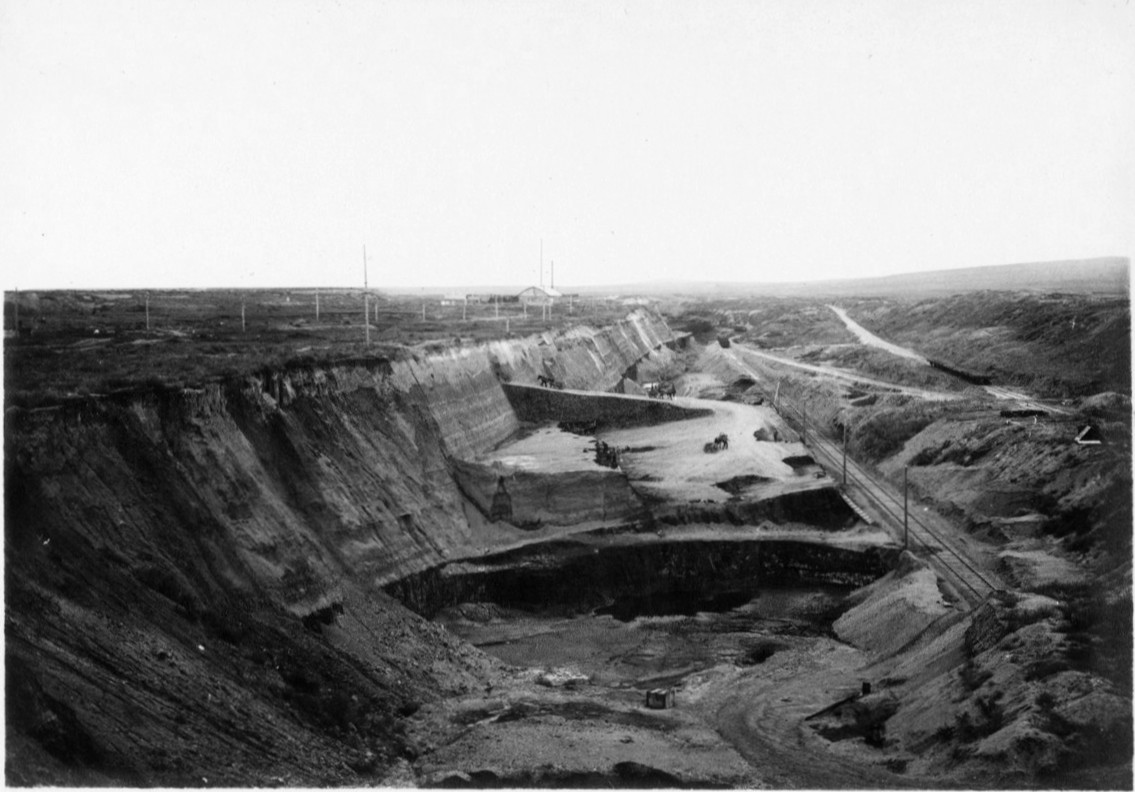
The massive Dalai Nor coal mine in north-eastern Manchuria.
Some American politicians pointed to Japan’s control of Chinese trade as a major obstacle to American economic growth. All of the problems of the Great Depression and its aftermath could be solved, they claimed, if American firms had access to the 530 million consumers of the Chinese marketplace and could compete with Japanese firms within the Empire itself. The Japanese steadily refused and curtailed American privileges in the Philippines despite the 1898 treaty.
Among U.S. citizens, many came to believe their demagogic politicians and blame the Japanese for their misery: the Dust Bowl, massive unemployment, bank failures and more were laid at the feet of the Chrysanthemum Throne. It is, after all, far easier to blame others than to look within, and a man who offers easy answers to the price of eggs will gain a following among the weak-minded and easily-led. The 1940 election saw both candidates – Democrat Paul McNutt of Indiana and Republican Wendell Willkie of New York - advocate increased confrontation with Japan over the trade question. McNutt won the presidency with what he and his party considered a mandate for war. The new president pressed the Japanese to open their closed markets, deploying a mix of threats and inducements.
The Japanese, for their part, found the American demands insulting: the Americans wanted access to China, but would not grant Japanese suppliers the same entry into the American economy. With Britain struggling against the huge German “Plan Z” fleet and likely facing defeat, it became obvious that an Anglo-American naval combination need not be feared in the near future even if Britain somehow survived. The Emperor's Cabinet announced in the summer of 1943 that American trade privileges in the Philippines not only would not be extended to China or the rest of the Empire as McNutt demanded, but ended entirely. Negotiations lasted for months, but made no progress with neither side seeing a need to compromise. McNutt requested a declaration of war against the Empire of Japan on a Tuesday morning, December 7th 1943, a motion carried by a narrow majority.
Order The Emperor’s Sword Here.
Please allow an extra six weeks for delivery.
Sign up for our newsletter right here. Your info will never be sold or transferred; we'll just use it to update you on new games and new offers.
Mike Bennighof is president of Avalanche Press and holds a doctorate in history from Emory University. A Fulbright Scholar and NASA Journalist in Space finalist, he has published an unknowable number of books, games and articles on historical subjects.
He lives in Birmingham, Alabama with his wife and three children.
Want to keep Daily Content free of third-party ads? You can send us some love (and cash) through this link right here.
|