Midway:
Lex and Sara, Part One
by Mike Bennighof, Ph.D.
October 2025
 The United States Navy lusted for its own battle cruisers as soon as the Royal Navy first debuted the type in 1906. But projects for “battle scouts” collapsed thanks to incompatible demands: the largest possible guns, a speed much faster than foreign ships of the same type, and armor capable of repelling shells equivalent to the ship’s own main armament. The United States Navy lusted for its own battle cruisers as soon as the Royal Navy first debuted the type in 1906. But projects for “battle scouts” collapsed thanks to incompatible demands: the largest possible guns, a speed much faster than foreign ships of the same type, and armor capable of repelling shells equivalent to the ship’s own main armament.
The six battle cruisers of the Lexington class, approved in May 1919 after years of war-induced delays, had been designed as the American equivalents of the British Hood class. They were gigantic ships, with powerful armament (eight 16-inch guns) and high speed (33 knots, reduced from 35 knots to allow for more protection). Armor, though less extensive than that of recent American “standard” battleships, was considered adequate in light of the lessons from the May 1916 Battle of Jutland.
The battle cruisers initially formed part of the massive 1916 building program that included six battleships and ten light cruisers, plus a whole flock of destroyers, submarines, and auxiliaries. Woodrow Wilson revived the program after the War to End Wars, as tensions rose with Japan, Britain, and Italy over the shape of the peace to come.
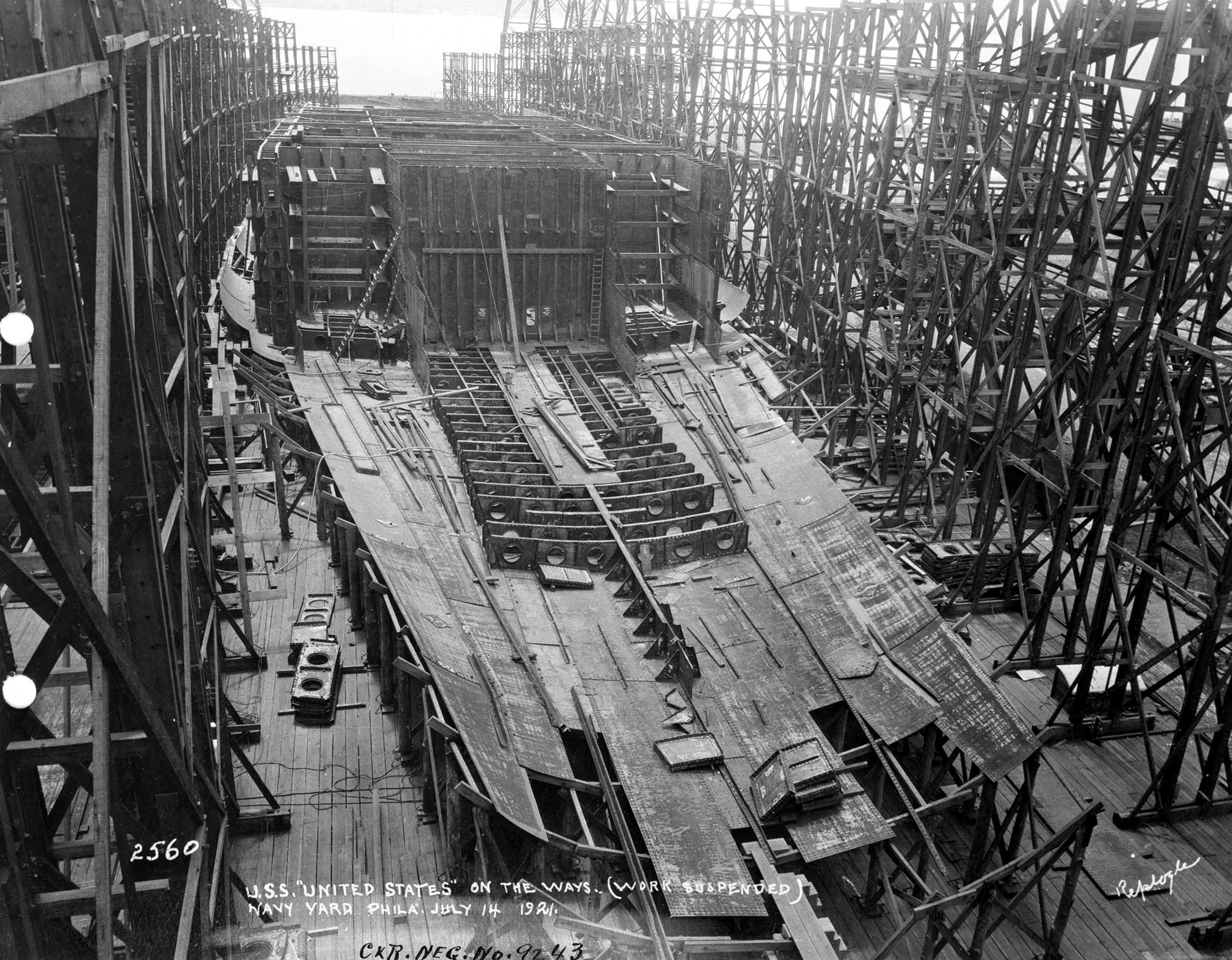
As far as work ever progressed on the battle cruiser United States.
Warren G. Harding, Wilson’s successor, didn’t want to pay for the big ships. When Idaho Sen. William Borah proposed an international naval disarmament conference, Harding swiftly embraced the idea. To sweeten the deal for the British and Japanese, the Americans offered to scrap or cancel many more capital ships than the total asked of either of the other major naval powers. The conference opened in November 1921, concluding in February 1922.
Unease at the enormous cost of six such ships, and at the thought of sinking that investment into a radically new type of ship, made it easier to negotiate them away during the Washington naval limitations talks. The final treaty allowed the United States and Japan to convert two of their incomplete battle cruisers into aircraft carriers; Britain could convert three small battle cruisers while France and Italy could also make two conversions each (the French made just one, and the Italians never exercised their option).
In late 1917, the Royal Navy sent naval constructor Stanley V. Goodall on detached duty to the Bureau of Construction and Repair, bringing with him the plans of the latest British designs including the new aircraft carriers. Goodall suggested a 22,000-ton carrier, but his American colleagues thought much bigger, in the range of 30,000 tons. By 1919, the Navy’s General Board wanted a carrier capable of operating a reasonably large number of aircraft in all weather, and act as aircraft depot ship for the battleships and cruisers in its squadrons, and finally to make 35 knots like the battle cruisers, light cruisers, and destroyers of the now-reborn 1920 (formerly 1916) program.
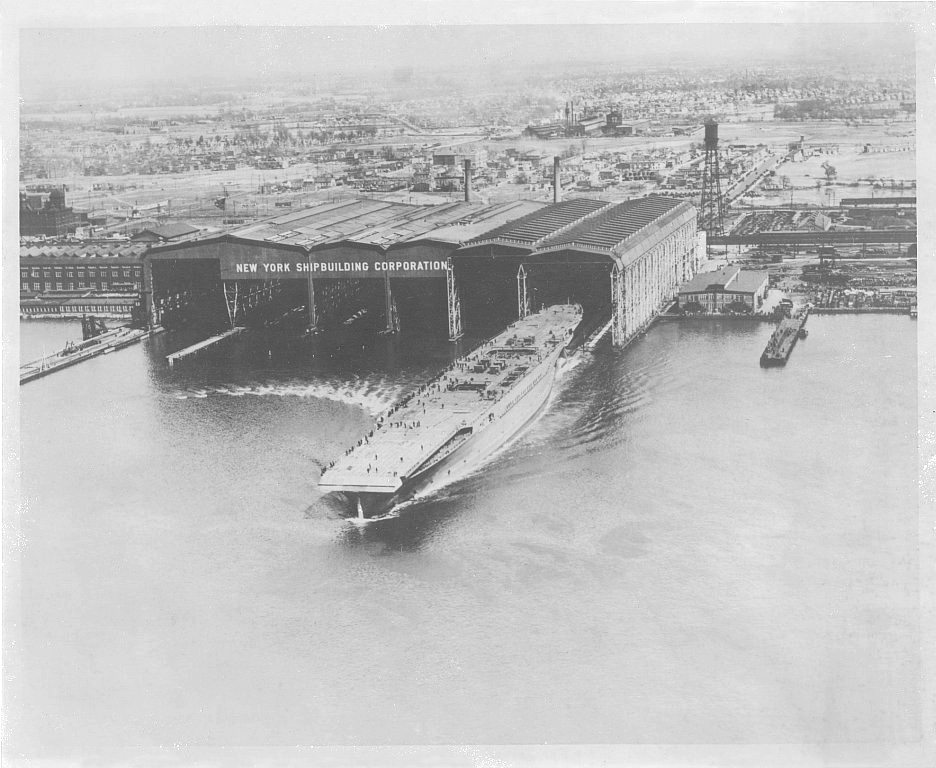
Saratoga is launched. 7 April 1925.
Charged with drafting the ship, which the General Board hoped to include in the 1920 program, the Preliminary Design office started with the hull of the new battle cruiser, at this point still Design 169 with ten 14-inch guns and displacing 34,800 tons. The carrier would have four 8-inch, six 6-inch, and four 4-inch guns, and two torpedo tubes. She would have her own air group of 30 planes, plus the capacity to carry and service up to 15 more from battleships and cruisers. She would be a big ship, displacing 29,000 tons; later studies took that up to 39,000 tons. The designers used the battle cruiser hull as a shortcut in what was a feasibility study; they did not expect a battle cruiser hull to actually be available. But in July 1921, well before the Washington conference opened, the General Board told Preliminary Design to start drafting potential conversions of the battle cruisers now under construction. The studies showed that a very capable carrier could be built on a battle cruiser hull, but a better one could be built from the keel up.
Those studies gave the Bureau of Construction and Repair a generous head-start over their Japanese rivals, though the British of course had been operating carriers for years at this point. The studies also informed the American negotiating position, especially in regards to maximum tonnage allowed for the carrier conversions.
The U.S. Navy selected the two most advanced battle cruisers for conversion, Lexington and Saratoga. Newport News Shipbuilding took a serious gut-punch, losing contracts for two battle cruisers and two South Dakota-class battleships. Lexington was still on the slipway at Fore River in Massachusetts, and Saratoga at New York Shipbuilding’s yard in Camden, New Jersey, when conversion work began in July 1922. The Preliminary Design staff also looked at converting the least-advanced battle cruiser, Ranger, which was estimated at 2.5 percent complete – a keel laid, and some steel procured but not assembled. The funding for Ranger could be used for the carrier, the keel dis-assembled, and the ship built from the keel up as a much larger carrier than the treaty otherwise would allow while still calling it a “conversion.” The treaty’s wording certainly allowed such an interpretation, but it would have made for a more expensive (though much more capable) ship.
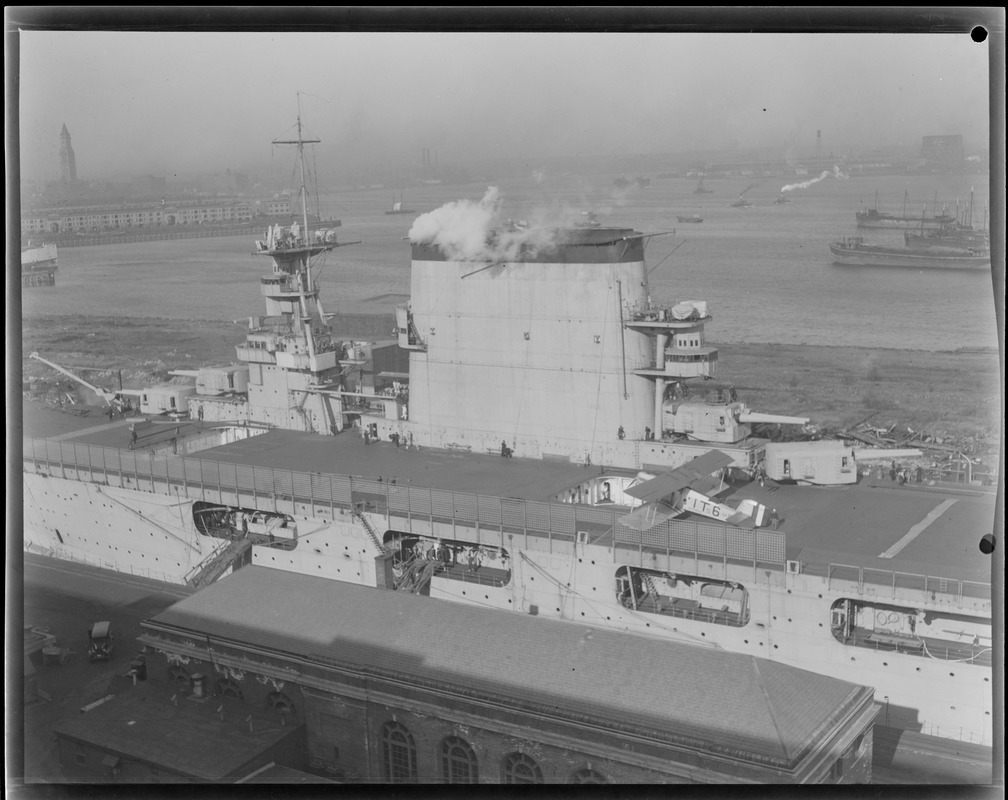
The newly-completed Lexington, seen at Boston, 18 January 1928.
The treaty’s original language allowed the conversions to displace 33,000 tons; the designs went well over that and the Americans lobbied for an increase. As a compromise, another 3,000 tons of armor and blisters (extensions fitted alongside the hull to lift it out of the water and thus restore buoyancy) could be added during modernization. The new carriers simply added the extra weight from the start, but even then, they came right up to the edge of the weight limit.
The early designs struggled with the issue of what to do about the massive amounts of smoke generated by the huge power plants inherited from the battle cruiser design (the Japanese conversions shared this problem). Solutions included a hatch in the flight deck that would be closed during air operations, and opened when the planes weren’t landing or taking off, and large, simple vents in either side of the ship.
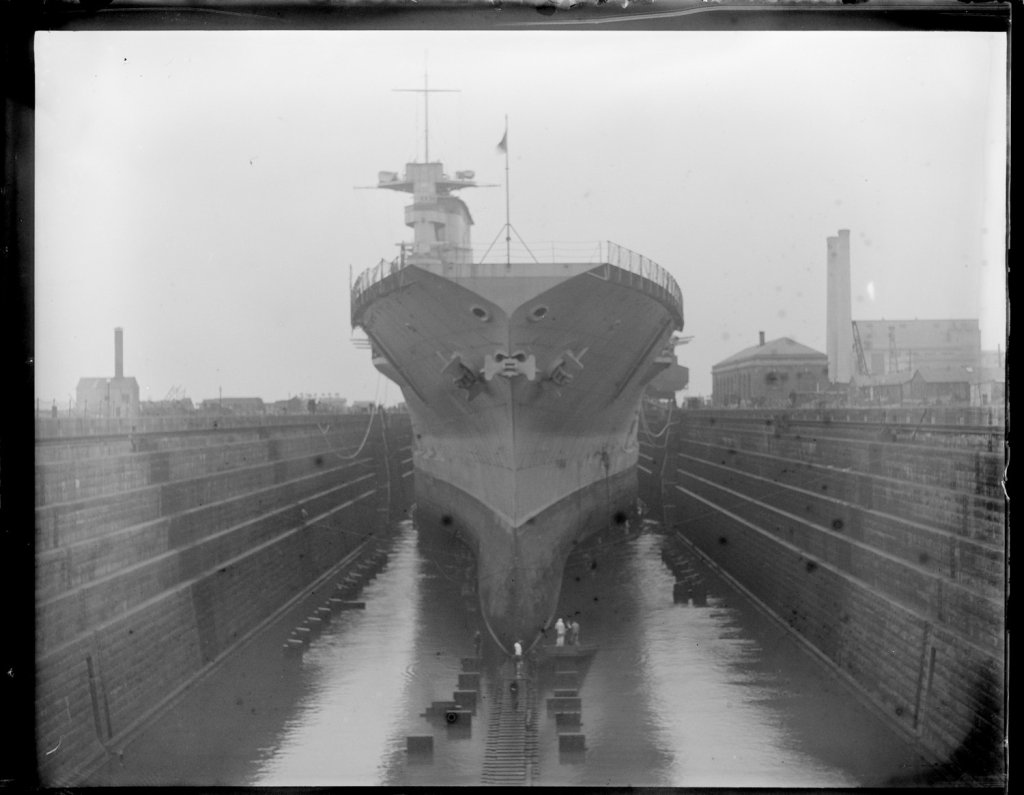
The bulbous bow of Lexington. January 1928.
The designers eventually went with a single huge, very tall funnel on the starboard side of the flight deck, just aft of the small island structure. This would waft the fumes away well above flight-deck level. It also greatly unbalanced the ship. To correct that, the carriers would carry 6,795 tons of fuel oil, but only 5,500 tons would be usable – the rest would be kept in port-side tanks as ballast. By using fuel oil rather than more common ballasts (concrete or pig iron), the designers evaded the treaty restrictions on displacement – fuel oil did not count toward the maximum allowance.
The design retained the battle cruiser hull, including its bulbous bow which improved speed but also threw up a sizeable bow wave. She would have eight 8-inch guns in four twin gunhouses; a last-minute change moved the aft gunhouses from an awkward spot a level below the flight deck up onto the flight deck itself, just behind the gigantic funnel. That allowed a flight deck 84 feet rather than 60 feet wide; the latter would have made aircraft landings hazardous. Even with that change, Lexington and Saratoga had a relatively narrow flight deck for their size, a legacy of their battle cruiser origins. Unlike later purpose-built carriers, their hangar deck formed part of the hull and therefore was fully enclosed, and the flight deck also served as the ship’s strength deck. Following the conventions of early 1920’s naval architecture, the fuel and gasoline tanks were firmly embedded in the ship’s structure, meaning that shocks would be transmitted to them in the event of battle damage or collision – this feature would doom Lexington at the Battle of the Coral Sea.
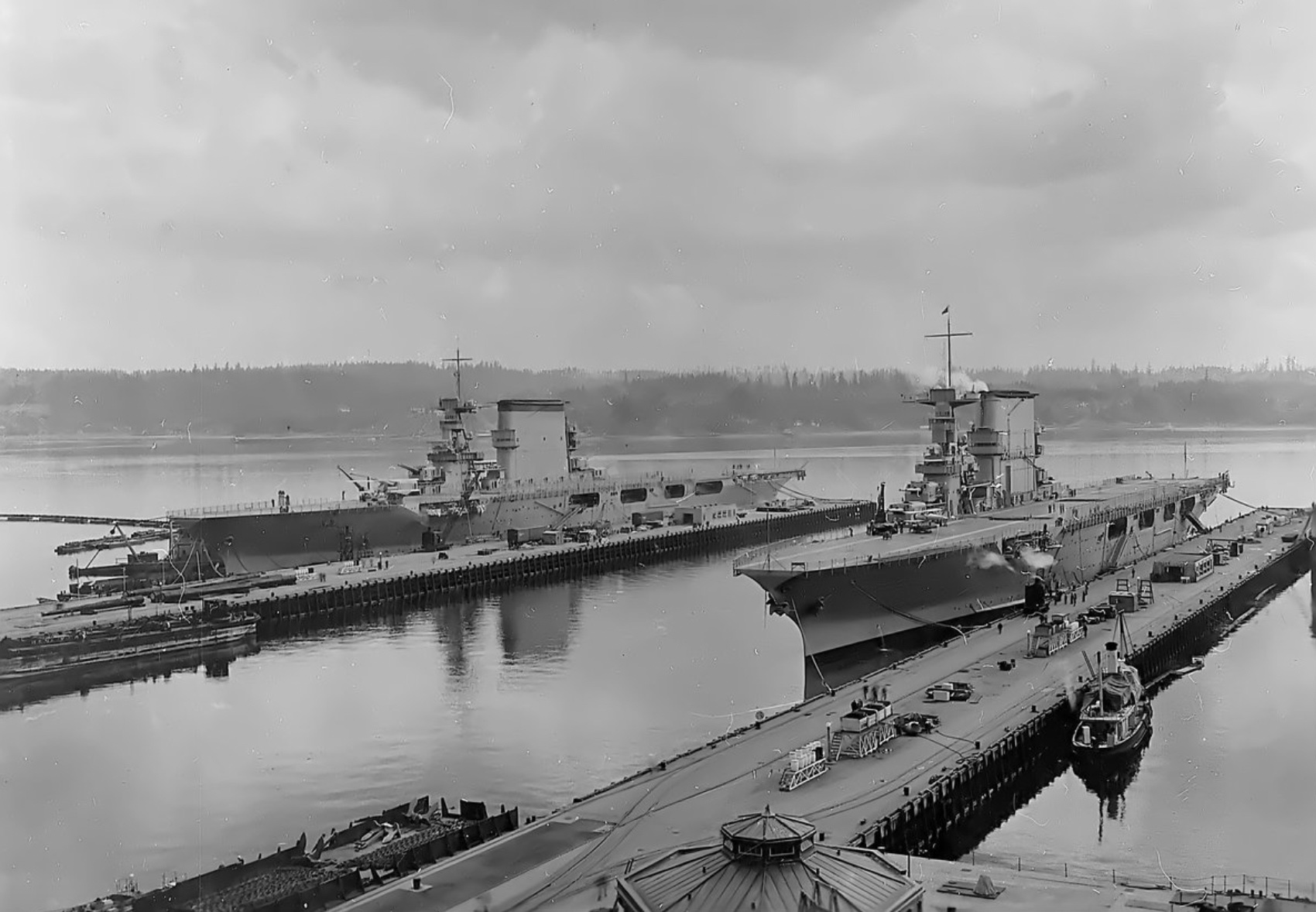
Lexington (left) and Saratoga, Puget Sound Navy Yard, 22 September 1928.
That enclosed hangar limited the air group to 72 planes; the first purpose-built carrier, Ranger, came in much smaller than the two ex-battle cruisers and displaced much less than half the tonnage of the big ships, yet she operated 76 aircraft. The annual Fleet Problem exercises held through the 1930’s showed that hangar capacity meant far less than operational capacity. The big carriers could mass more planes on their flight deck and launch them, and could do so in much rougher weather than could smaller carriers like Ranger. Lexington and Saratoga had a much taller hangar than later carriers; as bigger and more powerful aircraft came into service, they had no trouble accommodating them. Spare aircraft could even be dangled from the girders above the hangar. Both ships had a flywheel catapult early on, but it was removed in 1934. Throughout their service life, aircraft took off under their own power.
The 8-inch battery, intended to fight enemy cruisers, could only fire to the starboard side though the Navy claimed it could engage targets in either direction. If fired across the flight deck, the blast effect would likely have blown off the wooden planking and rendered the ship unable to operate aircraft, making this a contingency for the direst need only. In addition to the big guns, the ships initially carried an anti-aircraft battery of a dozen 5-inch guns in single mounts, placed in galleries on either side of and just below the flight deck. These guns could not fire across the deck, either. As commissioned, the ships carried no light anti-aircraft armament at all; this would be rectified in a series of refits, starting with .50-caliber machine guns mounted in 1934. Both received constant upgrades to their anti-aircraft suite; Lexington still retained more than 20 machine guns when sunk in 1942, but Saratoga traded hers in for more-powerful 20mm and 40mm automatic cannon. Until very late in the design stage the plans still included a pair of underwater torpedo tubes mounted aft, but these were deleted before construction work began.
Order Midway Here.
Pacific Inferno
• Midway
• Midway: Aftermath
• Midway: Rising Sun
• SWWAS: Islands
• Journal 42: Battleship-Carriers
Retail Price: $200.95
Package Price: $160.00
Gold Price: $128.00
Ignite the Inferno Here.
Gold Club members can apply their standard discount.
Sign up for our newsletter right here. Your info will never be sold or transferred; we'll just use it to update you on new games and new offers.
Mike Bennighof is president of Avalanche Press and holds a doctorate in history from Emory University. A Fulbright Scholar and NASA Journalist in Space finalist, he has published a great many books, games and articles on historical subjects; people are saying that some of them are actually good.
He lives in Birmingham, Alabama with his wife and three children. He misses his lizard-hunting Iron Dog, Leopold.
Daily Content includes no AI-generated content or third-party ads. We work hard to keep it that way, and that’s a lot of work. You can help us keep things that way with your gift through this link right here.
|