| Midway Deluxe Edition:
Japanese Battleship Pieces
By Mike Bennighof, Ph.D.
June 2023
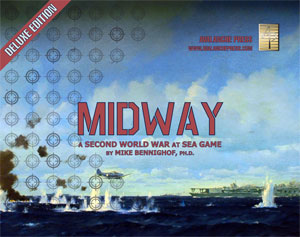 Throughout the early months of the Pacific War, up until the Battle of Midway, Japan’s naval striking power lay with the six heavy carriers of the First Air Fleet. Afterwards, of course, Japan found herself decidedly short of naval striking power. But in the years before the war, some of her admirals still clung to the notion that the battleship retained an important place in the war at sea. Throughout the early months of the Pacific War, up until the Battle of Midway, Japan’s naval striking power lay with the six heavy carriers of the First Air Fleet. Afterwards, of course, Japan found herself decidedly short of naval striking power. But in the years before the war, some of her admirals still clung to the notion that the battleship retained an important place in the war at sea.
There don’t appear to have been many such admirals, and they had little influence; mostly they seem to be (namelessly) cited in popular histories as straw men. Among those whose opinion counted, the aircraft carrier already had pride of place. That’s obvious by the amount of effort poured into training carrier and cruiser crews against that given the battleship men - Japanese battleship gunners received little practice, a lack reflected in their abysmal shooting.
Nevertheless, all of Japan’s operational battleships sortied as part of the Midway/Aleutians operation. None of them saw any surface action; only two of the fast battleships even saw enemy airplanes (which were far more interested in attacking the carriers than bombing the battleships). All of them appear in Second World War at Sea: Midway Deluxe Edition, so let’s have a look at them and their brand-new artwork.
The Fast Battleships
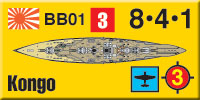
The battle cruiser Kongo, Japan’s last major warship built in a foreign shipyard, created an international stir when completed. She was huge, powerfully armed and very fast, with beautiful lines similar to those of her near-sister, the British battle cruiser Tiger. Three sisters were built in Japanese shipyards, and the Royal Navy begged unsuccessfully for their loan during the Great War.
Impressive as they appeared on paper and in naval reviews, they carried a number of hidden flaws. Their armor, like that of British battle cruisers, was woefully inadequate and they were extremely vulnerable to underwater damage. Torpedo bulges were added in the 1920’s which helped with the latter but slowed them considerably, and they were re-classified as battleships.
Three of them were modernized in the early 1930’s (the fourth had been de-militarized as a training ship to comply with international naval limitations agreements), but just a few years later the Imperial Navy decided to completely rebuild all four as fast carrier escorts. They were lengthened and received new boilers and turbines, thicker armor, new anti-aircraft armament, seaplane catapults and had their main armament modified to allow firing at a higher angle, thus improving the big guns’ range. When completed they could make 30 knots, plenty of speed to keep up with the carriers, and while they carried a modern anti-aircraft suite their job was to protect the carriers from surface attack.
All four participated at Midway and in the Pearl Harbor attack; two would be lost in the Solomons. Late in the war one would be torpedoed and sunk and the final survivors sunk at her moorings in the last weeks of the war by American aircraft.
The Super-Dreadnoughts
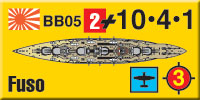 
According to some naval historians, Japan’s first dreadnoughts weren’t even dreadnoughts, since they carried two different calibers of 12-inch gun. When the Imperial Navy laid down Fuso in 1912, no one could mistake her credentials. The big new ship displaced 29,000 tons and carried a dozen 14-inch guns in six twin turrets, intended to out-class the contemporary American New York class. Fuso completed in 1915 and her sister Yamashiro two years later.
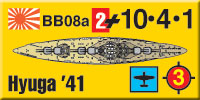
Initially the Imperial Navy planned to repeat the Fuso design with three more ships, but initially only Yamashiro received funding. By the time the money came through for the remaining ships, a much-improved design had been prepared that re-distributed the amidships turrets and allowed for better protection of the magazines. Ise and Hyuga completed in late 1917 and early 1918, but none of the four were deployed to Europe for service in the Great War.
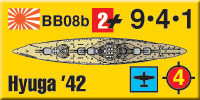
During the 1930’s they received radical reconstructions, improving their protection and most importantly installing completely new power plants that raised their speed to 25 knots. All four sortied for the Pearl Harbor strike, but remained far behind the First Air Fleet and were in little danger of encountering American surface forces. All four also took part in the combined Midway/Aleutians operation, deployed between the two strike forces where they could not have intervened to support either main force until days had passed.
Ise and Hyuga were converted to hybrid battleship-carriers after Midway, and somehow survived American air attacks during the operations off the Philippines in late 1944, with Ise successfully dodging 11 torpedoes. Both were sunk at their moorings by American air attacks in July 1945 and scrapped after the war.
Fuso and Yamashiro were considered unsuitable for similar conversions due to their turret layout, and were relegated to secondary duties after Midway. In October 1944 both were activated for the Combined Fleet’s October 1944 operations in the Philippines where both were sunk by American destroyer torpedoes.
You can read much more about them right here.
Even Bigger Dreadnoughts
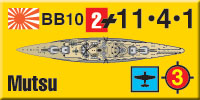
The two battleships of the Nagato class represented a major technological advance for the Imperial Navy. The Japanese adopted the “all-or-nothing” armor scheme pioneered by the U.S. Navy, and increased the caliber of their main armament to 16 inches. New boiler technology came available after the first ship had been laid down, but rather than delay them for re-designing construction went forward and the new boilers - which would have allowed both greater speed and greater protection due to the weight saved - would wait for the next class, which would never be completed.
Nagato and Mutsu carried eight 16-inch guns and joined the fleet in 1920 and 1921, respectively. When new they could make over 26 knots, faster than some nations’ battle cruisers. During the 1930’s they underwent reconstruction to improve their protection and convert their power plants to exclusively burn oil. The new torpedo bulges lowered their speed to 25 knots despite the increased horsepower, and their displacement rose to 40,000 tons.
Nagato, serving as Isoroku Yamamoto’s flagship, sent the fateful “Climb Mount Niitaka” message that began the Pacific War. Both ships sortied for the Pearl Harbor strike, remaining well behind the carriers, and both were part of the Main Body during the Midway operation. Neither saw much use afterwards; Mutsu was destroyed by an internal explosion in 1943 and Nagato survived the war to be expended in American atomic bomb tests.
The Most Super Battleship of All
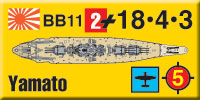
Unable to match the number of American battleships, the Imperial Japanese Navy embarked on a policy of building ships significantly superior to those of the United States (or any other enemy). The Yamato class weighed in at 70,000 tons, carrying nine 18-inch guns and making 27 knots. Her construction began in 1937 under tight secrecy; U.S. Navy intelligence had detected that the ships existed, but had great underestimated their size and firepower.
Yamato did not commission in time for the Pearl Harbor operation, joining the fleet days before the Combined Fleet set out for Midway and serving as flagship during the battle. Her sister Musashi joined the fleet in late 1942, while the third ship was completed as an aircraft carrier and the fourth laid down but suspended when the war began. Yamato would be sunk in a final glory ride in April 1945 after she was attacked by 386 American carrier planes, taking most of her crew with her.
You can read much more about her right here and here and here.
You can order Midway Deluxe right here.
Sign up for our newsletter right here. Your info will never be sold or transferred; we'll just use it to update you on new games and new offers.
Mike Bennighof is president of Avalanche Press and holds a doctorate in history from Emory University. A Fulbright Scholar and NASA Journalist in Space finalist, he has published an unknowable number of books, games and articles on historical subjects.
He lives in Birmingham, Alabama with his wife and three children. He misses his dog, Leopold. Leopold knew the number.
Want to keep Daily Content free of third-party ads? You can send us some love (and cash) through this link right here.
|