| Midway Deluxe Edition:
Japanese Carrier Pieces, Part Two
By Mike Bennighof, Ph.D.
February 2021
 Japanese shipbuilding strategy in the decade before the Second World War looked to skirt the various treaty limitations on aircraft carriers agreed at Washington and London. Light carriers would avoid the initial treaty limit if they were small enough; when that loophole was closed the Japanese instead built large civilian or naval support vessels of various types that could rapidly be converted to light aircraft carriers if war seemed likely. Japanese shipbuilding strategy in the decade before the Second World War looked to skirt the various treaty limitations on aircraft carriers agreed at Washington and London. Light carriers would avoid the initial treaty limit if they were small enough; when that loophole was closed the Japanese instead built large civilian or naval support vessels of various types that could rapidly be converted to light aircraft carriers if war seemed likely.
The light carrier also suited the Imperial Navy’s penchant for hyper-complicated operational plans with large fleets broken into small task forces attempting to accomplish many objectives at once. A light carrier could be attached to the smaller forces to give them at least a small amount of air cover; this practice would doom at least two of the light carriers when they were caught alone by strike groups launched from full-sized American carriers.
The Japanese brought two light carriers along on the Midway mission, plus two more went to the Aleutians in the simultaneous attack on American bases there. These were summoned to rejoin the Combined Fleet after the loss of the fleet carriers, but Admiral Isoroku Yamamoto decided not to make another attempt to fight the Americans and withdrew.
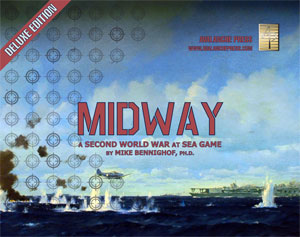
All four of those light carriers, plus two more than weren’t present but could have been, are included in Second World War at Sea: Midway Deluxe Edition, all of them with wonderful new artwork. Let’s have a look at them.
The First Carrier

The first ship built from the keel up as an aircraft carrier and completed as such, Hosho at first served to test aircraft carrier design and operations concepts after her commissioning in 1922. She spent the next decade in that role, but in 1932 she supported Japanese operations in China and her aircraft would be the first of the Imperial Navy to engage in aerial combat.
Hosho was a small ship, and by the late 1930’s she could not operate the Imperial Navy’s first-line aircraft. That relegated her to a training role in 1939, but in late 1941 she was assigned to the Combined Fleet’s Main Body - its battleship force - to provide scouting and anti-submarine air support. By this point she could only operate obsolete Yokosuka B4Y “Jean” biplane torpedo bombers, which had become the Imperial Navy’s standard carrier qualification training plane.
She brought eight planes along when she sortied with the battleships for the December 1941 strike against Pearl Harbor, and again for the Midway operations. Her planes saw no combat, but one of them located the sinking aircraft carrier Hiryu and Yamamoto contemplated throwing her biplanes into one final attempt to destroy the Americans. Sanity prevailed, for once, and Hosho returned to Japan to resume training duties. She survived the war to be scrapped afterwards.
The Loophole
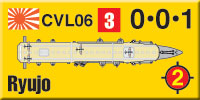
The Imperial Navy ordered Ryujo, the “Prancing Dragon,” to take advantage of a loophole in the Washington naval limitations agreement. Ships displacing less than 10,000 tons did not count as aircraft carriers, and so Ryujo would displace just 8,000 tons yet somehow was expected to operate 48 aircraft.
Her designers met that standard by drafting a very lightly-built and top-heavy ship that soon proved dangerously unstable. Reconstruction added ballast and torpedo bulges, and strengthened the hull, raising her displacement to 12,000 tons. She operated off China with the other Japanese aircraft carriers, but apparently never took on her supposedly full load of 48 aircraft.
Ryujo did not participate in the Pearl Harbor attack, instead supported the invasion of the Philippines and afterwards of the Dutch East Indies. She did enter the Indian Ocean when the First Air Fleet attacked Ceylon, but operated separately in a commerce-raiding role in the Bay of Bengal. When the Midway operation began, Ryujo and Junyo went north to attack the Aleutian Islands. Though he recalled Ryujo and Junyo after the debacle that cost First Air Fleet all four of its heavy carriers, Yamamoto did not stick around long enough for a new exchange of carrier strikes, which was probably a good thing for the Japanese.
Ryujo would be lost a few months later in the Battle of the Eastern Solomons, serving on one of those secondary missions beloved by Japanese planners, in direct contravention of newly-established Japanese carrier doctrine.
Converted Submarine Tenders

The Imperial Navy’s 1934 Fleet Mobilization Plan included a number of ships that could be converted to other uses; chiefly, to light aircraft carriers. The fast submarine tenders Tsurigisaki and Takasaki were laid down in 1935, but soon after completion Tsurigisaki began conversion to the light aircraft carrier Shoho, while Takasaki was not even finished before her conversion to the carrier Zuiho began.
They emerged from Yokosuka Navy Yard as 14,000-ton aircraft carriers theoretically capable of operating 30 planes. Like the previous light carriers, they were flush-decked, with no island and funnels sticking out of the side of the ship to divert exhaust gasses from the flight deck. Originally built with a diesel power plant, they received geared turbines designed for destroyers and could make 28 knots.
Shoho would be sunk during her only operation, the Battle of the Coral Sea, on one of those diversionary/secondary operations far from any support the heavy carriers could offer. Zuiho accompanied Hosho with the Japanese battleships on the Pearl Harbor operation. At Midway her air group saw no action; she brought two dozen planes (including a half-dozen obsolete A5M fighters) which escaped likely immolation when Yamamoto ordered a turn for home rather than a final throw of the dice. She later saw more action off the Solomons and Philippines, where she was sunk during the October 1944 Battle of Cape Engano.
Converted Liners
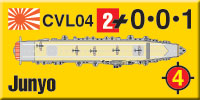
The Fleet Mobilization Plan also included a pair of passenger liners designed for supposedly easy conversion to aircraft carriers. The Nippon Steamship Line ordered Izumo Maru and Kashiwara Maru as luxury liners in 1939, with the Imperial Navy paying 60 percent for their cost. In exchange for that subsidy the ships had a bulbous bow and double hull, additional fuel tanks, added bulkheads and strengthened decks. The Navy bought the incomplete hulls in February 1941 and conversion work began.
The former liners could not match the same standards as a purpose-built aircraft carrier; they had no armor at all, and their commercial machinery was much heavier than the power plants of purpose-built carriers. They could make 25 knots as carriers, and on paper they could operate 54 aircraft though in practice even 48 planes proved too many for their crowded hangars.
Kashiwara Maru commissioned in May 1942 as the carrier Junyo, and she accompanied Ryujo on the mission to attack the Aleutian Islands. Like Ryujo, she avoided action off Midway when Yamamoto was overcome by a return of his senses and the urging of his staff. Junyo would later see action off the Solomons and the Philippines. She would survive the war and be scrapped shortly afterwards.
Izumo Maru, as the carrier Hiyo, commissioned too late for Midway but we included her in the game for the post-Midway scenarios. She also fought off the Solomons, and was sunk during the Battle of the Philippine Sea in 1944 thanks to atrociously poor damage control procedures.
Originally classed as light carriers, after the Battle of Midway both ships were re-christened as fleet carriers and used in that role, though they lacked the same capabilities as the purpose-built fleet carriers.
And those are the Japanese light carriers. Next time, we’ll look at the Japanese heavy cruisers.
You can order Midway Deluxe right here.
Please allow an additional four weeks for delivery.
Sign up for our newsletter right here. Your info will never be sold or transferred; we'll just use it to update you on new games and new offers.
Mike Bennighof is president of Avalanche Press and holds a doctorate in history from Emory University. A Fulbright Scholar and NASA Journalist in Space finalist, he has published countless books, games and articles on historical subjects.
He lives in Birmingham, Alabama with his wife, three children and his dog, Leopold.
Want to keep Daily Content free of third-party ads? You can send us some love (and cash) through this link right here. You don’t have to, but Leopold would like it if you did.
|