| 1940: Polish Exiles
The Polish Army in
France, Part One
By Mike Bennighof, Ph.D.
January 2024
 Poland’s defeat in the 1939 September Campaign only began the Polish soldier’s struggle against fascism. On 9 September, as the Polish Army launched its offensive along the Bzura River, Poland and France signed an agreement to raise a division of Poles resident in France, including reservists, men who had never been conscripted, and volunteers. Twelve days later, the two allies clarified that the division would be part of the Polish Army, commanded by Polish Army officers and its men subject to Polish military law, but would be organized according to French practice and be subject to French operational command. The French also reserve the right to incorporate smaller Polish units into their own formations. Poland’s defeat in the 1939 September Campaign only began the Polish soldier’s struggle against fascism. On 9 September, as the Polish Army launched its offensive along the Bzura River, Poland and France signed an agreement to raise a division of Poles resident in France, including reservists, men who had never been conscripted, and volunteers. Twelve days later, the two allies clarified that the division would be part of the Polish Army, commanded by Polish Army officers and its men subject to Polish military law, but would be organized according to French practice and be subject to French operational command. The French also reserve the right to incorporate smaller Polish units into their own formations.
Recruitment proceeded quickly, as Polish citizens living in France (chiefly coal miners and steelworkers) signed up for the division. In late October, Polish soldiers who had fought the Nazi invasion and escaped through neutral neighboring states began to arrive as well, swelling the numbers of Poles and overwhelming the Great War-era camp at Coëtquidan initially assigned to the division. Soon two more had to be turned over to the Poles, all three located in Brittany. The camps had been built by the U.S. Army and not used since; the new Polish soldiers were issued leftover uniforms, also of World War One vintage, from a French Navy depot.
The Polish consul-general in Lille, Aleksander Kawalkowski, took over much of the recruitment effort in his role as the Polish Embassy’s Director of Military Affairs. He set up over 200 recruiting stations throughout France, leaned on the French to expedite visas for Polish soldiers languishing in Hungary and Romania, and opened recruiting efforts in Britain, Canada, the United States and Latin America. Meanwhile, determined Poles who’d tried to return home to fight turned around and joined the new army in France instead. The Polish government-in-exile worked with the French to convince neutral states like the Netherlands to allow men who’d been interned while on their way from Poland to France to complete their journey. About 30,000 of the 85,000 men eventually enrolled in the exile army were Polish soldiers who escaped their country’s collapse.
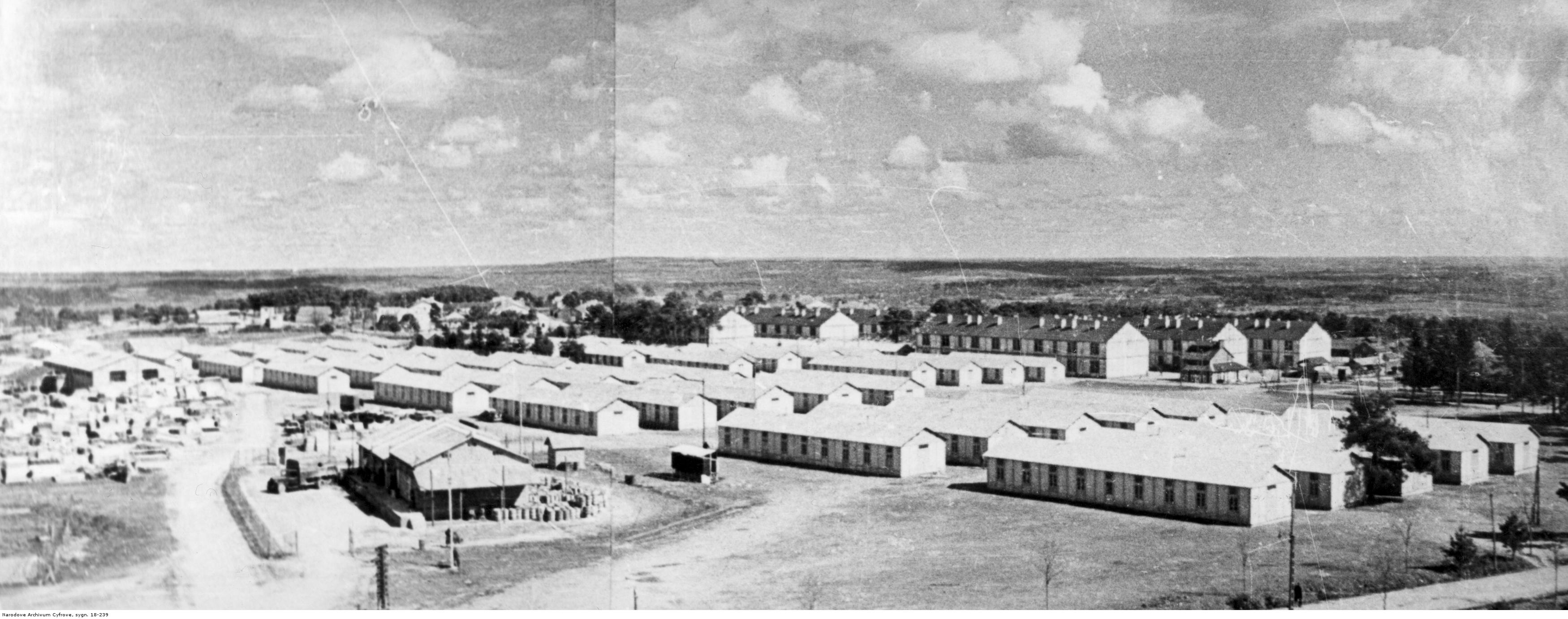
The camp at
Coëtquidan.
The French had expected to raise a single division manned by raw recruits and perhaps suitable for second-line duties. Instead, the Poles presented them with a force that eventually numbered four infantry divisions and two brigades, including a large cadre of combat-experienced officers and men. And even the new recruits proved determined to fight the Nazis – during its brief existence, the Polish Army in France did not record a single case of desertion. Legally speaking, many of the Polish recruits enrolled in France were conscripts, but the Polish government-in-exile had no means to enforce its draft laws on foreign soil, so in essence even these men were volunteers.
Those were the positives. Many of the Polish recruits raised in France had left their homeland because of their dislike for the military dictatorship. Some of the escaped soldiers blamed the Polish officer class for the defeat, and now that they stood on “free” soil, did not hesitate to voice this opinion. Still others were Communists. Some were second- or third-generation émigrés who spoke no Polish.
The French Army had not prepared for such an influx of manpower, nor were all French military and political leaders at ease with the presence of a foreign army on French soil, loyal to its own government and commanded by its own generals. The exile army’s commander, Wladyslaw Sikorski, obtained a new agreement with the French on 4 January 1940 that spelled out that the Polish Army owed its allegiance to the Polish government in exile, and would serve under Polish command. The French undertook to supply the Poles, including weapons, ammunition, food, and clothing as well as payroll.
Polish generals almost immediately accused their allies of slow-walking deliveries, and supplying second-rate weapons and equipment when they did make deliveries. Even when the Poles did finally receive their equipment, it was a mixed collection of weaponry. On the one hand, Polish infantrymen received the newest rifle in the French arsenal, the MAS 36 bolt-action model handed to elite units (including the Moroccans). But the two Polish divisions which took the field did not receive the 155mm howitzers allotted to similar French formations for their second, heavy artillery regiment.
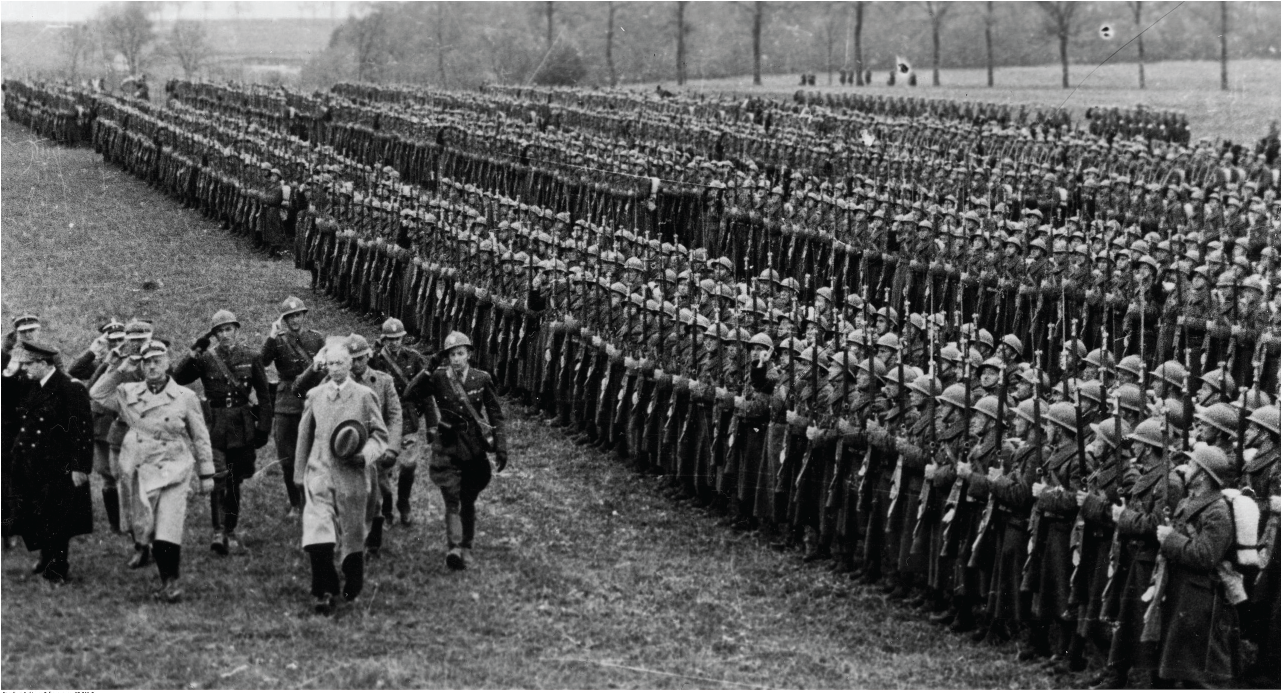
President of Poland Władysław Raczkiewicz and General Władysław Sikorski review the 1st Grenadier Division. 3 May 1940.
Instead, the Polish divisions fielded the nearly-immobile Model 1915/16 220mm heavy howitzer, designed as a siege gun rather than a field artillery piece. It had to be broken into two pieces for transport, and even those were almost too heavy for the horses with which the Poles were expected to move them. With his division still idle, in early June 1st Division commander Bronislaw Duch authorized field maneuvers for his artillerymen, who eventually worked out means to move the heavy guns.
Poland’s exiled military leadership quickly began to study the reasons for their defeat, and within weeks of the exile army’s establishment, they issued Most Important Conclusions and Experiences from the September Campaign, a thorough analysis of their defeat and lessons to be learned from it. The French Army had no interest, but the Poles took it to heart.
Along the key important conclusions, the Poles had not had enough anti-tank guns in their formations. The Polish anti-tank gunners had been skilled and determined, often to a suicidal extent, but their artillery regiments had not been as capable of defending themselves from enemy tanks as pre-war planners assumed. Each Polish artillery regiment would therefore include two anti-tank companies, one for each battalion, to keep the big guns from being overrun. The French high command noticed these extra companies, and detached them to support their own formations, while also stripping the two Polish divisions not committed to front-line combat of their anti-tank guns and gunners.
The Mountain Brigade
The French had wanted only infantry divisions, a policy to which Sikorski agreed as the best means to get his men back into action as quickly as possible; but the commandant of the Coëtquidan camp, Col. Stanislaw Maczek, had other ideas. Maczek had commanded the 10th Motorized Cavalry Brigade during the fall campaign, the Polish army’s best mechanized unit. When he crossed the border into Hungary on 19 September his brigade had seen repeated defensive successes and had not been defeated despite facing two German panzer divisions. Most of his surviving soldiers had followed him to France.
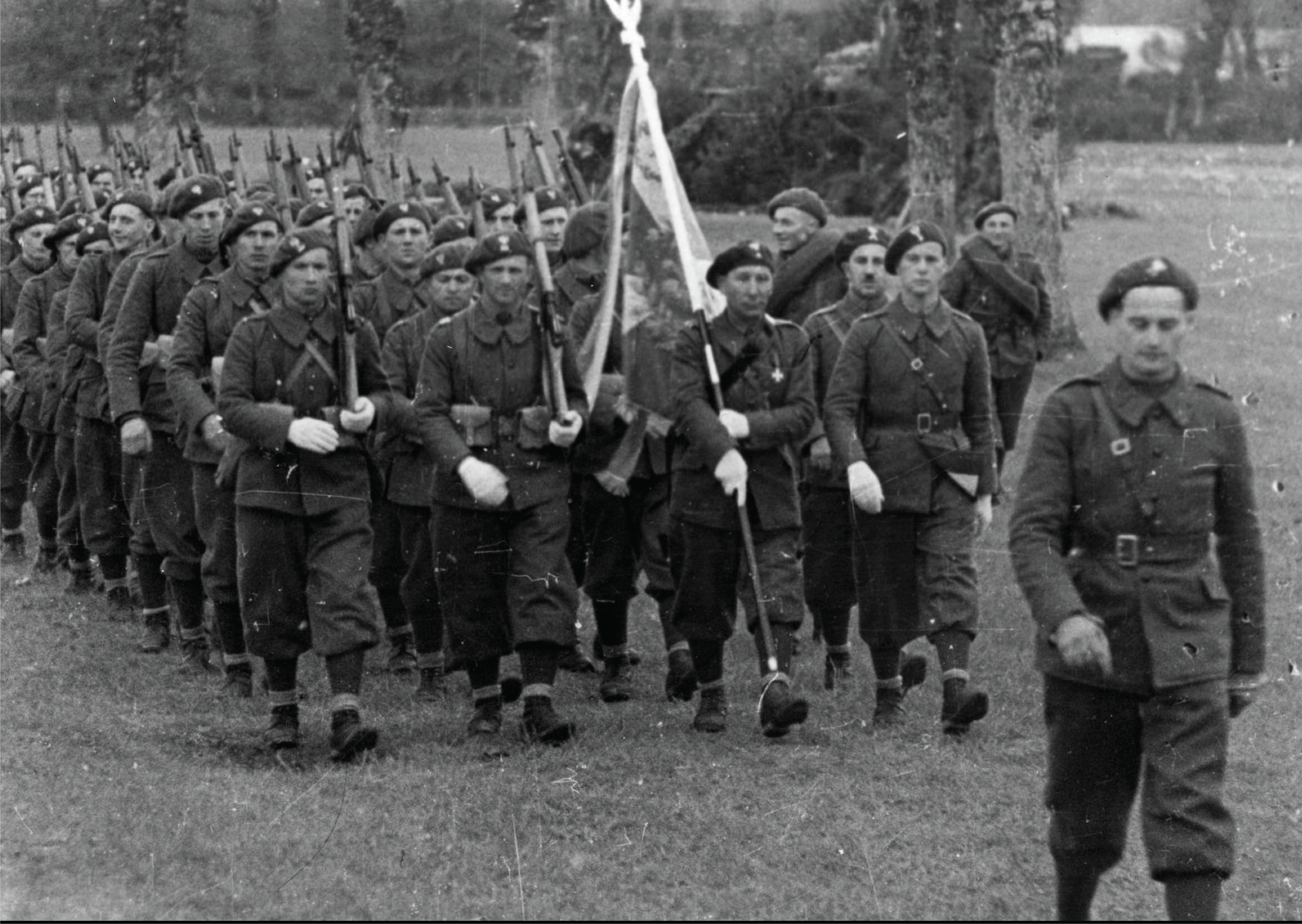
Podhale Rifles, Spring 1940.
A former Kaiserjäger officer in the Austro-Hungarian Army, Maczek was also considered the Polish Army’s leading expert on mountain warfare and he lent his energy to assembling a mountain brigade as well, giving it the traditional Polish title “Podhale Rifles.” The Rifles were the first exile unit declared combat-ready, not least because Maczek siphoned off many of the best officers and men from the infantry divisions. Formed before most of the professional cadre that escaped the fall of Poland had made it to France, the Rifles had a high proportion of Polish workers recruited in France (about 65 percent) and a large number of officers and NCO’s from the Polish veterans of the Spanish Civil War living in exile in France. These latter men were mostly Communists and had been unwelcome to return home to Poland; now, they would fight for their country on foreign soil.
Allotted to the Allied force to be sent to Finland to intervene against the Soviets, it went instead to Narvik in Norway in April, fighting very well in the high mountains. Rushed back to France, it fought in Brittany in June and disbanded as French resistance collapsed. Most of its soldiers made it to England, where they joined the new Polish army in exile.
The Armored Brigade
Maczek did not want to see his highly trained tankers and other specialists toting rifles in the trenches, and simply ignored his instructions to form an infantry division. He re-created his beloved Black Brigade, without its black uniforms and coal-scuttle helmets. The 1st Polish Armored Brigade, always referred to as the 10th Armored Cavalry Brigade by the Poles, carried on the tradition of their most successful armored formation from the September Campaign (Poland still fields a 10th Armored Cavalry Brigade).
Maczek’s brigade waited without heavy equipment until well after the German attack began. Finally supplied with new tanks, they hurried into action in early June with the French 4th Army, fighting to cover its retreat until they ran out of fuel. In September 1939, Maczek had brought most of his men safely over the Hungarian border after a hard-fought series of delaying actions against the Germans panzers. He kept them together to form his new unit, and that gave his brigade extraordinary morale and cohesion, even if it only entered combat once the French logistical infrastructure had begun to collapse.
The armored brigade initially formed at Coëtquidan like the infantry divisions, but at first the French would only hand over a small number of decrepit Renault 17 light tanks for training. On 24 May, two weeks after the German offensive began, the French Army formally authorized the brigade’s existence and began to issue factory-new Renault R35 and R40 light tanks and GMC trucks. Five days later, Maczek received orders to move his brigade to Paris and prepare to enter combat.
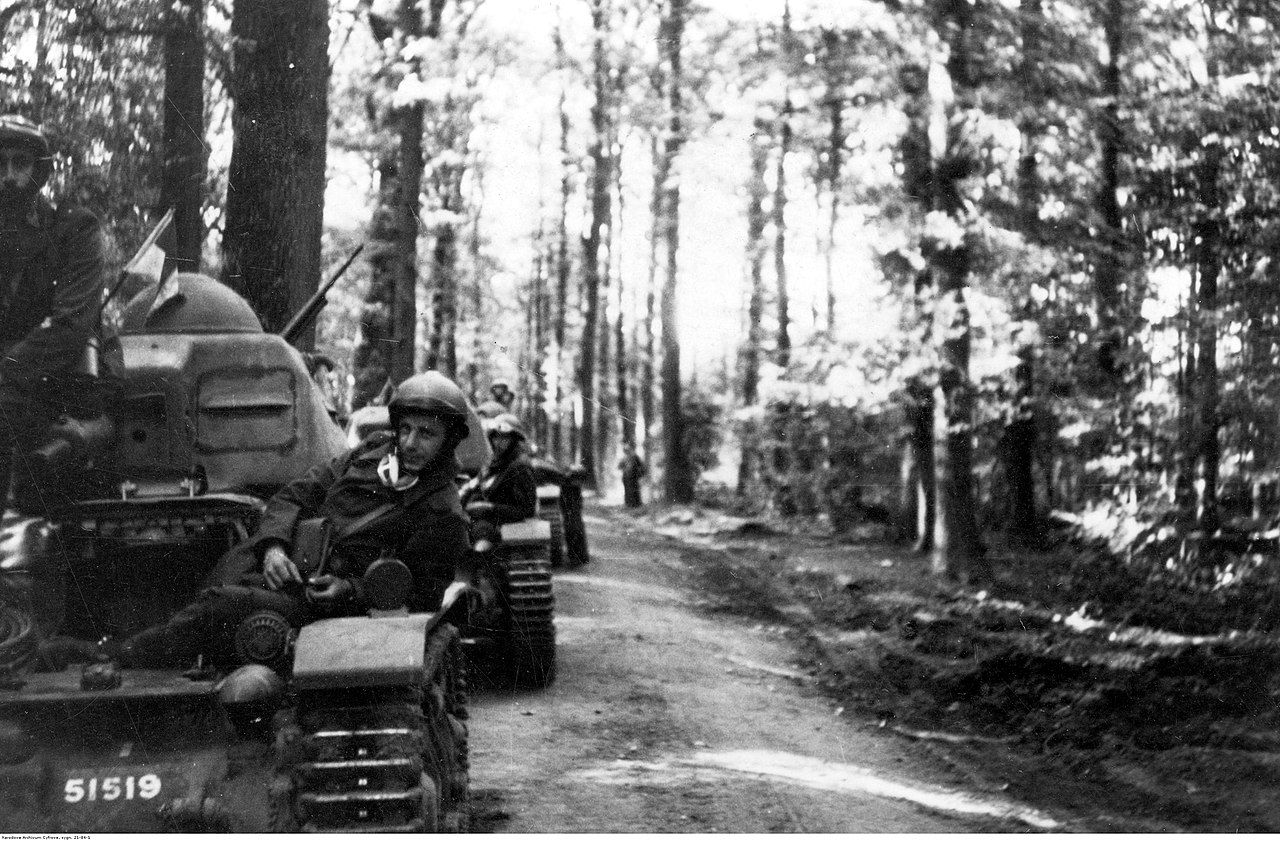
Polish tankers of the 10th Armored Cavalry Brigade.
Those orders came on 9 June, and by the 11th Maczek’s brigade had arrived in Champagne to join the French Fourth Army. The “brigade” was little more than a reinforced battalion combat group, with a battalion of tanks, two squadrons of truck-mounted infantry and some anti-tank guns. The remainder of the brigade stayed in Paris, awaiting equipment; most of the 2nd Tank Battalion rolled off to seek Germans to fight as soon as they got their hands on their tanks.
For the next week, the Polish brigade fought delaying actions, allowing French infantry to retreat and avoid encirclements. Eventually many of the Polish tanks would be lost due to lack of fuel, but Macek’s men gained a good reputation among French commanders. That couldn’t help turn the tide, and soon it became obvious that France would be defeated.
Where Bronislaw Duch of the 1st Grenadier Division requested permission from his French superiors to disband his unit and Bronislaw Prugar-Ketling of 2nd Rifle Division simply informed his corps commander of the decision he had taken, Maczek did neither. It’s unclear whether he ever received orders from Sikorski to disband his brigade, but on the 18th he ordered his men to destroy their vehicles and artillery and make their way out of France in small groups to England, asking neither permission nor forgiveness from his French superiors.
Only about 40 percent of Maczek’s men arrived in Britain, and most of these did so with the help of Polish consulates who provided money and civilian clothes allowing them to take trains to Marseille and book passage from there. Only a handful escaped as part of the general evacuation of Allied troops. In England these remnants formed a new armored brigade that eventually grew into the famed Polish 1st Armored Division.
You can order 1940: Polish Exiles right here.
Polish-Lithuanian Commonwealth
The Deluge
Lithuania's Iron Wolves
Legend of the Iron Wolf
1940: Polish Exiles
Retail Price: $90.96
Package Price: $70
Gold Club Price: $56
You can join the Commonwealth right here.
Sign up for our newsletter right here. Your info will never be sold or transferred; we'll just use it to update you on new games and new offers.
Mike Bennighof is president of Avalanche Press and holds a doctorate in history from Emory University. A Fulbright Scholar and NASA Journalist in Space finalist, he has published a great many books, games and articles on historical subjects; people are saying that some of them are actually good.
He lives in Birmingham, Alabama with his wife, three children, and new puppy. He misses his lizard-hunting Iron Dog, Leopold.
Want to keep Daily Content free of third-party ads? You can send us some love (and cash) through this link right here.
|