Kursk 1943:
Publisher’s Preview
by Mike Bennighof, Ph.D.
August 2026
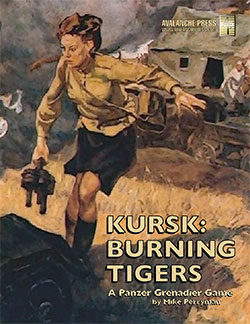
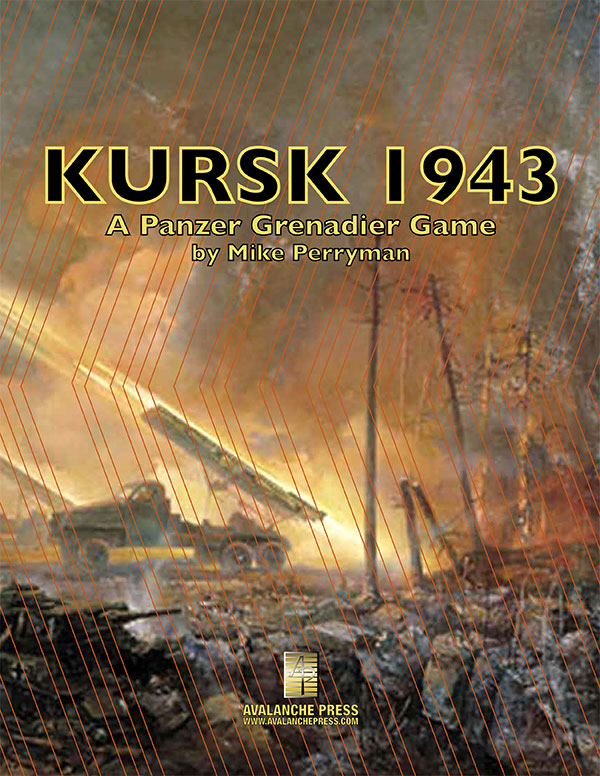 While the June 1943 Battle of Kursk may not be history’s largest tank battle, it is an iconic representation of World War II armored warfare, and a staple of both popular military histories and wargames. So, it’s both inevitable, and necessary, that Panzer Grenadier include a game about this battle. Two of them, actually, but today we’ll talk about Kursk 1943. While the June 1943 Battle of Kursk may not be history’s largest tank battle, it is an iconic representation of World War II armored warfare, and a staple of both popular military histories and wargames. So, it’s both inevitable, and necessary, that Panzer Grenadier include a game about this battle. Two of them, actually, but today we’ll talk about Kursk 1943.
The Battle of Kursk took place in July 1943, and is usually considered the turning point of the Great Patriotic War. The massive battle itself did not yield a decisive result, but afterwards the Germans would never again go on the strategic offensive. This is the tipping point, that moment where both sides are capable of seizing the initiative.
The Germans made their attack as a pincer movement, with two distinct forces assaulting the Soviet-held salient around Kursk from the north and the south. On the south flank, Fourth Panzer Army spearheaded the German effort, with three panzer corps of its own and an additional panzer corps on its right flank. Those panzer troops included the three divisions of the II SS Panzer Corps and the Grossdeutschland Panzer Grenadier Division. The battle opened on 5 July 1943 with the three German SS divisions advancing to the north and north-east side-by-side.
 The Soviets initially opposed the southern attack with Sixth and Seventh Guards Armies, dug in along three well-fortified lines and supported by the thickest minefields yet sown in this war plus many additional anti-tank batteries. First Guards Army and First Tank Army would be committed as reinforcements, along with more separate corps and divisions. The Soviets initially opposed the southern attack with Sixth and Seventh Guards Armies, dug in along three well-fortified lines and supported by the thickest minefields yet sown in this war plus many additional anti-tank batteries. First Guards Army and First Tank Army would be committed as reinforcements, along with more separate corps and divisions.
The climax of the battle took place at Prokhorovkha, where Fifth Guards Tank Army met the II SS Panzer Corps head on. The huge clash of armor proved a stalemate: the Soviets could not push the Germans back, but neither could the Germans break through to their objectives.
Kursk 1943 is a new edition of our old Kursk: South Flank game. That’s the game that re-launched both Panzer Grenadier and Avalanche Press itself, so I’ve always had a certain fondness for it. Since then, the game system has received a new (Fourth) edition, and there’s been a great deal of new scholarship on the battle itself. Because of the latter, Kursk 1943 is a markedly different game than the old South Flank.
 Since South Flank was designed and submitted, there’s been a debate about the Battle of Prokhorovka. Valeriy Zemulin of Kursk State University and Dr. Ben Wheatley of the University of East Anglia have challenged the received wisdom regarding the battle. A lot of it’s what academic historians dismiss as “cannon counting,” since the outcome and the historical import of the battle are largely unchanged. Short version: Pavel Rotmistrov of Fifth Guards Tank Army, whose reports were the basis for much of the tale in the old days, made stuff up. Since South Flank was designed and submitted, there’s been a debate about the Battle of Prokhorovka. Valeriy Zemulin of Kursk State University and Dr. Ben Wheatley of the University of East Anglia have challenged the received wisdom regarding the battle. A lot of it’s what academic historians dismiss as “cannon counting,” since the outcome and the historical import of the battle are largely unchanged. Short version: Pavel Rotmistrov of Fifth Guards Tank Army, whose reports were the basis for much of the tale in the old days, made stuff up.
That cannon (or in this case, tank) counting causes a major shift in the tactical part of the story. Those are the elements from which a Panzer Grenadier game builds its story. It’s enough that I think a revision of the game’s Prokhorovka scenarios is warranted, as well as a much deeper dive into that part of the great battle.
 South Flank had 40 scenarios, and we’ve retained that number for Kursk 1943. The first 25 scenarios cover the period between 5 and 9 July, from the battle’s opening to just before the climactic clash of armor at Prokhorovka. Those carry over to Kursk 1943, in revised form to bring them in line with the Fourth Edition rules and give a few some developmental updating. South Flank had 40 scenarios, and we’ve retained that number for Kursk 1943. The first 25 scenarios cover the period between 5 and 9 July, from the battle’s opening to just before the climactic clash of armor at Prokhorovka. Those carry over to Kursk 1943, in revised form to bring them in line with the Fourth Edition rules and give a few some developmental updating.
The old game’s last fifteen scenarios dealt with the fighting at Prokhorovka, and drew on the historiography of the time. Since the latter has changed, the scenarios need to change as well. But I also am quite sure that fifteen scenarios are not nearly enough to tell such a complex and dramatic story. The game also ends abruptly at that point, without addressing the aftermath (the final German attempts to revive their offensive, and the immediate Soviet counter-attacks).
 For Kursk 1943, I decided to end the scenario set on 9 July. The Battle of Kursk is a scenario-rich environment, perhaps the most fruitful battle there is for Panzer Grenadier scenario opportunities. Kursk 1943 adds fifteen new scenarios from the 5 – 9 July time frame. We’ll do a separate scenario book down the road on the great battle (which apparently was not history’s greatest/largest/bestest tank battle) and the days right after. It deserves more than eight scenarios. For Kursk 1943, I decided to end the scenario set on 9 July. The Battle of Kursk is a scenario-rich environment, perhaps the most fruitful battle there is for Panzer Grenadier scenario opportunities. Kursk 1943 adds fifteen new scenarios from the 5 – 9 July time frame. We’ll do a separate scenario book down the road on the great battle (which apparently was not history’s greatest/largest/bestest tank battle) and the days right after. It deserves more than eight scenarios.
This is how history works. The events, whatever they are, are seen in a new light as additional evidence is either uncovered, or more often, appreciated for its import when it was dismissed in earlier studies. History is a constant, living, changing thing.
 Kursk 1943 will become a tighter, more focused game. Those first 32 scenarios are solid; I gave them some fresh development as I don’t think they were given their due the first time around. The story-arc format works better with the eight added scenarios from the first week, I think. Kursk 1943 has six chapters, with each chapter sporting a battle game to tie the scenarios together. Kursk 1943 will become a tighter, more focused game. Those first 32 scenarios are solid; I gave them some fresh development as I don’t think they were given their due the first time around. The story-arc format works better with the eight added scenarios from the first week, I think. Kursk 1943 has six chapters, with each chapter sporting a battle game to tie the scenarios together.
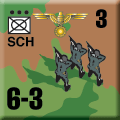
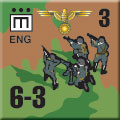
The scope of the game remains the same: four geomorphic map boards (meaning that you arrange the separate map panels to make the final game map) and a whopping 693 pieces (528 units and leaders, 165 markers). We needed all of those pieces, because there were three distinct forces on the Kursk battlefield in this sector: the German Armed SS Nazi Party militia on one side and the Red Army of Workers and Peasants regulars (RKKA) and Guards on the other. Each of them brings the full array of troops, tanks, weapons and leaders.
 All three armies are at their peak; the Armed SS managed to avoid the losses of the Stalingrad campaign and have gained a great deal more operational skill than they showed in their early, bumbling attempts at mechanized warfare. The regular German Army’s defeat at Stalingrad has instead elevated Himmler’s uniformed thugs in the feudal struggle for the Supreme Leader’s favor, and now they wield the very best weapons available to the Third Reich, and plenty of them All three armies are at their peak; the Armed SS managed to avoid the losses of the Stalingrad campaign and have gained a great deal more operational skill than they showed in their early, bumbling attempts at mechanized warfare. The regular German Army’s defeat at Stalingrad has instead elevated Himmler’s uniformed thugs in the feudal struggle for the Supreme Leader’s favor, and now they wield the very best weapons available to the Third Reich, and plenty of them
A note here: The Armed SS were not a branch of the German armed forces, but rather of the Nazi Party. Their members were not soldiers, and so in the interest of historical accuracy we refer to them as “militia” as this was their actual legal status.
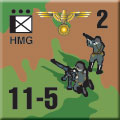 Along with better tanks, the Armed SS also fields better infantry and very large machine-gun platoons. They have the best anti-tank guns Germany can offer (the new 75mm) and armored personnel carriers to bring the troops into battle. Along with better tanks, the Armed SS also fields better infantry and very large machine-gun platoons. They have the best anti-tank guns Germany can offer (the new 75mm) and armored personnel carriers to bring the troops into battle.
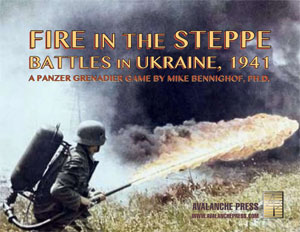
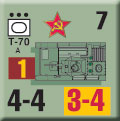
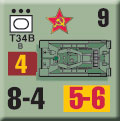
The Soviets, for their part, have finally figured out how to apply the theory of armored warfare to actual practice. The T34 remains the backbone of Soviet tank brigades. Both the Soviets Guards and the RKKA bring the same infantry, machine gun and support weapon units seen throughout the war. The “Katyusha” multiple rocket launch system is now in more common use, but these are the same basic units seen in Panzer Grenadier games stretching from Ukraine 1941 (Fire in the Steppe) through Manchuria 1945 (The Last Campaign).
Despite the new outlook on history, Kursk 1943 remains the ultimate tank battle game. It’s one of the centerpieces of Panzer Grenadier, and I’m very pleased to return it to print as a landmark of what can be done by blending history and game-play.
 PS: You can get black SS pieces for Kursk 1943, and another chapter with four historical scenarios from the August 1943 Soviet Operation Rumyantsev, in Golden Journal No. 51: Dogs of War, PS: You can get black SS pieces for Kursk 1943, and another chapter with four historical scenarios from the August 1943 Soviet Operation Rumyantsev, in Golden Journal No. 51: Dogs of War,
Order Dogs of War Here.
Gold Club members can use their max discount.
Sign up for our newsletter right here. Your info will never be sold or transferred; we'll just use it to update you on new games and new offers.
Mike Bennighof is president of Avalanche Press and holds a doctorate in history from Emory University. A Fulbright Scholar and NASA Journalist in Space finalist, he has published an unknowable number of books, games and articles on historical subjects.
He lives in Birmingham, Alabama with his wife and three children
Want to keep Daily Content free of third-party ads? You can send us some love (and cash) through this link right here.
|