The Emperor’s Sword:
Super-Destroyer Shimakaze
by Mike Bennighof, Ph.D.
July 2025
 In 1939, the Japanese Navy ordered two new destroyer designs, breaking with the “Special Type” that had been the basis of fleet destroyers since Fubuki was laid down in 1926. Many documents of the time describe them as “cruiser” types. Navy planners believed the destroyer’s mission had been radically changed by the advent of capable aircraft, and two very different roles would be filled by future destroyers: anti-aircraft defense of fleet carriers and nighttime surface combat. In 1939, the Japanese Navy ordered two new destroyer designs, breaking with the “Special Type” that had been the basis of fleet destroyers since Fubuki was laid down in 1926. Many documents of the time describe them as “cruiser” types. Navy planners believed the destroyer’s mission had been radically changed by the advent of capable aircraft, and two very different roles would be filled by future destroyers: anti-aircraft defense of fleet carriers and nighttime surface combat.
Shimakaze, the “experimental” destroyer (known as Type C) produced for the surface combat role, greatly exceeded her designers’ expectations. She was a large boat, in the same size range as the French Mogador-class super destroyers or Italian Capitani Romani small light cruisers. Normal displacement was 3,048 tons, compared to 2,250 for the Yugumo-class fleet destroyers built during the same time or 2,610 for the big American Sumner-class of the late war years.
Laid down in August 1941, construction slowed down once war broke out and she was not completed until May 1943. Shimakaze then took part in extended trials, and the results greatly exceeded what were already an ambitious set of design parameters.
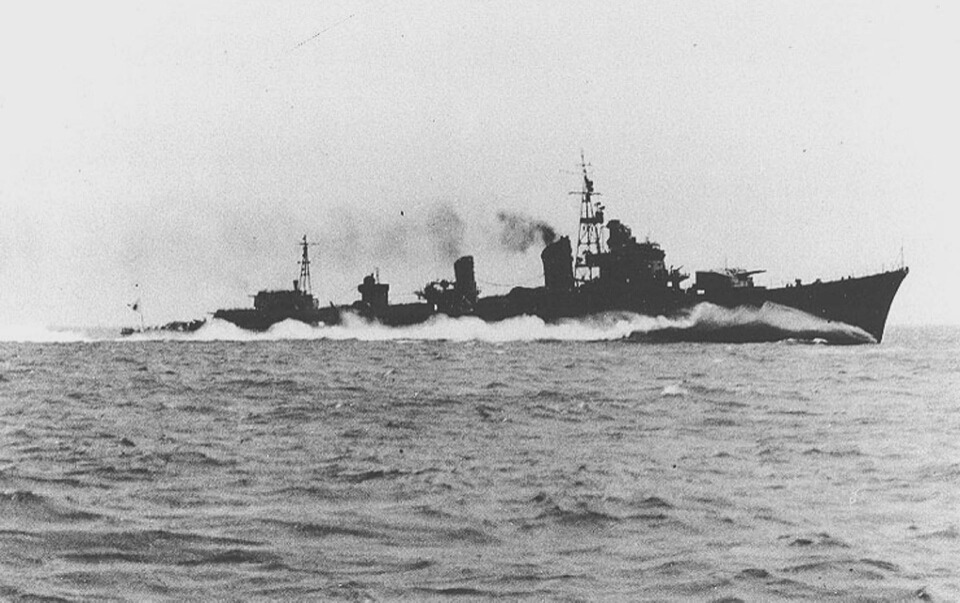
Shimakaze on speed trials following re-armament, May 1944. Only known photo.
At Shimakaze’s heart lay a sophisticated set of three high-pressure Kampon boilers. Expected to produce 75,000 horsepower, on trails they almost touched 80,000. By contrast, most Japanese destroyers were designed to reach 52,000 horsepower; the 8,300-ton American Atlanta class also made 75,000 horsepower. Designed for 39 knots, Shimakaze made 41 — a speed equalled by very few warships.
But it was her armament that set Shimakaze apart from other destroyers. Like the Special Type destroyers, she carried six five-inch dual-purpose guns in three turrets (though a new model with faster traverse than previous destroyers). Unlike them, she had 15 tubes for the Imperial Navy’s huge and deadly 24-inch “Long Lance” oxygen-fueled torpedoes. This gave her immense firepower, though in practice the Japanese tactic of opening surface engagements with large spreads of the big torpedoes fired at maximum range had very little effect for the number of weapons expended. Shimakaze also carried two depth charge throwers and 18 charges, and was one of the first Japanese warships fitted with radar.
When her fine qualities became apparent, the Navy ordered sixteen slightly enlarged near-sisters, none of which were laid down before the war ended. The big power plants were extremely expensive to build, and resources went to cheaper and desperately needed anti-submarine escorts, and to cheaper and ultimately useless suicide weapons.
In service, Shimakaze’s very different capabilities made it difficult to integrate her into tactical formations. She saw her first sortie in July 1943, as part of the force covering the evacuation of Kiska. A Japanese cruiser-destroyer force slipped into the Aleutians under the cover of fog and took the island’s 5,183-man garrison aboard in a 55-minute operation on 28 July. Two days later, the Americans flung thousands of shells at the rocky island and then landed over 34,000 men on it, only to discover that the Japanese had disappeared.
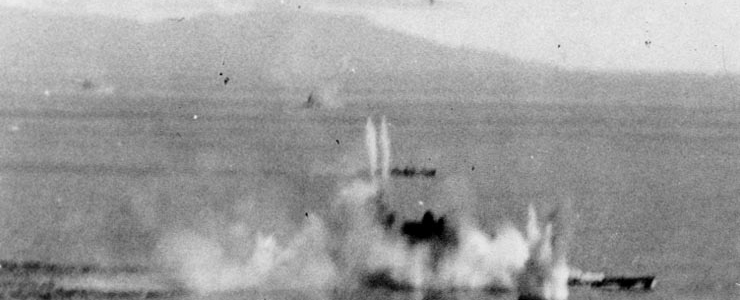
Battleship Musashi under air attack in the Sibuyan Sea, 24 October 1944. Shimakaze may be the destroyer under attack in the background.
In early 1944, Shimakaze underwent a refit similar to those given the Japanese Special Type destroyers. She lost one of her 5-inch turrets, and received at first 14 and then 28 25mm anti-aircraft guns in exchange. The Japanese disliked removing torpedoes from any warship, however, and all 15 tubes remained.
Afterwards, Shimakaze went to Truk to join the Combined Fleet, operating as a separate attached destroyer though usually steaming with the 32nd Destroyer Division (four Yugumo-class boats). She deployed with the giant battleships Yamato and Musashi during the Battle of the Philippine Sea, and in the attempt to reinforce Biak in June 1944.
Though Shimakaze was part of Admiral Takeo Kurita’s surface action group that surprised the American escort carriers off Samar on 25 October 1944, she was held out of the fighting. Hundreds of survivors from the heavy cruiser Maya, sunk a day earlier by four torpedoes from the American submarine Dace, crowded Shimakaze’s decks and made it nearly impossible to use her guns and torpedoes. Kurita ordered her to stand off, and she slipped away with the rest of his force when they retired from the fight.
An extraordinary ship, Shimakaze was lost on an exceedingly ordinary mission. On 11 November 1944, she helped escort a troop convoy to Ormoc on the northwest coast of Leyte, bringing 10,000 troops of the 26th Infantry Division to reinforce the Japanese forces on the island. Attacked by hundreds of carrier planes from the American Task Force 38, Shimakaze and three other destroyers were lost, along with all five troop transports and over 9,000 soldiers.
Second World War at Sea: The Emperor's Sword includes eight Shimakaze-class boats. They’re the most powerful destroyers seen in the game series, and even four of them together are a formidable force in a surface engagement.
Order The Emperor’s Sword Here.
Please allow an extra six weeks for delivery.
Sign up for our newsletter right here. Your info will never be sold or transferred; we'll just use it to update you on new games and new offers.
Mike Bennighof is president of Avalanche Press and holds a doctorate in history from Emory University. A Fulbright Scholar and NASA Journalist in Space finalist, he has published an unknowable number of books, games and articles on historical subjects.
He lives in Birmingham, Alabama with his wife and three children.
Want to keep Daily Content free of third-party ads? You can send us some love (and cash) through this link right here.
|