South Pacific:
Scenarios & History, Part Two
by Mike Bennighof, Ph.D.
May 2026
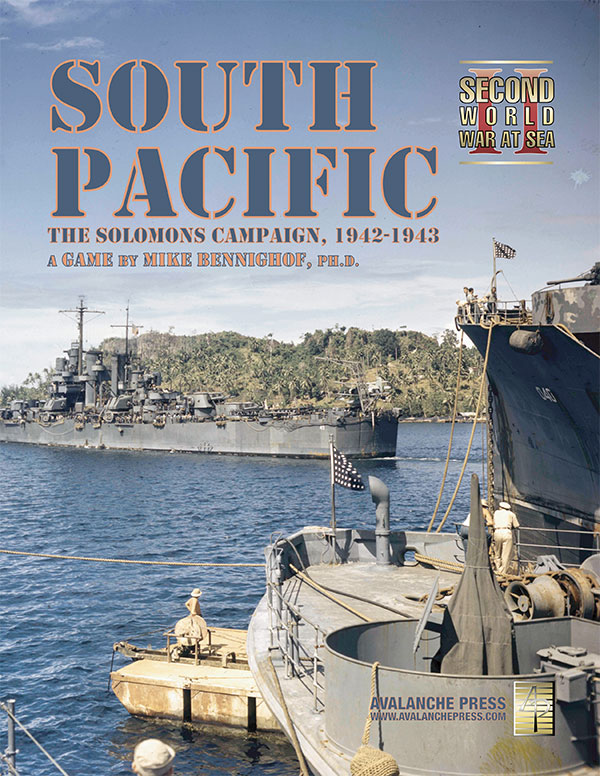 Ironbottom Sound is a scenario book that expands Second World War at Sea: South Pacific. It comes with 36 new scenarios for South Pacific, extending the story through August 1943 and the campaign for New Georgia. All of the maps and pieces needed are included in South Pacific; the companion history book, Solomons Naval Campaign, comes bundled with Ironbottom Sound. Ironbottom Sound is a scenario book that expands Second World War at Sea: South Pacific. It comes with 36 new scenarios for South Pacific, extending the story through August 1943 and the campaign for New Georgia. All of the maps and pieces needed are included in South Pacific; the companion history book, Solomons Naval Campaign, comes bundled with Ironbottom Sound.
While the Solomons naval campaign is probably best remembered for the fearsome night surface battles in Ironbottom Sound, it was also the background for two of the four carrier battles fought during the Pacific War (the others being Coral Sea and Midway, each of which gets its own Second World War at Sea game).
The first of these, the Battle of the Eastern Solomons took place in late August 1942. The Americans had landed on Guadalcanal a little more than two weeks previously, and their aircraft carriers provided support and most importantly protected the vulnerable transports bringing reinforcements and supplies. The Japanese aimed to disrupt this traffic, and drive off or destroy the carriers providing air support.
South Pacific’s second chapter is tightly focused on this battle, though it’s one of the shorter segments with two operational scenarios (the ones that take place on the operational map, where task forces move and seek one another) and six battle scenarios (where the action goes straight to the tactical map). It was one of the last chapters designed and finalized, when space considerations had become an issue for the South Pacific scenario book. I could not fit as many scenarios into the chapter as I really wished.
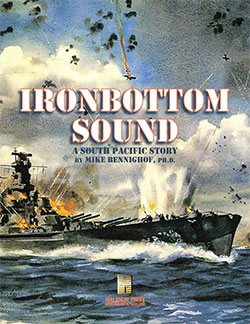 The scenario/analysis book Ironbottom Sound provides much more space (slightly more than doubling the total), and Eastern Solomons benefits greatly. There are another four operational and six battle scenarios, for a total of eighteen. Other publishers call that a complete game plus an expansion; we call it “Chapter Two.” The scenario/analysis book Ironbottom Sound provides much more space (slightly more than doubling the total), and Eastern Solomons benefits greatly. There are another four operational and six battle scenarios, for a total of eighteen. Other publishers call that a complete game plus an expansion; we call it “Chapter Two.”
Eastern Solomons is an interesting battle, because while the Japanese had studied the lessons of Midway and drafted new doctrine based on those conclusions, they had not yet implemented them. A courier plane delivered the new fighting instructions to the carrier commander, Chuichi Nagumo, as they steamed toward the battle area. Nagumo, who amazingly kept his job after the debacle at Midway (some junior staffers were fired, proving that some things never change), appears to have leafed through them, but had no time to implement any of the changes.
Instead, Operation Ka went forward as one of the hyper-complicated Japanese operations that marked the early months of the war. Nagumo was charged both with finding and destroying the American carriers operating off Guadalcanal and at the same time running a troop convoy safely to the island. To accomplish this, he had Japan’s two remaining heavy carriers (Shokaku and Zuikaku) while a light carrier (Ryujo) provided additional fighter protection for the two big flattops and a fourth carrier (Junyo) stayed behind at Truk for lack of planes.
The Americans, led by Frank Jack Fletcher, had three aircraft carriers: Enterprise, a veteran of Midway, and Saratoga and Wasp, both of which had arrived on the scene at Midway a few days after the battle. He also had a battleship (North Carolina, assigned to protect Enterprise) and a screen of cruisers and destroyers for each carrier. Like the Japanese, the Americans retained their pre-Midway methods and each carrier formed the core of its own unique task force. Unlike the Japanese, who had mastered the art of the combined strike, each American carrier would launch airstrikes separately from the others.
While the Americans began the battle with a significant edge in striking power, just before it began Fletcher detached Wasp and her escorts to steam southward to meet a pair of oilers operating out of New Caledonia in order to refuel. That gave the Japanese a slight edge in the air, though neither side realized this. The shortage of tankers on the American side, exacerbated by the conversion of four new fleet oilers into escort carriers, would dictate many of their operational decisions.
 Saratoga under way. Saratoga under way.
In South Pacific (and Ironbottom Sound) we study the battle through the game scenarios, just as we do in the rest of the Second World War at Sea series. Eastern Solomons is a more “concentrated” battle than Midway or Coral Sea, with the action taking place in a fairly short window of time. So, the main event scenario in the game pretty much tells the whole story: Saratoga’s air group smoked Ryujo with a single strike, while Shokaku and Zuikaku launched a combined strike that pressed through heavy anti-aircraft fire to cripple but not sink Enterprise. That defensive fire (that gave North Carolina her “Showboat” nickname) devastated the attackers and flamed a few Wildcats of Enterprise’s Combat Air Patrol as well.
On the next day, American land-based aircraft attacked and drove off the reinforcement convoy, which had continued forward even as Nagumo withdrew. The Japanese surface elements that had pressed forward through the night hours in hopes of intercepting the American carrier forces also turned around. Meanwhile, Wasp and her escorts charged forward (a charge limited to 22 knots by Wasp’s turbine problems) at the prompting of Chester Nimitz in Pearl Harbor who appears to have believed either Shokaku or Zuikaku to have been damaged (neither had been struck) and signaled “Let’s finish off those carriers.” Wasp failed to locate the Japanese, which may have been a good thing for her crew.
Those actions allow us to play out a day-after scenario (in the Ironbottom Sound book), with Wasp trying to find the Japanese and Enterprise (her planes having flown to Guadalcanal) trying to escape the area under Saratoga’s protection. And we can see how Hiroaki Abe’s Vanguard Force with its two battle cruisers would have fared against North Carolina’s death-star-like firepower.
Wargames also allow us to explore possibilities, and so Ironbottom Sound includes an alternative Eastern Solomons scenario introducing post-Midway Japanese practice early enough to have an effect on this battle. The Japanese had made some adjustments already, increasing the allotment of fighter planes to both Shokaku and Zuikaku to allow them to fly a heavier Combat Air Patrol. Since Japan did not have a reserve of pilots and planes, these came chiefly from Junyo, which is why she was left behind at Truk. They also stripped some aircraft from Hiyo and Zuiho, the other two surviving carriers, which remained in home waters.
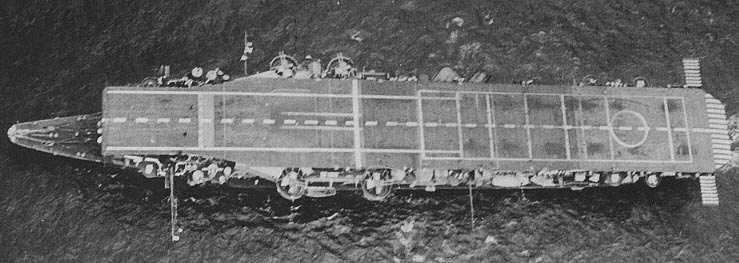
The doomed light carrier Ryujo.
In the alternative scenario Ryujo operates with the two heavy carriers; her job is to fly CAP and protect the big ships. But the real problem faced by the Japanese is that they started this war at all. It was a war of choice, not necessity, and it was driven by the Navy’s carrier faction which had no excuse to not have realized its terrible weakness.
The Japanese replacement system did not produce new pilots in any quantity, and the reforms intended to replenish the squadrons (put in place after Pearl Harbor, even before the Midway disaster) would not bear fruit until 1943. Even worse, the Japanese did not rotate individual pilots and aircrew; “they won’t let you go home unless you die” became the pilot’s lament. Exhausted pilots died before they could impart their experience to new recruits at home.
Further, Japanese industry had interrupted its assembly lines to produce new models and the Navy faced a shortage of planes as well as pilots. Japanese tactical doctrine exacerbated this problem, as a carrier’s primary protection came from its fighter planes. Her escorts were intended to defend against enemy surface ships, not against enemy aircraft, and their anti-aircraft batteries only fought off attacks directed against them and not the carrier. When Japanese carriers went into battle without their full air group, they were even more vulnerable than an American carrier in a comparable situation.
In Ironbottom Sound, we also take a look at what the Japanese might have achieved with a more robust system to provide planes and pilots, which fills the decks of all four carriers (Junyo as well as the three actual participants). The Americans get to use Wasp, which makes things about even. Even odds were about the best the Japanese could expect at this stage of the war.
Finally, in another Ironbottom Sound addition, we bring the full, reconstituted First Air Fleet (re-named the Third Fleet) into action with all six carriers (only two of which are any good). The Americans now get to use the carrier Hornet and her escort group, on their way to relieve Wasp to head home for repairs. They would arrive a week after the battle.
And that’s the approach I took to the Eastern Solomons chapters of South Pacific/Ironbottom Sound. Next time we’ll look at a different chapter.
Order South Pacific Here.
Order Ironbottom Sound Here.
Includes Solomons Naval Campaign book.
Order Solomons Naval Campaign Here.
Companion piece to Ironbottom Sound, or just read it separately.
Tales of the South Pacific
The grandest naval game ever made, with more scenarios and history.
• South Pacific
• Ironbottom Sound
• Solomons Naval Campaign
Retail Price: $236.98
Package Price: $200
Gold Price: $160
Tell the Tales.
Sign up for our newsletter right here. Your info will never be sold or transferred; we'll just use it to update you on new games and new offers.
Mike Bennighof is president of Avalanche Press and holds a doctorate in history from Emory University. A Fulbright Scholar and NASA Journalist in Space finalist, he has published a great many books, games and articles on historical subjects; people are saying that some of them are actually good.
He lives in Birmingham, Alabama with his wife and three children.
Daily Content includes no AI-generated content or third-party ads. We work hard to keep it that way, and that’s a lot of work. You can help us keep things that way with your gift through this link right here.
|