Leyte 1944:
Japan’s Type 89 Tank
by Mike Bennighof, Ph.D.
May 2025
 The Imperial Japanese Army saw little combat in the First World War, its battlefield experience not extending far beyond conquest of the German naval base at Tsingtao. Observers attached to the British Army tried to keep their superiors informed of new developments, and when reports came of the strange new machines called “tanks,” the Japanese asked the British to provide a sample. The Imperial Japanese Army saw little combat in the First World War, its battlefield experience not extending far beyond conquest of the German naval base at Tsingtao. Observers attached to the British Army tried to keep their superiors informed of new developments, and when reports came of the strange new machines called “tanks,” the Japanese asked the British to provide a sample.
A British Mark IV tank was imported in 1918, along with a British crew to demonstrate its capabilities. Over the next several years the Imperial Army obtained a total of 16 tanks of various models, and in 1925 decided to form a force of four tank battalions. A few Renault M1917 light tanks were imported to train a cadre, while Japanese tank designers led by the young engineer Tomio Hara began work on the first domestic tank design.
Lacking a domestic automobile industry, the Japanese had to design almost every aspect of their new tank from scratch. Where other countries could order parts and sub-assemblies “off the shelf,” Osaka Arsenal would have to make over 10,000 parts for Hara’s first design. Work began in May 1926 and a prototype rolled out in February of the next year.
 Known as “Experimental Heavy Tank I,” this vehicle had a main turret with a short-barreled 57mm gun and two smaller turrets each holding one machine gun. This design feature stood at the cutting edge of tank development at the time: French, British, German and Soviet designs all featured machine guns in separate turrets. Hara and his engineers had developed several innovative features, particularly the suspension. The tank was made of mild steel, and on its trials in June proved very slow, but the Imperial Army’s generals who assembled to view the experiment seemed thrilled that it moved at all. The army’s future tanks, they declared, would be made in Japan. Known as “Experimental Heavy Tank I,” this vehicle had a main turret with a short-barreled 57mm gun and two smaller turrets each holding one machine gun. This design feature stood at the cutting edge of tank development at the time: French, British, German and Soviet designs all featured machine guns in separate turrets. Hara and his engineers had developed several innovative features, particularly the suspension. The tank was made of mild steel, and on its trials in June proved very slow, but the Imperial Army’s generals who assembled to view the experiment seemed thrilled that it moved at all. The army’s future tanks, they declared, would be made in Japan.
They did not, however, place an order for series production of the new tank. Despite the generals’ enthusiasm, the army ordered several dozen Renault NC tanks, a modified version of the FT17, and designated them OTSU. They also ordered several sample tanks from British firms. Although Hara had proven that Japanese engineers could design a tank essentially from scratch and do so in an amazingly short period, and Osaka Arsenal had managed to build it, Japanese industry could not produce acceptable armor plate for tanks. Several more years would pass before Nihon Steel rolled out armor suitable for tanks.
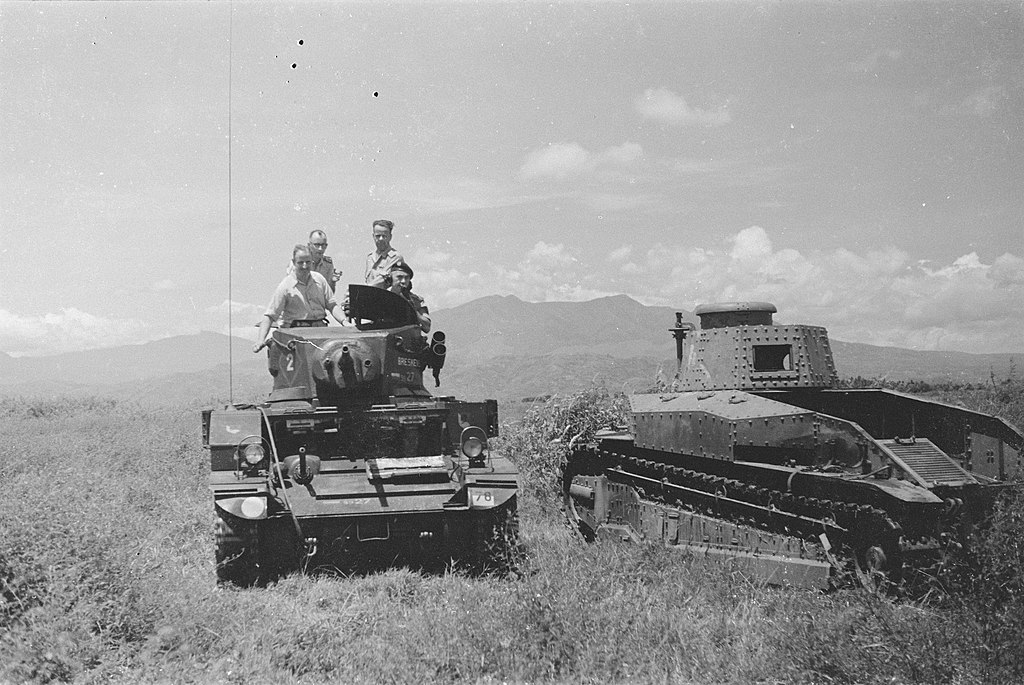
A Dutch M3 Stuart light tank rolls past a long-abandoned Type 89, February 1947.
The prospect of large-scale actions in China renewed Japanese interest in tanks. Mitsubishi Heavy Industry finally received an order in 1929 for Japan’s first domestic tank, a design derived from the British Vickers Medium C, known in Japan as the Type 89 Light Tank. Later re-designated a Medium Tank, the Type 89 like most Japanese weapons took its title from the Japanese year in which it was introduced - 2589 or 1929, 2589 years from the divine founding of the Japanese monarchy in 660 B.C. The Type 89 also carried a short-barreled 57mm gun, could make 15 miles per hour and weighed 12 tons. It had only 15mm of armor, sufficient to keep out machine-gun fire but little else. The vehicle went into series production in 1931.
The Type 89 first saw action in the Shanghai Incident in February 1932, when the 2nd Independent Tank Company took five Type 89 and 10 NC tanks to support the Japanese naval troops fighting in and around the city. In March 1933 the 1st special tank Company equipped with 11 of the tanks fought in Jehol Province in North China, making an advance of 190 miles in three days.
The Type 89 performed better than the French NC Renault, but still showed some problems: The space directly beneath the gun was completely open, and Chinese machine gunners soon discovered they could spray the crew with impunity. The gasoline engine tended to overheat very quickly in hot weather and could not be easily started in cold weather. The low speed did not bother the Japanese; the proper place for tanks was alongside infantry, and they saw no need for greater performance.
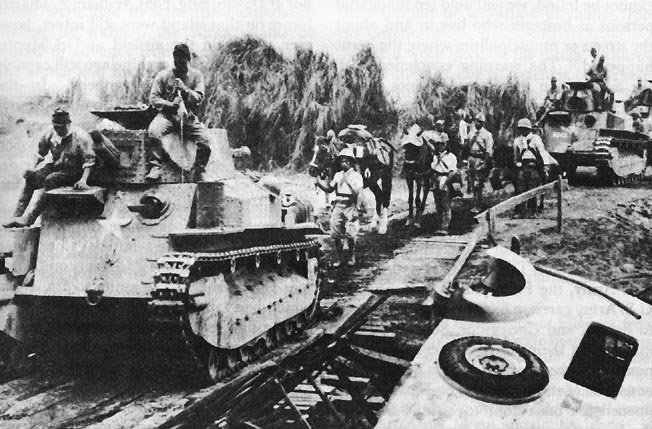
Type 89 tanks on their way to Manila, 2 January 1942.
Improvements to the Type 89 followed, with an armored gun mantlet quickly fitted. Mitsubishi had just developed an air-cooled diesel engine that showed promise as a power plant for tanks, and in 1933 a new model, designated Type 89B, appeared with this engine although the gasoline version remained in production until 1936. Though Japanese tank development lagged years behind other nations, in this area they were more advanced than even the United States or Germany until the end of World War II. the Mitsubishi diesel, produced in 6-, 8- and 12-cylinder versions, greatly reduced the risk of fire, used less fuel and did not require the high-grade gasoline that Japan increasingly could not produce as the war dragged on.
Japan gave emphasis to production of warships and aircraft, with few resources devoted to armored vehicles. Thus the Type 89 soldiered on even after a much better tank, the Type 95 Chi-Ha, entered production in 1935. Capt. Kojiro Nishizumi, Japan's first official “God of War,” commanded a Type 89 in the captures of Shanghai and Nanking. Nishizumi’s tank acquired at least 1,300 bullet pockmarks yet somehow kept functioning; Nishizumi died in northern Kiangsu Province in 1938 during a reconnaissance on foot ahead of his tank. He became a national hero, while his bullet-riddled tank first went to Yasukuni Shrine and then made a tour of Japan. The two of them became the subjects of a 1940 Japanese film, showing him as a devoted family man as well a fearsome soldier, and he and his tank became iconic images of the Imperial Japanese Army.

“God of War” Kojiro Nishizumi and his faithful Type 89 tank. Note the bullet scars.
The Type 89 made up about half the Japanese tank force at Nomonhan in 1939, where it was completely outclassed by Soviet BT-type fast tanks. Their last wide-spread use came in 1941 and early 1942 during the invasion of the Philippines, where even the American M3 light tank proved superior, and in Burma against British and Indian forces.
American forces encountered the ancient tank again in 1944 during the invasion of Leyte. The 7th Independent Tank Company nominally had 11 machines, deployed at Burauen Airfield to push heavy rollers. The three tanks considered fit for combat trundled off to attack the American beachhead on the first night of the invasion, to be promptly destroyed.
We couldn’t leave that action out of Panzer Grenadier: Leyte 1944, and so the Type 89 appears in the mix of new pieces. It balances its poor armor and weak armament with low speed, but at least it doesn’t have to face any American tanks.
Click here to order Leyte 1944.
Sign up for our newsletter right here. Your info will never be sold or transferred; we'll just use it to update you on new games and new offers.
Mike Bennighof is president of Avalanche Press and holds a doctorate in history from Emory University. A Fulbright Scholar and NASA Journalist in Space finalist, he has published a great many books, games and articles on historical subjects; people are saying that some of them are actually good.
He lives in Birmingham, Alabama with his wife and three children. He misses his lizard-hunting Iron Dog, Leopold.
Daily Content includes no AI-generated content or third-party ads. We work hard to keep it that way, and that’s a lot of work. You can help us keep things that way with your gift through this link right here.
|