War of the States, War of
the Empires
A Comparison of Battles in Europe and America of the 1860s
By Mike Bennighof, Ph.D.
August 2017
Sociologists and historians have known for over a century
that war is contagious. Social upheavals, technological change
and economic shifts often result in multiple conflicts. So
it was in the period 1859-1871, when the American Civil War
took place as well as wars between France and Austria, Austria
and Denmark, Prussia and Austria and finally Prussia and France.
Plus the Poles rose against the Tsar in a bloody revolt, and
Garibaldi overthrew the King of Naples and tried to knock
off the pope. The pope’s army also fought the Royal
Italian Army in an ill-fated crusade.
Though these wars took place at the same time and used the
same weapons for the most part, there are some key differences.
We’ll take a look at the Civil War and the European
battlefields in this piece, and how those differences translate
into game terms.
The Bayonets of 1859
Though only five years passed between the last battle of
the Crimean War and the outbreak of war in 1859 between France
and Piedmont on one side and Austria on the other, this conflict
usually marks the start of the 1860s cycle of violence. The
Minie rifle had become the standard infantry weapon, and
the French now introduced rifled artillery as well. Battles could
now be fought at greater range, with weapons capable of inflicting
even greater damage.
The war had two major battles, at Magenta and at Solferino.
Solferino’s carnage famously caused Henri Dunant to
found the International Red Cross to care for wounded soldiers.
But the actual flow of the battle had a profound effect on
other observers as well.
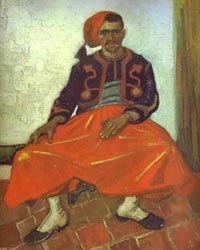
“The Zouave” by Vincent van Gogh, 1888
When the United States split into warring factions two years
later, many troops (mostly Northern, but some Southern as
well) marched off to the front uniformed as Zouaves. These
colorful French regiments, formed from French colonists in
Algeria, wore baggy pants, bright shirts and tousled caps.
And fought very well; though it looks clownish today the Zouave
uniform signalled toughness and spirit to the young men of
the time. Southern units soon received gray uniforms modelled
on those of the Zouaves’ toughest opponents, Austria’s
sharpshooting jäger battalions.
On the battlefield, the French achieved success with mass
bayonet charges. Austrian troops, having little practice with
their new Lorenz .57-caliber rifled muskets, failed to adjust
for the curved arc of fire of their new weapon and the French
soon entered a “safe zone” as they drew near the
Austrian lines. But very few noticed the ballistic problem
at the time; instead, the Austrian army adopted the dreaded stosstaktik of massed charges.
The Confederate side attracted the bulk of the pre-war U.S.
Army’s professional officer corps. These men brought
with them the latest thinking of the day: the same conclusion
drawn by the Austrians, that the bayonet charge would overwhelm
firepower. And Confederate armies paid the price, just as
the Austrians would. Historian Grady McWhiney’s bizarre
proposition that Southern troops charged due to their Celtic
heritage is demonstrably false; they did it because their
generals believed it would work.
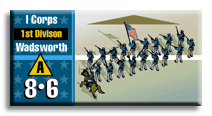

In our games, the Confederate and Union troops are not distinguished
by special rules. In both Gettysburg and Chickamauga
& Chattanooga, designer Dave Powell
neatly took care of the Southern penchant for the offensive
in the victory conditions. The Confederate player must attack
in order to win the game.
In Battles
of 1866: Frontier Battles, when troops execute a frontal assault they can attempt to close with the bayonet, which prevents the defender from retreating to reduce casualties and increases losses for both sides (a valid tactic when the attacker has a greater numerical edge). But the defenders get to fire first against a frontal assault, which can be devastating. The frontal assault is actually a very useful tactic when deployed judiciously; unfortunately for the Austrian player, some of his corps commanders are not so judicious and may attempt to launch bayonet charges whether the player wants them to or not.
Elite or Not
From the beginning, the series rules first provided in Gettysburg for War of the States/War of the Empires were intended
to serve games set on both continents. In retrospect that
was probably an error in judgement; we knew even then that
it would be a couple of years at best before a game set in
Europe would appear even had Gettysburg been a runaway
success.
This caused confusion among some players, as the rules mention
elite units yet there are no elite units in Chickamauga & Chattanooga and by the time Battles of 1866: Frontier Battles was released, there were none in that game either, despite the presence of the Prussian Guard and Austria's light cavalry. At this scale, there's just no need for additional elitism beyond that already conveyed by the game's morale system.
That reflects an element of historical game design I strive for whenever possible, but all too rarely achieve: to make the underlying game system yield historically valid results without scads of special rules. In this case, the morale ratings of elite units, interacting with processes like the Cold Steel and light cavalry rules, make the units elite without any additional rules for their eliteness.
Another measure of a unit's combat value is the number of steps with which it is represented. For the most part, a European brigade has more steps than a similarly-sized American division. A Prussian or Austrian brigade losing a step will usually see its combat strength reduced by just one factor, while a Union or Confederate division might lose two or three combat factors per step. That’s not a comment on American bravery but rather
on the personnel systems that made Prussian, Austrian and
Italian divisions more cohesive than American ones.
European armies contained a much greater proportion of long-service regulars, and the two societies handled replacements in very different
fashion as well. The American armies often recruited entirely
new regiments, while allowing the old ones to run down. This
deprived new soldiers of the experience of old hands, but
did provide new colonelcies for the politically connected.
European armies by this time usually recruited their troops
from geographic districts, and each regiment usually had a
“replacement” battalion at its home station which
fed new men into the field battalions as they suffered losses.
This gave greater unit cohesion and allowed regiments to pass
on experience. It also meant that every unit should have a
cadre of tough, older non-commissioned officers.
Order Battles of 1866: Frontier Battles right here.
Order Chickamauga & Chattanooga right here.
Mike Bennighof is president of Avalanche Press and holds a doctorate in history from Emory University. A Fulbright Scholar and award-winning journalist, he has published over 100 books, games and articles on historical subjects.
He lives in Birmingham, Alabama with his wife, three children and his dog, Leopold.
|