| North Cape:
Chapter Two: Spring 1942
By Mike Bennighof, Ph.D.
January 2025
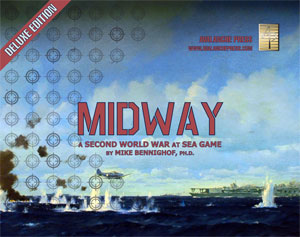
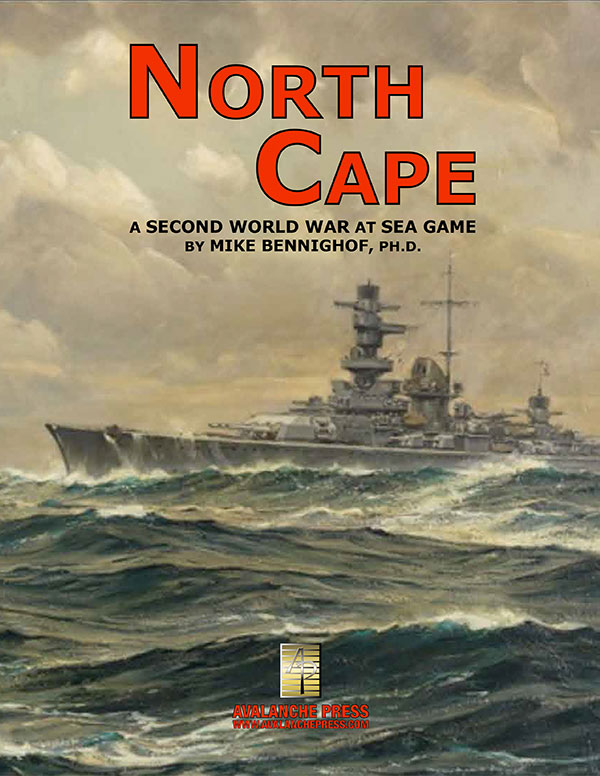 Second World War at Sea: North Cape is a big game, in the size range of Midway and Java Sea with a very large operational map and lots of ships and planes. It sort of has to be, as it covers a big campaign taking place over a very big stretch of ocean. Second World War at Sea: North Cape is a big game, in the size range of Midway and Java Sea with a very large operational map and lots of ships and planes. It sort of has to be, as it covers a big campaign taking place over a very big stretch of ocean.
The Murmansk convoys (some of them actually went on the Arkhangel’sk) began in the autumn of 1941 as a political gesture, as Winston Churchill wanted to make a physical show of Britain’s support for the Soviet Union as German spearheads pushed toward Moscow and Leningrad. The initial convoy operation demonstrated a clear lack of seriousness, with Churchill insisting that additional feats of derring-do be tacked onto the otherwise relatively straightforward mission.
By the spring of 1942, the situation had radically changed. The United States had entered the war, unleashing massive quantities of military aid that needed to be delivered. And the Americans backed their commitment with warships to bolster the British convoy escorts. Meanwhile, the Germans finally noticed this back-door route to the Soviet Union, and figured out that they actually had ports and airfields perfectly placed to allow them to attack this traffic with surface ships, submarines, and aircraft.
Chapter Two of North Cape picks up the action in March 1942, when the convoy traffic resumed to accommodate the flow of American aid, through May 1942, with the transit of Convoy PQ.16 heading east to Murmansk, and Convoy QP.12 coming back westwards with mostly empty ships. These return convoys also carried loads of Russian timber, metal ores and other raw materials. While these cargoes were usually a matter of opportunity, the Western Powers intended to exact at least some payment from the Soviets rather than grant them weapons and other materials as a gift. For their part, the Soviets did not wish the Lend-Lease program to present them as beggars, beholden to the capitalists. Both sides had political reasons to assure that goods moved in both directions.
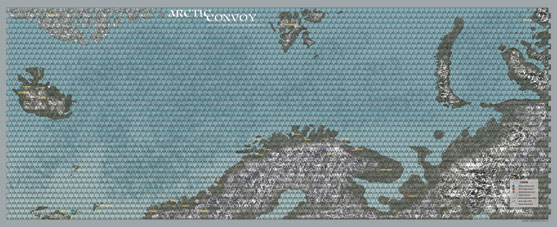
Those three months of the campaign represent some of the most intense action. Chapter Two has fifteen scenarios: six operational scenarios, which take place on the big map of the Arctic Ocean and surrounding waters, and nine battle scenarios, which move the action directly to the tactical map where ships and planes shoot at each other with guns, bombs, and torpedoes. That’s what we’d put into one of our Campaign Studies, and much more than most publishers would call a complete game. For us, it’s one chapter.
For me, the designer, it’s a chapter that includes some memories. Among those nine battle scenarios is Number Eleven, Sinking the Galleon. It’s a much-revised version of the first scenario I ever designed and got published in a game, the old Quarterdeck Games The Royal Navy. I was fourteen years old, and I got hold of Frank Pearce’s then-new Last Call for HMS Edinburgh and studied every line closely and crafted a game version of the gold-bearing cruiser’s final battle. As part of that payment for freely-given aid, she was carrying five tons of the Tsar’s gold bars, though the Germans did not know this.

Edinburgh, heading westward as part of the same operation that brought the merchant ships of Convoy QP.15 home (though the cruiser sailed separately) had already been damaged by a submarine’s torpedo. Per usual, the German destroyers acted far less aggressively than the situation demanded, but through very lucky shooting (usually described as “excellent gunnery,” but they rarely showed such skill) they badly damaged both of the cruiser’s escorting destroyers and sank Edinburgh herself with a long-range torpedo hit. But not before Edinburgh sank one of the German destroyers with a devastating salvo from her main guns, and in keeping with their usual practice, the remaining German boats fled the scene rather than finish off the damaged British destroyers.
This is an aspect of Second World War at Sea games that I deeply appreciate as the games’ designer. North Cape, like all of its sister games, has two distinct levels: the operational scenario and the battle scenario. The battle scenario, as seen in Sinking the Galleon (and pretty much all of them) makes for interesting game-play all on its own. This isn’t just a “battle board” to resolve combat in the operational scenarios. They tell parts of the story that the operational scenarios can’t match; players are unlikely to bring about a clash between the German 8th Destroyer Flotilla and Edinburgh exactly as happened in the actual campaign. The battle scenarios are crucial to the story arc, to telling the story of the campaign through the game’s scenarios.
It's not just the actions that happened, but those that didn’t, yet were likely. The chapter kicks off with Operation Sports Palace, the first of the handful of sorties that the dread battleship Tirpitz made against the British convoys (in this case, in pursuit of Convoy PQ.12). Tirpitz came within 50 miles of the homeward-bound Convoy PQ.8, and within 110 miles of the Murmansk-bound PQ.12, but failed to make contact with either convoy. The British, for their part, failed to make contact in their own attempts to intercept the battleship. That’s the sort of missed-connection situation that cries out for the battle scenario treatment, even though the battles did not actually take place. So we have them, in North Cape, so you can see for yourselves if Tirpitz really was such a threat.

The next operation, PQ.13 (the code names of these early convoys came from the initials of an Admiralty staffer, Commander Phillip Quellyn Roberts), would face more potential opposition, as the Germans transferred more ships to Norway. The Germans staged more surface ships to Norway and then . . . kept them in port. The Allies couldn’t know this, and had to deploy major assets of their own to counter them. Once again, only the German destroyers sortied, and in a confused battle the British light cruiser Trinidad managed to torpedo herself. We have that battle!
The very presence of Tirpitz and a pair of heavy cruisers spooked the First Sea Lord, Sir Dudley Pound, and he urged that the convoy traffic be suspended. American President Franklin D. Roosevelt, who knew the value of credibility in a crisis, insisted that they go forward, and offered powerful American naval reinforcements to make it happen. That brings the American fast battleships onto the game board, and for the rest of the chapter the Axis player has to deal with the knowledge that somewhere out there is a death star capable of exposing the over-rated Tirpitz as the warmed-over Dreadnought Age design she was.
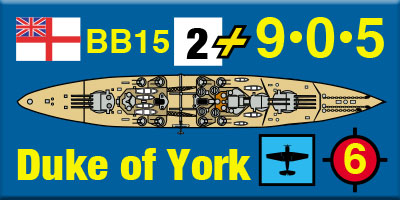
Mechanically speaking, Second World War at Sea is quite straightforward, with most game functions built around rolling a 6 on the die. It’s easy to play, as wargames go (that’s an important caveat); both halves of the game (operational and tactical) work intuitively. It’s the most popular naval game series in the known universe for a reason.
But what truly sets it apart is its ability to tell a story. North Cape is yet another example of this; all six chapters show this same rich depth and immersive play experience.
You will be glad you played this game.
You can order North Cape right here.
Sign up for our newsletter right here. Your info will never be sold or transferred; we'll just use it to update you on new games and new offers.
Mike Bennighof is president of Avalanche Press and holds a doctorate in history from Emory University. A Fulbright Scholar and NASA Journalist in Space finalist, he has published a great many books, games and articles on historical subjects; people are saying that some of them are actually good.
He lives in Birmingham, Alabama with his wife and three children. He misses his lizard-hunting Iron Dog, Leopold.
Daily Content includes no AI-generated content or third-party ads. We work hard to keep it that way, and that’s a lot of work. You can help us keep things that way with your gift through this link right here.
|