| Tropic of Capricorn:
Argentina’s Airships
By Mike Bennighof, Ph.D.
June 2020
 In the years following the First World War, South American economies boomed as Europe once again began buying huge quantities of beef, grain and other agricultural products. In Argentina, rapid growth led to the arrival of airships, the great floating symbol of the modern age. In the years following the First World War, South American economies boomed as Europe once again began buying huge quantities of beef, grain and other agricultural products. In Argentina, rapid growth led to the arrival of airships, the great floating symbol of the modern age.
The Argentine Navy had developed an interest in light-than-air craft well before the Great War. In 1906 Lt. Pedro Padilla visited England and observed several airships, writing enthusiastic reports back to Buenos Aires. On his return, the Navy Minister ordered Padilla to prepare a detailed study of airship use for the Navy, and the lieutenant recommended purchase of two French-built Godard airships for naval scouting.
For the next several years the Argentines studied the question, and finally in 1916 President Victorino de la Plaza authorized an airship base and training center at Fort Barragan in Ensenada, a port on the Plata estuary about 35 miles from Buenos Aires. Thanks to the war raging in Europe it took a few more years to actually acquire airships and the training needed to use them.
With the war ended, Baron Antonio de Marchi bought an Italian O-class semi-rigid ship, in the hopes of establishing commercial service between Buenos Aires and Montevideo, Uruguay. In 1920 an Italian crew brought her to Buenos Aires to great public excitement. The mayor of Buenos Aires designated part of the main railway station as an airship terminal. The ship made test flights at the end of the year, and her public debut in January 1921.
Huge crowds turned out for the commissioning, and the bishop of Vasallo Torrega blessed the airship, christening her El Plata. Bad weather prevented the flight, but finally she took to the skies over the capital on a series of promotional flights. But despite his political connections - he was married to the granddaughter of former president Juan Roca - the baron couldn’t raise enough investment capital to get his airline off the ground. At the end of 1921 he sold El Plata and the airline’s support equipment to the Argentine Navy at a huge loss.
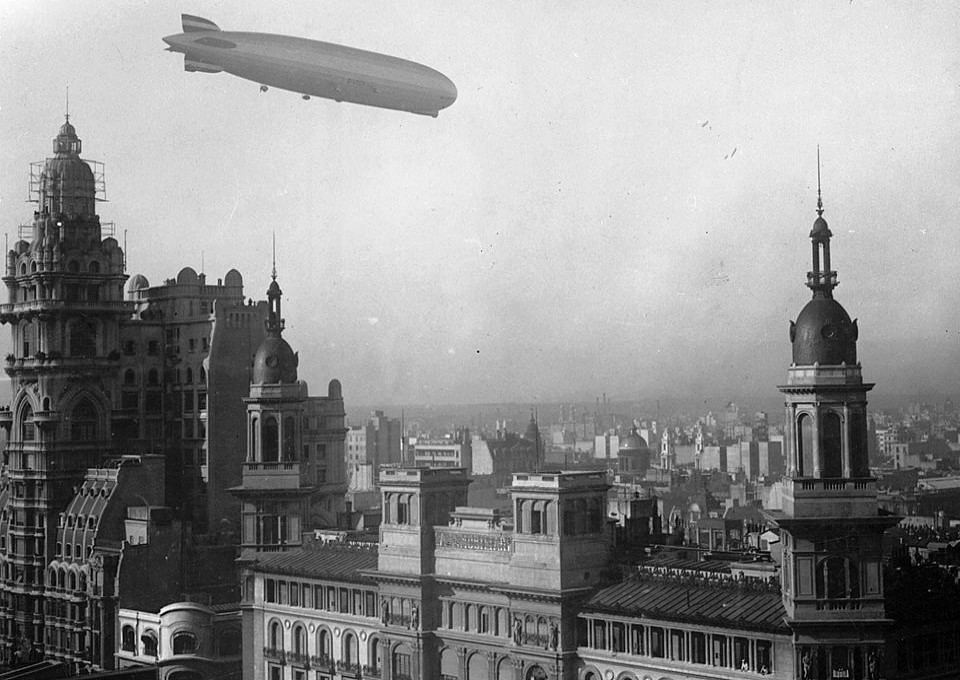
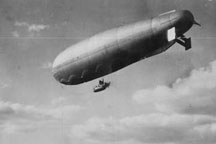
Graf Zeppelin over Buenos Aires, 1934.
President Hipolito Yriogoyen signed an order funding the flight school and airship base at Ensenada, as well as acquisition of a sister ship. Italian instructors were hired, and training flights with El Plata began immediately. She exercised with the fleet, and made longer and longer flights. At the end of 1922 her sister ship, Los Andes, arrived and Argentine crews went to Italy to train at the Italian airship center in Ciampino.
But just as enthusiasm for airships was waxing in Argentina, it waned in Italy under the influence of Italo Balbo, appointed Air Minister in 1926. Balbo preferred large airplanes deployed in large formations, and shut down the lighter-than-air program. Deprived of Italian support, the Argentine program began to slowly deflate as well.
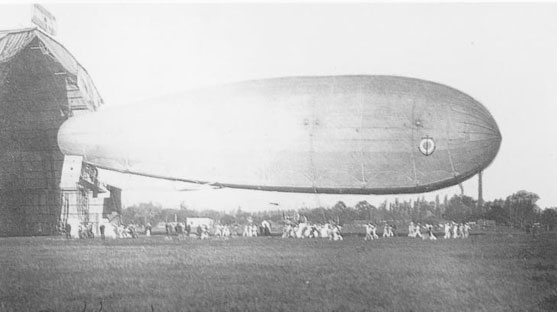 El
Plata is brought out of her hangar, 1927. El
Plata is brought out of her hangar, 1927.
The airship section and school moved to the Punta Indio naval base in 1924, joined a few years later by the Navy’s flight school. By the late 1920’s the airships were undertaking a flight every week, a very rapid pace. One airship would be active at a time, with the other deflated and held in reserve. They trained crews, worked with the fleet, and undertook propaganda missions over Argentine cities. The Navy was pleased with its airships but as they became worn, replacement proved a problem. With the Italian program shut down, Caproni had shifted its airship works to build conventional aircraft. If Argentina wished to continue its airship division, the Navy would have to switch to the British firm of Vickers or the American Goodyear-Zeppelin company for parts and support.
In January 1929 Los Andes was destroyed when a cyclone devastated the Punta Indio naval base and surrounding areas; there were no casualties except the airship program. El Plata was judged too worn to re-inflate to replace her sister, and she was formally retired in 1930. With the Great Depression raging, there was no funding for replacements as the military junta that overthrew Yrigoyen that same year had no wish to spend their rapidly-dropping foreign currency reserves. A downward trend began for the Argentine economy that would last for over 60 years, as per capita income fell from the world's top five (ahead of France and Germany) to “developing” levels. Successive governments, both military and civilian, indulged in massive budget deficits that simply encouraged inflation.
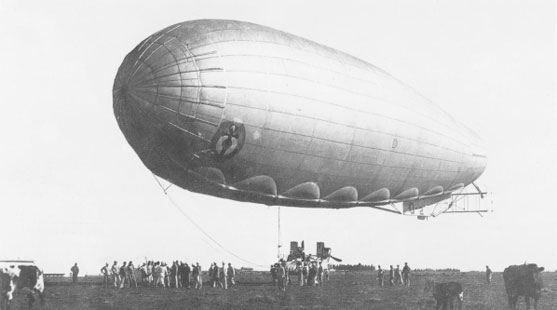 Los
Andes prepares for liftoff. Los
Andes prepares for liftoff.
In the world of The Second Great War, that’s not exactly how things happened. Italy maintained her airship program, the Great Depression was a far milder recession with no Weimar war debt or banking crisis to fuel it, and the quasi-fascist government of former War Minister Augustin Justo retains plenty of foreign exchange reserves and the will to spend them on the military. Argentina is prosperous, and Justo considers the fleet’s airships to be an important symbol of that prosperity.
Replacements for the small original airships are ordered in 1932 and delivered in 1934, both built by Caproni in Italy. Bradley and Zuloaga are semi-rigid ships of the typical Italian type, with a rigid keel along the bottom of the ship but depending on gas pressure to retain their sausage shape rather than the wooden or metal framework used in a rigid airship. The keel houses internal bomb racks and crew quarters, and the machine guns mounted for defense - leaving a gaping “blind spot” above the ship.
The two airships each have a gas volume of about 3.5 million cubic feet, with five stations along the keel where airplanes can attach themselves through a “trapeze” installation. When not in use the aircraft dangle in the open air, and can be refueled there and re-armed but only with machine-gun ammunition or small bombs. Their pilots can climb up into the airship’s keel by ladder.
The Argentines were very pleased with their airships, flying them during fleet exercises and on propaganda tours all across the republic. That is, until their hated Brazilian rivals unveiled their own new airships in early 1940, gigantic vessels of the Valkyrie class close to four times the size of the Argentine ships and considerably more capable, operating a dozen aircraft out of a true hangar. Italy could supply nothing like them, and the Argentines would have to wage the Second Great War on the short side of an airship gap.
Click here to order Tropic of Capricorn (Playbook edition) right now!
Sign up for our newsletter right here. Your info will never be sold or transferred; we'll just use it to update you on new games and new offers.
Mike Bennighof is president of Avalanche Press and holds a doctorate in history from Emory University. A Fulbright Scholar and NASA Journalist in Space finalist, he has published an uncountable number of books, games and articles on historical subjects; a few of them were actually good.
He lives in Birmingham, Alabama with his wife, three children and his dog, Leopold. Leopold enjoys gnawing his deer antler and editing Wikipedia pages.
Want to keep Daily Content free of third-party ads? You can send us some love (and cash) through this link right here.
|