| Knights of Granada
By Mike Bennighof, Ph.D.
November 2021
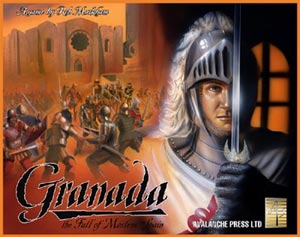 Granada: The Fall of Islamic Spain, a complete game exclusively for our Gold Club, is one of our most beautifully-designed games, and one of the best as a two-player contest. Players lead either the forces of Granada trying to stave off their kingdom's extinction, or the united forces of Castille and Aragon who are out to wipe out Islam in Iberia. Granada: The Fall of Islamic Spain, a complete game exclusively for our Gold Club, is one of our most beautifully-designed games, and one of the best as a two-player contest. Players lead either the forces of Granada trying to stave off their kingdom's extinction, or the united forces of Castille and Aragon who are out to wipe out Islam in Iberia.
The game is based on the final war for Granada, which lasted form the invasion by Ferdinand and Isabella in 1480 until Granada fell by intrigue in January, 1492. Players win through capture or retention of Granada's castles, the strategic key of the early Renaissance.
The Spanish player's striking power lies in the knightly orders of Santiago, Calatrava and Alcantara. These are the strongest and most numerous Spanish units.

“Weep like a woman for what you could not defend like a man.” Granada's last king makes submission. Painting by Francisco Pradilla Ortiz.
Knights of Santiago
Saint James (Santiago) is the patron saint of Spain, his name itself a battle cry for Spanish soldiers of this era. King Fernando II of León created the “Military Order of Saint James of the Sword” in 1162 by knighting a number of lesser noblemen who had taken on the task of defending pilgrims along the roads to Santiago de Compostella, the shrine where Saint James' remains are held.
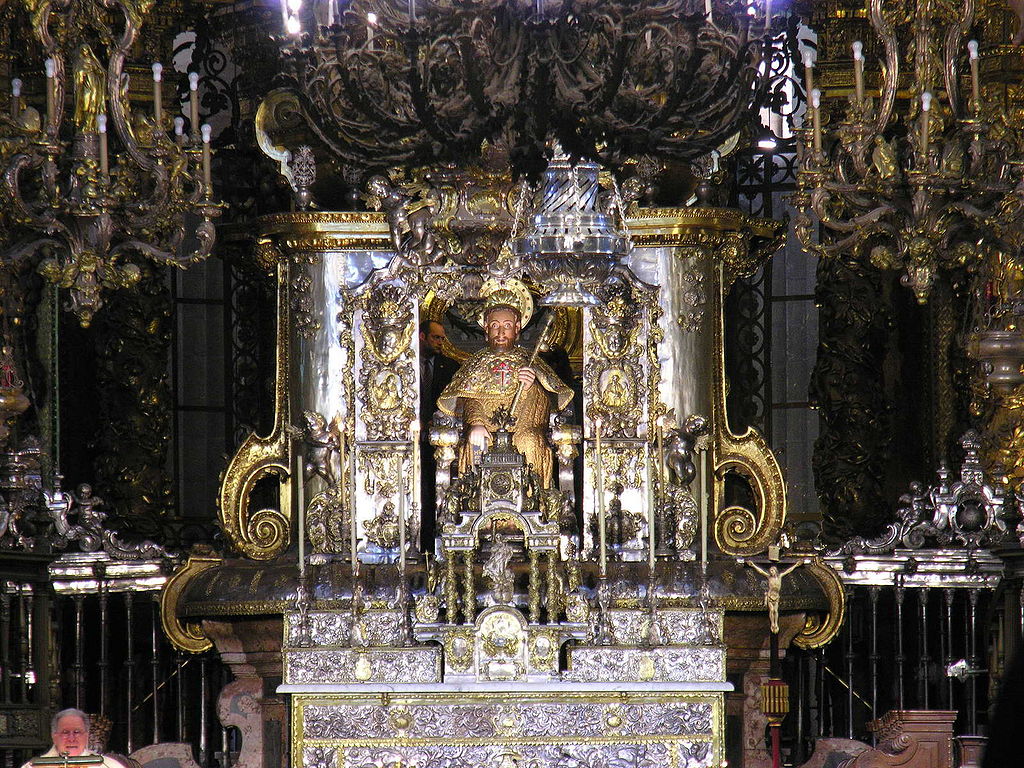
The shrine as it appears today.
Over the following centuries, the order became wealthy and powerful. At its height, it counted over 700,000 members. Knights swore an oath to defend the poor, aid the sick, and to follow a vow of "marital chastity" (sex with wives was approved, sex with others discouraged).
The order grew weaker in the decades before the final campaign of the Reconquista. Civil war broke out between the order's Castillian and Aragonese chapters in 1445 when a new Grand Master could not be chosen. The order lost over a quarter of its membership through fratricidal combat, murder, and resignations.
The knights entered Ferdinand and Isabella's campaign in Granada determined to wipe out this stain on their honor, and fought fanatically as a result. In the first campaign, the king entrusted command of the force facing Malaga to the Grand Master of the Order, Don Alfonso de Cárdenas.
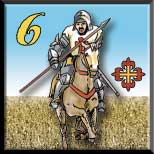 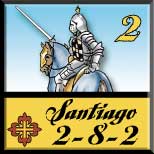
The Grand Master led his army into a trap, as Muhammed al-Zagal lured him into a series of narrow valleys and cut his army to pieces. The Knights of Santiago maintained discipline as the army fell apart, but eventually broke up as well when the Grand Master fled. "Oh God," the Grand Master cried out, "You have changed the cowardice of these infidels into desperate courage!" Several hundred knights and thousands of other Spaniards fell captive to the Moors, who also took the Order's sacred banner.
The Order fought on throughout the 12-year war, and Ferdinand honored them by allowing them to be the first Spanish troops to ride into Granada after her surrender. The recovered sacred banner finally flew from the city's Alhambra.
Knights of Calatrava
The Knights of Calatrava began as an order of fighting monks. In 1147, the Knights Templar abandoned the recently-captured fortress of Calatrava, claiming it could not be held against Moorish counter-attack. Abbot Raymond of the Cistercian monastery at Fitero offered to hold the castle with his brothers. A retired knight had trained the monks in sword and lance, and they were fanatically eager to die for their faith.
 
King Alfonso IX of Castille, probably expecting them to do just that, agreed to let them try. For three years they held off the Muslims, and as a reward, Alfonso knighted them. Following the Cistercian rules of poverty, chastity and obedience, the fighting monks became the spearhead of the Reconquista, fighting in all its campaigns. Successive kings of Castille and Aragon rewarded the order with castles and lands. By the 14th century, the monks had lost their fanatical edge, intriguing instead over control of the order's wealth.
The order's Grand Master, Lopez de Padilla, put the knights' vast wealth at Ferdinand's disposal and financed the final war with Granada portrayed in the game. The knights fought in all the important battles, but when Granada fell, Padilla believed the order had no further mission. It was dissolved, with some members returning to a contemplative life, and others seeking new worlds to conquer as secular knights.
Knights of Alcantara
This order began as a small group living under monastic rule and fighting the Muslims, called the Order of San Julian from the small town where they were founded. In 1213 the order took over the fortress of Alcantara from the Knights of Calatrava, who did not wish to maintain a major base so far from their other holdings, and became theoretically subject to that order.
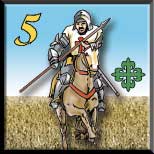 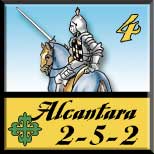
By 1318 the Knights of Alcantara had acquired lands and castles of their own, and ignored the orders of the Grand Master of Calatrava. A civil war broke out that year over election of a new Grand Master of Alcantara, and rival Grand Masters vied for control until 1473. In that year, Ferdinand of Aragon imposed an outsider, Juan de Zuniga, as the new Grand Master.
Zuniga re-directed the order's energies toward the war with the Moors, and was a major instigator of the dual monarchs' decision to conquer Granada once and for all. The knights fought throughout the war, but were never as militarily important as the other two Spanish orders. Zuniga served as a military commander during the wart, but his role was primarily as a political advisor.
After Granada fell, Pope Alexander VI celebrated by naming King Ferdinand Grand Master of Alcantara for life, without so much as consulting Zuniga. The previous grand master bowed to the inevitable two years later. Like the other two orders, the Knights of Alcantara lost their reason for existence the moment Granada's last king handed over the keys to his city. The order declined rapidly thereafter, abandoning celibacy in 1540. It remains in existence, as do the others, still holding great wealth despite the best efforts of Napoleon, the Popular Front and Francisco Franco to dispossess them.
Granada: The Fall of Islamic Spain is free to Gold Club members.
Click here to join the Gold Club right now!
Sign up for our newsletter right here. Your info will never be sold or transferred; we'll just use it to update you on new games and new offers.
Mike Bennighof is president of Avalanche Press and holds a doctorate in history from Emory University. A Fulbright Scholar and NASA Journalist in Space finalist, he has published a great many books, games and articles on historical subjects; people are saying that some of them are actually good.
He lives in Birmingham, Alabama with his wife, three children, and his Iron Dog, Leopold.
Want to keep Daily Content free of third-party ads? You can send us some love (and cash) through this link right here.
|