| Ode to the Austrian Navy
By Mike Bennighof, Ph.D.
November 2020
 Once, long ago, Austria had a navy. I was aware of this from my earliest days. Salzburg's military museum, buried in the depths of the Hohensalzburg fortress, is mostly dedicated to the exploits of my grandfather's old unit, the 59th “Erzherzog Rainier” Infantry Regiment. But when I was small, it also had a large model of a torpedo boat, and a painting of an Austrian cruiser slicing through the Adriatic. I'm not sure either is still there, but I clearly remember seeing them. But then, sometimes, I do get confused. Perhaps the painting and model were in Vienna. Once, long ago, Austria had a navy. I was aware of this from my earliest days. Salzburg's military museum, buried in the depths of the Hohensalzburg fortress, is mostly dedicated to the exploits of my grandfather's old unit, the 59th “Erzherzog Rainier” Infantry Regiment. But when I was small, it also had a large model of a torpedo boat, and a painting of an Austrian cruiser slicing through the Adriatic. I'm not sure either is still there, but I clearly remember seeing them. But then, sometimes, I do get confused. Perhaps the painting and model were in Vienna.
So why did Austria-Hungary have a navy? I’ve studied this question for many years, and the answer seems simple. Naval advocates (the Navy Ministry and the civilian Navy League) offered up two reasons. In the event of war against Italy, a powerful fleet would prevent amphibious landings along Austria’s Dalmatian coast. In the event of war alongside Italy, the fleet would be Austria-Hungary’s contribution to the Triple Alliance in the Mediterranean.
As a faction within the Navy’s leadership argued, minelayers, torpedo boats and submarines would have made the islands and narrow waters of Dalmatia a death trap for any invading fleet. As for the Triple Alliance, the Austro-Hungarian leadership regarded it as a dead letter even while they struggled to fund the land forces. Instead, the Navy built battleships for a reason the resonates more than a century later: because the projects enriched politically-connected defense contractors.
 So the Imperial and Royal Austro-Hungarian Navy was an absurd institution with no reason to exist, and therefore perfectly resonant with Imperial Austrian culture. That very absurdity is what has driven me to include it in as many games as possible. Not everyone gets the joke, which is, of course, part of the joke. I really did spend too much of my time in Vienna in cafes instead of the archives. So the Imperial and Royal Austro-Hungarian Navy was an absurd institution with no reason to exist, and therefore perfectly resonant with Imperial Austrian culture. That very absurdity is what has driven me to include it in as many games as possible. Not everyone gets the joke, which is, of course, part of the joke. I really did spend too much of my time in Vienna in cafes instead of the archives.
I started my obsession while still a teenager, when I signed on to do various design and development tasks for Jack Greene at Quarterdeck Games. Among the tasks Jack set for me was to craft an operational game to go along with The Royal Navy, then the new Quarterdeck naval game. This was a purely tactical game, a series of battle scenarios from both the First and Second World Wars, and fairly complicated with hit records on separate sheets of paper and intense interaction between armor thickness and gunnery penetration. I did make sure it had at least a few Austrian ships in it.
 As a topic for this operational game, Jack set the cruises of the German battlecruiser Goeben on the Black Sea during World War I. I'm sure he had a good reason for this and shared it with me. Jack taught me a lot about game mechanics and guided me through the design process, but before this game was finished, Quarterdeck went away. As a topic for this operational game, Jack set the cruises of the German battlecruiser Goeben on the Black Sea during World War I. I'm sure he had a good reason for this and shared it with me. Jack taught me a lot about game mechanics and guided me through the design process, but before this game was finished, Quarterdeck went away.
That heavily Jack-influenced game became the basis for Great War at Sea. It’s evolved considerably since then, but there’s a lot of the old game still visible (not least the split between operational and tactical games, since the original had no tactical game at all). We’ve done several versions of a game set in the Mediterranean, with The Wine-Dark Sea as the most recent and up to date.
The Wine-Dark Sea has the full Austro-Hungarian order of battle as it appeared, and a few ships that were planned but not built: the Ersatz Monarch class dreadnoughts, two flavors of proposed battle cruiser, the 1906 fast armored cruiser, the 1917 fast armored cruiser, the Ersatz Zenta light cruisers. the four “China cruisers” and the proposed large destroyer. And there are a couple of aged cruisers in Cruiser Warfare.
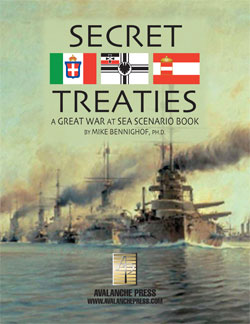
That didn’t seem like enough, so there are still more Austro-Hungarian ships in the expansion book Secret Treaties. The story background has the Triple Alliance partners (Germany, Italy and Austria-Hungary) taking their commitments seriously and touching off a Mediterranean naval arms race, thereby providing an excuse to provide pieces for ships designed or proposed by the Austrian, Italian and French navies but never actually built. The Austrian contingent includes the 1906 “small dreadnought” design, the 1917 battleship and battle cruiser designs and the proposed conversion of a torpedo depot ship into an aircraft carrier.
 We have a Golden Journal that allows me to indulge in strange game stuff, and for some reason it took a whole before I finally used it to add more Austrian ships to a naval game (in this case, The Wine-Dark Sea). Golden Journal No. 35: Viribus Unitis is all about alternative designs: fast battleships with lighter armament, semi-dreadnoughts with full dreadnought armament, Austrian ships sold off to allies who might make better use of them. We have a Golden Journal that allows me to indulge in strange game stuff, and for some reason it took a whole before I finally used it to add more Austrian ships to a naval game (in this case, The Wine-Dark Sea). Golden Journal No. 35: Viribus Unitis is all about alternative designs: fast battleships with lighter armament, semi-dreadnoughts with full dreadnought armament, Austrian ships sold off to allies who might make better use of them.
That seemed like the best place for them; naval series developer Jim Stear insists that every piece we put in a book or game should appear in at least one scenario. That’s a good rule, but what do you do with two different versions of the same ship when all of the scenarios are supposed to follow the same story arc? I’m sure there are creative ways to work around that, but lacking the skill for that I just put them in a different product. Which is sort of like cheating, but that freed more space in Secret Treaties for things like Italian fast armored cruiser designs so I think it’s a good solution.
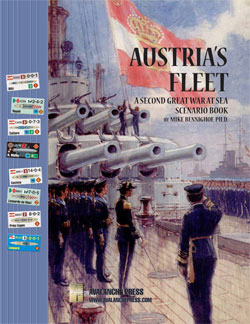
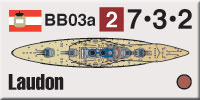 The Imperial and Royal Navy gets to appear again in Second Great War at Sea: Austria’s Fleet, which is part of the Second Great War alternative history story arc. And I crafted that alternative history with two objectives in mind: to present the Austrian Navy in a 1940’s guise, and to kill off Hitler. I ended up making him a bitter, mediocre artist with a bloated ego and delusions of adequacy, because that seemed the worst possible fate. The Imperial and Royal Navy gets to appear again in Second Great War at Sea: Austria’s Fleet, which is part of the Second Great War alternative history story arc. And I crafted that alternative history with two objectives in mind: to present the Austrian Navy in a 1940’s guise, and to kill off Hitler. I ended up making him a bitter, mediocre artist with a bloated ego and delusions of adequacy, because that seemed the worst possible fate.
The Austrian fleet of 1940 (they’ve dropped the “-Hungarian” by this point) includes modernized versions of their Great War and projected ships, plus some new classes that follow similar design practices. It’s a surprisingly popular series (well, it surprises me), and they’re fun to write and design. Crafting a story that includes a purpose for the Austrian Navy and then keeps it from getting wiped out wasn’t easy.
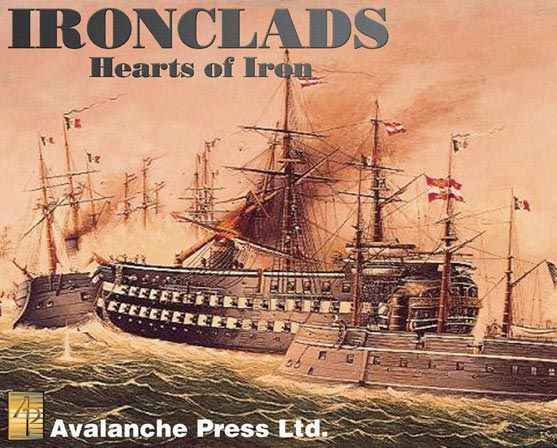 I got to put an earlier version of the Austrian Navy (before it was Imperial and Royal) in Ironclads: Hearts of Iron and the smaller introductory game, Ironclads: Helgoland 1864. I drew pretty heavily on Great War at Sea for the operational side of the game; the tactical part uses the same Naval Tactical Map as Great War at Sea but play itself is different (it does retain “roll a 6, stupid” as the key to its game engine). I got to put an earlier version of the Austrian Navy (before it was Imperial and Royal) in Ironclads: Hearts of Iron and the smaller introductory game, Ironclads: Helgoland 1864. I drew pretty heavily on Great War at Sea for the operational side of the game; the tactical part uses the same Naval Tactical Map as Great War at Sea but play itself is different (it does retain “roll a 6, stupid” as the key to its game engine).
Originally, I intended to put the ships in Ironclads on the same ultra-huge pieces we used in Zeppelins and Rome at War. Developer Jim Stear convinced me to keep them consisted with the other naval series, and I see that now as a better solution (while the big pieces fit on the Naval Tactical Map, it gets kind of awkward in some situations). That freed a lot of cardboard real estate and I used it for a lot more Austrians: the squadrons of screw-powered ships of the line and frigates offered as an alternative to the ironclad program and the armored ships Austria attempted to purchase from foreign shipyards.
The Austrian Navy is central to Hearts of Iron; the rivalry between the Austrian Empire and the upstart Kingdom of Italy played out in the Battle of Lissa, the first battle between armored warships on the high seas. You can’t have an Ironclads series without the Austrian Navy. Or any other naval game series; I suppose I’ll have to write a Third Great War story so we can get them into Cold War at Sea.
Click here to join the Gold Club, get updates and score discounts on the Austrian Navy.
Sign up for our newsletter right here. Your info will never be sold or transferred; we'll just use it to update you on new games and new offers.
Mike Bennighof is president of Avalanche Press and holds a doctorate in history from Emory University. A Fulbright Scholar and NASA Journalist in Space finalist, he has published countless books, games and articles on historical subjects.
He lives in Birmingham, Alabama with his wife, three children and his dog, Leopold.
Want to keep Daily Content free of third-party ads? You can send us some love (and cash) through this link right here. You don’t have to, but Leopold would like it if you did.
|