| Lithuania’s Iron Wolves:
The Pieces
By Mike Bennighof, Ph.D.
November 2023
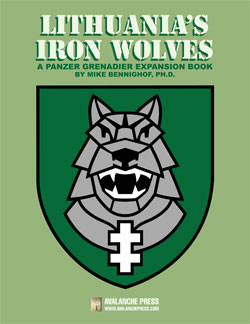 I always wanted Panzer Grenadier to be the game series that went where no one else dared. And if I’ve accomplished nothing else in over 25 years of running this firm and its predecessor, I succeeded in that regard beyond all expectations. Whether or not this is a good thing is debatable, but it does mean that Panzer Grenadier players have access to a range of play experiences they can find nowhere else. I always wanted Panzer Grenadier to be the game series that went where no one else dared. And if I’ve accomplished nothing else in over 25 years of running this firm and its predecessor, I succeeded in that regard beyond all expectations. Whether or not this is a good thing is debatable, but it does mean that Panzer Grenadier players have access to a range of play experiences they can find nowhere else.
And so it is with Lithuania’s Iron Wolves, which gives you the forces of Lithuania with which to fight the Germans, the Poles and the Soviets in battles that never happened. This is, to the best of my knowledge, the only treatment of the Lithuanian Army of World War II ever offered at the tactical scale (and all those at other scales of which I’m aware were also by Avalanche Press).
Here’s a look at the Iron Wolves themselves:
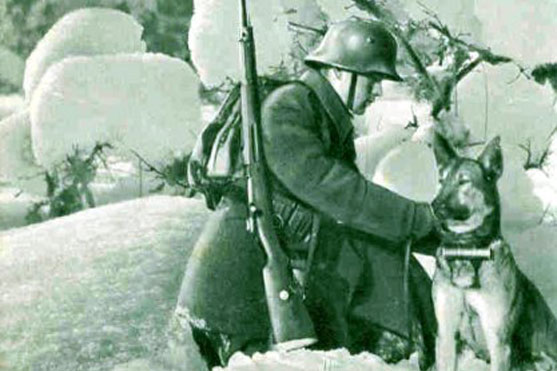
Not an Iron Wolf, but a defender of Lithuania all the same.
Lithuania’s Iron Wolves includes 165 pieces; 107 represent pre-war Lithuanian troops, weapons and leaders, with another 30 more from the collaborationist Lithuanian Defense Force and 28 for the Polish Home Army.
Foot Soldiers
Lithuania tried to create a modern, mechanized army, but its three divisions remained a bayonet force in 1939. They existed in peacetime as cadre forces, to be fleshed out by members of the “Rifle Association” — a “club” controlled by the Ministry of Defense and serving as an army reserve in all but name.
  
Lithuania seized hundreds of thousands of varied rifles during the chaos of the Russian Civil War and the Soviet-Polish War, but standardized its small arms in the early 1930’s. Infantrymen carried either the Belgian-made FN Model 30 bolt-action rifle or the Czech-made Vz.24.
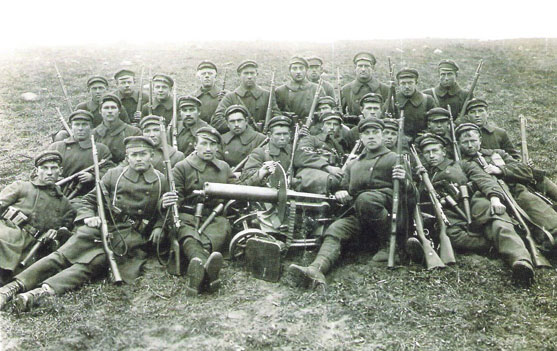
Lithuanian infantrymen with a Maxim machine gun.
Lithuania’s infantry regiments received comparatively lavish allotments of machine guns. The army held on to the Maxim M1910 weapons taken during the independence struggle — a perfectly serviceable weapon despite its anachronistic look with its shield and small wheels. Lithuania also purchased Czech ZB.26 light machine guns and Vickers and Browning medium machine guns.
Armor
Lithuania obtained its first real tanks in 1923, when it bought a dozen of the ubiquitous Renault FT-17 light tanks from France. All of the Lithuanian models carried machine guns only, and all of them appear to still have been in operation in 1939.
  
The backbone of the Armored Detachment was the Vickers Four-Ton Tank. Lithuania bought 16 of them in 1933, and 16 more in 1936. This was an export design, armed with machine guns only in a rotating turret. The British Army used the small vehicles only for training, but numerous countries bought them including Latvia, Belgium and Switzerland.
In 1938 the Lithuanians sought a much more capable tank, and after looking at various Czech and Swedish models settled on the LTL design offered by the Czech firm CKD. The Lithuanians chose an Oerlikon automatic 20mm cannon as the main armament rather than the standard 37mm gun used on most Czech tanks, appreciating its firepower against soft targets. The tanks had not been delivered when the Germans seized the remainder of Czechoslovakia in March 1939; the new management diverted the vehicles to Slovakia after re-arming them with the standard 37mm gun.
Had Lithuania fallen into the German orbit as envisioned during the talks between German Foreign Minister Joachim von Ribbentrop and his Soviet counterpart, Vyacheslav Molotov, it’s easy to assume that the Lithuanian Army would have had somewhat better luck obtaining arms from Czech factories. Germany did not provide many modern arms to her allies, but we included more capable Czech-made tanks in the mix to allow for some 1941 scenarios. The Lithuanians had shown interest in all the vehicles included in the set, though turning that interest into a purchase would not have been easy.
Heavy Weapons
Along with the Renault light tanks, the Lithuanians also purchased a large number of used French Schneider Model 1897 75mm field guns in the early 1920s, and these remained the backbone of the artillery branch in 1939. “Heavy” artillery consisted of British 18-pounders. Like their mortal enemies, the Poles, Lithuania equipped its forces with the Swedish 37mm Bofors anti-tank gun; unlike the Poles, the Lithuanians actually paid for their guns and so had far fewer available in relative terms.
 
It’s hard to judge the fighting ability of an army that didn’t take the field, but Lithuania took its military training very seriously, with universal conscription and what appear to have been serious attempts to keep a solid cadre. They probably would not have been quite as good as the Poles, and would have suffered the same handicap of grossly inadequate artillery support.
You can order Lithuania's Iron Wolves right here.
You can order Legend of the Iron Wolf right here.
Polish-Lithuanian Commonwealth
The Deluge
Lithuania's Iron Wolves
Legend of the Iron Wolf
1940: Polish Exiles
Retail Price: $90.96
Package Price: $70
Gold Club Price: $56
You can join the Commonwealth right here.
Sign up for our newsletter right here. Your info will never be sold or transferred; we'll just use it to update you on new games and new offers.
Mike Bennighof is president of Avalanche Press and holds a doctorate in history from Emory University. A Fulbright Scholar and NASA Journalist in Space finalist, he has published a great many books, games and articles on historical subjects; people are saying that some of them are actually good.
He lives in Birmingham, Alabama with his wife and three children. He misses his lizard-hunting Iron Dog, Leopold. Leopold believed himself an iron wolf.
Want to keep Daily Content free of third-party ads? You can send us some love (and cash) through this link right here.
|