Elsenborn Ridge:
Scenario Preview, Chapter Two
by Mike Bennighof, Ph.D.
September 2025
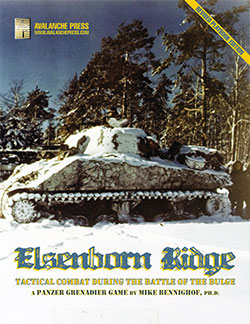 Thanks to its popularity, we waited much too long to give Panzer Grenadier: Elsenborn Ridge the same updates as the other older Panzer Grenadier games (like 1940: The Fall of France). And then once we had the new and revised Playbook edition, we waited much too long to give it the same scenario preview that other series games have received. In going back over them I’m both amazed that I managed to craft something this good, and very pleased that I finally gave them the story-arc format we’ve made standard practice for our newer games. Thanks to its popularity, we waited much too long to give Panzer Grenadier: Elsenborn Ridge the same updates as the other older Panzer Grenadier games (like 1940: The Fall of France). And then once we had the new and revised Playbook edition, we waited much too long to give it the same scenario preview that other series games have received. In going back over them I’m both amazed that I managed to craft something this good, and very pleased that I finally gave them the story-arc format we’ve made standard practice for our newer games.
One of the aspects I really like in this game is the map design: the maps are both geomorphic (they fit together with any other maps from Panzer Grenadier, Panzer Grenadier (Modern) or Infantry Attacks series games) and they represent actual terrain (in this case, places like the Twin Villages). Philippe Léonard took that concept even further with Ardennes 1944, which is set for the most part in a different part of the battle.
I designed this game myself, so I have some bias, but now that Elsenborn Ridge has a chapter structure based on theme instead of just a chronological list, with historical background and battle games, I consider it the best game in the Panzer Grenadier series. Let’s have a look at more of those scenarios:
Chapter Two
The Twin Villages
Holding the line north of 99th Infantry Division, the veteran U.S. 2nd Infantry Division would pull out behind a screen from the attached 395th Infantry Regiment (part of 99th Infantry Division) and march south to shore up the weak front around Camp Elsenborn, an abandoned Belgian Army barracks. But to get there, they had to secure the “twin villages” of Rocherath and Krinkelt.
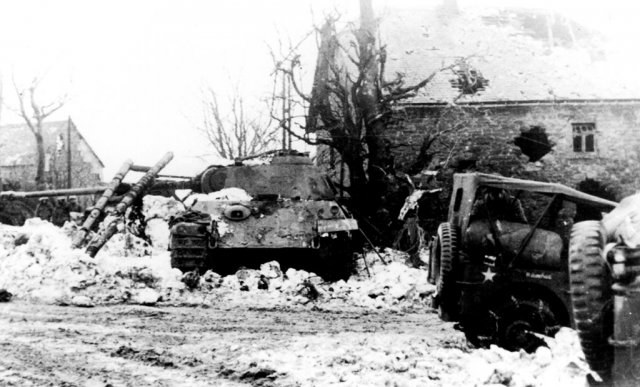
Using a bazooka, Lt. Robert A. Parker of the 644th Tank Destroyer Battalion destroyed this SS militia Panther on the evening of 18 December.
The Americans won the race for Krinkelt, getting marching infantry and tank destroyers into place just before SS militiamen supported by tanks surged down the Schwarzenbruch Trail and burst out of the woods to attack. They had already been slowed by the resistance of the 99th Infantry Division, and now encountered fresh American troops who’d had a few hours to prepare the villages for defense.
Scenario Six
The First Night
17 December 1944
Frustrated over his division’s lack of progress, Hugo Kraas of 12th SS Panzer ordered his youthful militiamen to continue their assault after dark. The shattered People’s Grenadier battalions pulled back into the woods to re-form, while the Americans had been reinforced by Lt. Col. William McKinley’s battalion of the 2nd Infantry Division and some tank destroyers.
Conclusion
The Germans had numbers and armor on their side; the Americans had stubbornness and a massive concentration of artillery: seven artillery battalions with 112 guns backed the defense, though communication with McKinley’s forward observers had been lost. The grandson of President William McKinley held his positions through the night despite repeated German attempts to take the vital crossroads, and by midnight the Hitler Youth had seen their attack break down.
Notes
And now we begin the saga of the epic battle for the Twin Villages. Just the one Twin Villages board (23) is in play, but there are an awful lot of SS militia bearing down on the Americans. But the Americans have better morale, and a truly massive (if inflexible) array of artillery support.
Scenario Seven
Valor and Sacrifice
18 December 1944
Repelled by the furious American defense and overwhelming firepower, the young SS volunteers of the Hitler Youth re-formed to assault the “twin villages” of Krinkelt and Rocherath again at dawn. The SS party militia could not advance to the west without securing the vital crossroads, yet as occurred at several other points during the Battle of the Bulge the positions took on an importance completely detached from operational reality as men fought and died in and around the small stone buildings. This time, the SS division committed its full panzer regiment.
Conclusion
Aided by their tanks, the militiamen finally made progress into the American positions, many of them taken only through point-blank cannon fire. But with the Americans having re-established communications with their artillery battalions, the massive rain of shells inflicted enormous casualties on the SS. At one point an American infantry company commander called down artillery fire on his own position - a step that sounds dramatic in movies, but in practice is utterly devastating. All but 12 of the American riflemen were killed. Around noon a heavy barrage allowed McKinley’s battalion to pull back into the twin villages; close to 3/4 of his initial force had become casualties.
Notes
Like the last scenario, this one features one board with a lot of pieces on it. While Elsenborn Ridge has “generic” geomorphic maps like the other games, I designed this board (Number 23) specifically for the Twin Villages scenarios, so it actually is a “real terrain” map that’s a little fudged to send the roads off the edges at the points common to the other boards in the series.
Scenario Eight
Panzer Graveyard
18 December 1944
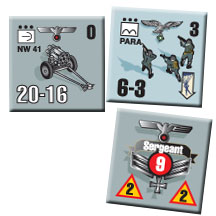 With the Lausdell crossroads in German hands, the SS militia could finally strike at the twin villages themselves. The panzers assaulted the stone buildings directly, backed by their own panzer grenadiers and Army infantrymen of the 12th People’s Grenadier Division, a veteran outfit despite its title. Inspired by McKinley’s stand and the awesome artillery support, the Americans fought for every room of every building in both villages. With the Lausdell crossroads in German hands, the SS militia could finally strike at the twin villages themselves. The panzers assaulted the stone buildings directly, backed by their own panzer grenadiers and Army infantrymen of the 12th People’s Grenadier Division, a veteran outfit despite its title. Inspired by McKinley’s stand and the awesome artillery support, the Americans fought for every room of every building in both villages.
Conclusion
Punishing artillery fire had gutted the SS militia battalions during the morning battle, but rather than await help from other formations 12th SS simply sent its tanks against the villages with little to no infantry support. American bazooka teams took a fearful toll of German armor in the narrow village streets: 60 by German admission, over 100 by American claims. The arrival of People’s Grenadier infantry eased the tank slaughter somewhat, but when night fell the Americans still held most of the villages.
Notes
The Germans are pretty tough, but the Americans are tougher and this time they’re the ones with a couple of battleships’ worth of artillery (which, unlike the opening German barrage, they get to use for the entire game). Even so there are a lot of Germans with a lot of tanks, so this one’s going to be a brawl for all concerned.
Scenario Twelve
Militia Fury
19 December 1944
During the night of the 18th, the American command decided its troops had held the twin villages for as long as necessary to disrupt the German timetable. The defenders could pull out the next night. Meanwhile, the German command had decided that the Hitler Youth had had enough; the SS division would assault the twin villages for one more day and then give way to an Army panzer grenadier division from the Army Group reserve. Kraas was determined to redeem his command with success, whatever the cost to his young fanatics.
Conclusion
Both sides remained relatively quiet during the night, but when daylight came fighting again erupted in both villages. Massive American artillery barrages again claimed many German militiamen’s lives, and in the early afternoon 2nd Infantry Division ordered its troops to pull out as soon as darkness fell. Fighting died down as the Americans prepared to leave, and rather than press their advantage the battered Hitler Youth and People’s Grenadiers gladly let them go.
Notes
It’s a small space with a lot of troops involved, where the Germans have a mixed SS/Army force backed by tanks trying to eject an American tank-infantry force that sports better morale than they do and enormous artillery support. The Germans are in for a long day.
Scenario Ten
Elsenborn Ridge
22 December 1944
No map included the label “Elsenborn Ridge” in late 1944; V Corps commander Leonard T. Gerow coined the phrase to indicate the line of hills near the Elsenborn Barracks where he wished his troops to establish a fallback position. After the bitter fighting for the Twin Villages and Dom Bütgenbach farm the Americans made an orderly withdrawal to the new line. Soon afterwards the Germans threw a fresh division into a new attempt to widen their breakthrough.
Conclusion
An experienced division that had fought in Italy and Alsace, 3rd Panzer Grenadier nevertheless sent its troops forward in brutal frontal assaults and suffered accordingly. The next spring, Belgian villagers would find German bodies stacked three and four deep in front of the American positions. Massive artillery fire again made the difference, as the gunners fired at well above rates their weapons’ manuals said was physically possible and rained thousands of shells on attackers with deadly accuracy.
Notes
The Germans have numbers and they have tanks; the Americans have some 57mm popguns and lots and lots of artillery. It’s going to be a hard day for the Herrenvolk.
And that’s Chapter Two. Next time, we dig into Chapter Three.
Order Elsenborn Ridge Here.
Sign up for our newsletter right here. Your info will never be sold or transferred; we'll just use it to update you on new games and new offers.
Mike Bennighof is president of Avalanche Press and holds a doctorate in history from Emory University. A Fulbright Scholar and NASA Journalist in Space finalist, he has published a great many books, games and articles on historical subjects; people are saying that some of them are actually good.
He lives in Birmingham, Alabama with his wife and three children. He misses his lizard-hunting Iron Dog, Leopold.
Daily Content includes no AI-generated content or third-party ads. We work hard to keep it that way, and that’s a lot of work. You can help us keep things that way with your gift through this link right here.
|