| Malta in the Great War
By Mike Bennighof, Ph.D.
September 2013
War came to Malta in August 1914 even before the formal British declaration, as the Mediterranean Fleet sortied from the island to pursue the German battle cruiser Goeben and her consort, the light cruiser Breslau.
In the last decades of the 19th Century into the early years of the 20th, Malta hosted the Royal Navy’s most important fleet. The Mediterranean Fleet usually had the Royal Navy’s newest battleships, and the greatest number of them. That changed in 1904, when the new First Sea Lord, Sir John Fisher, established three roughly equal fleets (Channel, Atlantic and Mediterranean) with the newest ships retained at home. Marking a similar strategic re-alignment, the British Army reduced its Malta garrison as well. At the end of 1906 Fisher moved two more battleships back to England.

Semi-dreadnought Agamemon receives a new 12-inch gun at Malta, 1915
In 1912, the Royal Navy moved its battleships from Malta to Gibraltar. Field Marshal Herbert Viscount Kitchener, met with Fisher, First Lord of the Admiralty Winston Churchill and Prime Minister Herbert Asquith at Malta, and presented a strong case to retain a naval presence at Malta. Ground and naval reinforcements could not reach Malta for weeks in case of an Italian or Austrian attack, he argued. Churchill countered that the old pre-dreadnought battleships of the Mediterranean Fleet would soon be out-classed by the new Austrian and Italian dreadnoughts just entering service. Leaving them at Malta would make them easy prey for either potential enemy fleet.
Apparently Kitchener then asked if the pre-dreadnoughts could be replaced by powerful cruisers fast enough to elude the enemy dreadnoughts and disrupt invasion attempts. Churchill agreed to the scheme, promising to station two battle cruisers (raised to three at Asquith’s urging and later to four) and four armored cruisers at Malta. A squadron of eight dreadnoughts would join them in 1915.
One battle cruiser arrived in November 1912 and two more in August 1913; the fourth (New Zealand) never made it to the Mediterranean. The First Cruiser Squadron of four armored cruisers and four light cruisers went to Malta in January 1913. A half-dozen pre-dreadnoughts temporarily joined the Mediterranean Fleet in late 1912 as a show of force during the Blakan Wars, but they returned to England by the middle of the next year.
By August 1914, the Malta garrison consisted of five battalions of British regulars: 2nd Royal Warwickshire, 2nd West Yorkshire, 1st Royal Welsh Fusiliers, 2nd Cameronians (Scottish Rifles) and 2nd Middlesex. The Royal Malta Artillery had a peacetime cadre of 443, and the Royal Garrison Artillery had just over 1,400. Two companies of Royal Engineers completed the garrison’s combat troops. Command went to Gen.Sir Leslie Rundle, a division commander during the Boer War and corps commander in Britain before coming to Malta in 1909.
Britain declared war on Germany on 4 August 1914, and within hours the garrison’s regular battalions received new orders. Three of them soon departed for England (two of them on the afternoon of the 4th) to join the British Expeditionary Force, while one went to Egypt. The fifth remained until October, when it too went to the Western Front.
To replace them, two battalions of the King’s Own Malta Regiment of Militia had been mobilized two days before the declaration of war. The four battalions of the 1st London Brigade, a Territorial Force formation, arrived on 4 September to augment the garrison. Throughout the rest of the war, Territorial battalions shuffled from Malta to the various fronts to be replaced by new, green units which in turn left garrison duty for combat.
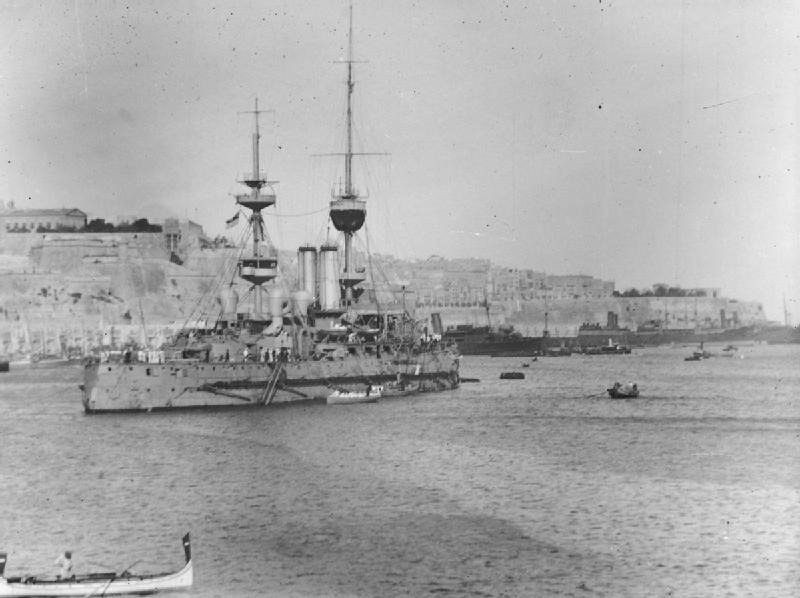
Pre-dreadnought battleship Jupiter stops in at Malta, March 1915.
Maltese quickly volunteered for both the Royal Navy and the British Army; in all about 24,000 served in the Great War and just over 500 died. The only distinctly Maltese unit to serve in combat was a small detachment of the Royal Malta Artillery that saw action at Gallipoli. Both battalions of the King’s Own Malta Regiment volunteered for front-line service, but were disarmed and employed as stevedores unloading supply ships, one battalion on the Salonika front and one at Gallipoli. A composite battalion of Maltese militia served in the Cyprus garrison during 1915.
Malta’s biggest role came as “Nurse of the Mediterranean,” tending wounded soldiers from the fronts at Salonika and Gallipoli. In August 1914 the island housed three military hospitals with 369 beds, plus one separate facility dedicated to venereal disease with another 20 beds. A huge expansion began in the spring of 1915 to accommodate the flow of wounded from Gallipoli; by war’s end Malta had 27 hospitals with 25,000 beds. Over 135,000 wounded passed through Malta’s hospitals. Two prisoner-of-war camps also housed Turkish prisoners.
The French Mediterranean Fleet operated from Malta starting in August 1914, but the British felt that their presence crowded the harbor. The French fleet commander, Louis-René-Marie Dartige du Fournet, in turn felt that his crews could not properly train and would lose their fighting edge by spending too much time in the island’s legendary whorehouses. In April 1916 the French moved to Argostoli in the Aegean Islands, eventually shifting to Corfu, but continued to send ships to Malta for repairs.
Between the dockyards, hospitals and other war-related services, Malta soon went from jobless despair to full employment. Yet this did not bring prosperity to the Maltese. With troops and military supplies having first call on shipping to the island, prices for food and other basic items soared. Wages did not keep pace. In May 1917 the recently-unionized dockyard workers downed tools and walked out on strike; a small wage increase followed but did little to ease living conditions. With the war’s end the employment opportunities disappeared but inflation continued; meanwhile the British government made no moves toward a long-promised constitution for the island. Widespread riots broke out in Valletta in June 1919; when Royal Marines fired into an unarmed crowd of demonstrators they responded by beating a British soldier to death.
The new governor, Field Marshal Herbert Viscount Plumer, quickly increased wages and introduced bread subsidies, while pressing hard for the island’s self-government. With Plumer’s firm support, the Maltese gained a constitution in 1921 that guaranteed home rule through a two-chamber elected parliament.
Base YOUR fleet at Malta! Order Great War at Sea: Mediterranean right now!
|