| Arctic Convoy: Germany
By Mike Bennighof, Ph.D.
September 2017
Our Second World War at Sea series has taken gamers to all the corners of the Earth, from the frigid waters off Tierra del Fuego through the warm seas of the Indian Ocean and western Pacific to all the waters around Europe. Of all these, the harshest environment has been that found in Arctic Convoy. Allied (mostly British) forces must escort convoys through the Barents and Norwegian Seas to their destinations at Murmansk and Archangel in far northern Russia.
The Germans are badly outnumbered, but they almost always get to pick when and how they will strike, so they don't need overwhelming force to win the game. The Kriegsmarine contingent includes all the ships that participated in the Arctic campaign, as well as a few that could have but did not — as it is in the real world and in other games in the series, players do not always have perfect intelligence regarding the other side's capabilities. All of them have been given new artwork since Bismarck, the previous boxed game in the series.
Battleships
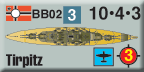
Though not the super-battleship concocted by Nazi propagandists and latter-day amateur historians, Tirpitz certainly managed to tie down a huge concentration of Allied naval and air power merely by existing. She's fast and well-protected, with a powerful armament when compared to the British King George V class or reconditioned veterans of the Great War. But as we showed in an earlier Content piece, Tirpitz and her sister Bismarck did not by any measure mark a new age of battleship design and owe much to the old Imperial Navy's last battleships. She is no match for the big American modern battleships like Alabama or South Dakota, but unfortunately these rarely appear in Arctic Convoy scenarios.
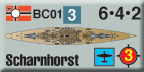
Though often called a "battle cruiser," Scharnhorst was actually a small battleship with a light main armament. She does have sufficient strength to overwhelm any Allied cruiser, requiring battleship escorts if she is on the prowl. Her final mission is covered, and she appears as a potential convoy raider in a number of other scenarios as well.
Aircraft Carrier
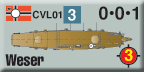
German Grand Admiral Erich Raeder claimed in 1942 that his surface fleet would have much greater success against the Allied convoys if they only had an aircraft carrier to aid in scouting and in keeping Allied aircraft away from German ships. Adolf Hitler personally ordered the heavy cruiser Seydlitz, which was then nearing completion, converted into an aircraft carrier, and she's present here to test out Raeder's assertion.
As a converted cruiser, she's not a very large ship and carries an even smaller air group than the purpose-built carrier Graf Zeppelin, which appeared in Bismarck. Her air group has a dozen dive-bombers and a dozen fighters — we've provided both the Me109T, which was ready in 1942, and the Me155 variant ordered when the carrier program resumed in 1942.
Cruisers
The Germans built their so-called "pocket battleships" to attack enemy merchant shipping, and here they do that very well. Though not fast or well-armored, their big guns will allow them to shoot up a cruiser escort and get at the transports. As with Scharnhorst, the presence of these ships forces the Allies to provide a capital ship escort. Two of them are included; their third sister was in the out-of-print Cone of Fire and was lost in 1939.
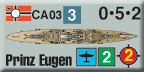
The traditional heavy cruisers built for the German Navy had serious mechanical troubles and never really fulfilled their potential. Admiral Hipper made several forays into the Arctic waters against Allied convoys and skirmished with their escorts. Prinz Eugen was several times assigned to move to northern Norway but did not make any actual sorties there.
German light cruisers were in no way comparable to the big, capable ships built by the United States or Britain or even the smaller ships laid down by Italy and Japan. They performed only limited duties during the war years, though the British expected to meet them in the Arctic and the Germans made plans to use them there.
Destroyers
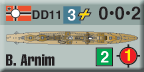
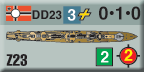
Well aware that they would be outnumbered in any future war at sea, the Germans tried to compensate by building ships superior to any other of the same type. While this sounded good on paper and in meetings, the policy resulted in ships prone to frequent breakdown, with sophisticated systems adopted well before the technology had been thoroughly proven.
The 1934 type destroyers were equivalent to those built by other navies at about the same time, though they suffered from a weak hull structure and trouble with their high-pressure steam propulsion. The 1936 type, which came into service in 1941, took those problems and compounded them with poor manufacturing standards as wartime production caused factories and shipyards to cut corners and more and more unwilling slave laborers replaced the highly skilled workers drafted into the armed forces. The German designers attempted to fit a heavier armament on the boats, and the 150mm guns caused many problems: they were too heavy for their structural supports, and their cartridges came in two pieces causing handling problems and lowering their rate of fire.
Despite all these problems, the destroyers were active against enemy convoys, participating in a number of surface actions against the escorts, and also in raids along the Soviet Arctic coastline. They are the only destroyers in the Second World War at Sea series with a secondary gunnery factor.
Click here to order Arctic Convoy now!
Mike Bennighof is president of Avalanche Press and holds a doctorate in history from Emory University. A Fulbright Scholar and award-winning journalist, he has published over 100 books, games and articles on historical subjects.
He lives in Birmingham, Alabama with his wife, three children and his dog, Leopold.
|