| Afrika 1944:
The Pieces
By Mike Bennighof, Ph.D.
January 2021
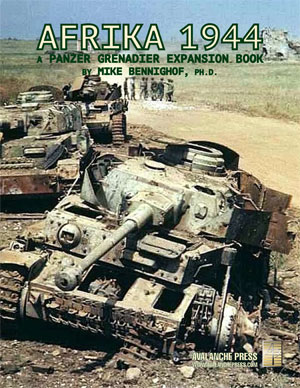 World War II in the North African desert is usually remembered as a series of intense tank battles, at least that’s always been the case in the wargame universe. Yet while the Allies deployed the ubiquitous Sherman, the German tanks that waged those battles weren’t the famous Tigers and Panthers but rather the Panzer III and Panzer IV, usually with their early-war, outdated main armament. World War II in the North African desert is usually remembered as a series of intense tank battles, at least that’s always been the case in the wargame universe. Yet while the Allies deployed the ubiquitous Sherman, the German tanks that waged those battles weren’t the famous Tigers and Panthers but rather the Panzer III and Panzer IV, usually with their early-war, outdated main armament.
Afrika 1944 is a Panzer Grenadier supplement that lets you play with the big German tanks in the desert. It’s mostly an expansion for An Army at Dawn, but you’ll need some American and British pieces from Liberation 1944 and Elsenborn Ridge to even the odds a little.
Could the campaign have continued much longer? Two important factors combined to drive the Axis out of Africa: massive commitment of American industrial, financial and military resources to the Allied cause, the and steady erosion of Italian fuel supplies. The Allies steadily gained the ability to conduct more and more operations, while the Italian Navy lost its ability to escort vital supply and troop convoys across the Mediterranean.
A reduction in Allied capabilities or increase in those of the Axis would not necessarily result in the fall of Egypt. Allied soldiers — British, Poles, Indians, New Zealanders and many others — fought with grim determination and would have presented a serious obstacle to panzers at the pyramids whatever their supply situation. A continued stalemate would be a likely result. Not the only potential result, but one opening interesting gaming possibilities. How would those big German tanks with their huge guns perform with miles of visibility before them? Would the Allied answers — designed and built for the most part based on the lessons of the earlier desert campaigns — stand up to them?
That's the basis for Afrika 1944, and the result is pretty straightforward: battles with big tanks sporting thick armor and big guns across the desert sands. There are 88 pieces to bring the Afrika Korps up to 1944 standards. Here's a look at some of them.
Tanks
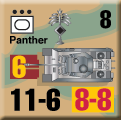 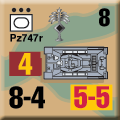 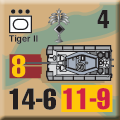
We know: it's all about the tanks. Big, heavy tanks. And the 1944 Afrika Korps has plenty of them: Tiger, Tiger II, and Panthers plus the Pz 747r: the Soviet-made T-34 in German service. The huge open spaces of the desert maps make the Tiger II with its long-barreled 88mm gun especially deadly, but all of these tanks are very potent weapons. The Panther is the main battle tank of the 1944 Afrika Korps panzer divisions, while the others all serve in heavy tank battalions attached to the corps or army command.
The Afrika Korps also receives the very capable PzKw IVF2, the "Mark IV Special" that took British tankers by surprised in the last months of the actual desert war. There's also the upgraded IVH model that did not see combat in Africa, but fought on both the Eastern and Western fronts as Germany's standard medium tank and proved more than a match for the Soviet T-34/76 and American Sherman.
The T-34 appears in Afrika Korps livery as well. Gamers have a thing for captured equipment, though in practice it's very difficult to put someone else's ships, planes and tanks to use. The maintenance infrastructure just doesn't exist for them: parts to repair them, nor are technicians trained to make said repairs. And tanks break down a lot. Still, captured Soviet tanks were slated to participate in the invasion of Malta, so we included a few here as well.
Other Vehicles
  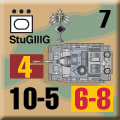
Very few assault guns (turretless tanks, usually controlled by the artillery branch) saw action with the Afrika Korps; Special Unit 288 brought a handful, but otherwise the Germans relied on actual tanks in the desert. That was no longer the case by 1944 on other fronts and unlikely to have been so in Africa, either. The StuGIIIG had a long 75mm gun in a low-slung frame, giving it almost the same performance (at least on paper) as a later-model PzKwIV at a fraction of the cost.
By definition the Hetzer was not an assault gun but a tank destroyer, designed to ambush enemy armor rather than support infantry attacks. In practice, the lines blurred between the two types with the same vehicles used in both roles. The Hetzer carried the long 75mm gun of the StuGIIIG on a Czech-made chassis, making for a lightweight but extremely cost-effective solution that would continue in production even after the war's end.
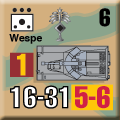
Despite the mobile nature of the desert war, the Germans fielded very little self-propelled artillery. That would have been a very different case in 1944, and so they have the Wespe, a standard leFH18 105mm howitzer on a modified PzKw II light tank chassis. Though a very successful weapons system, the Wespe did not enter production until early 1943 and was not available to Rommel in his tank battles. It is now.
Infantry
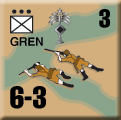
German infantry reorganized after 1942, and we reflect that in the Panzer Grenadier system by replacing the INF (infantry) units of the early years with GREN (grenadier) platoons. There's no reason to think the same organizational change wouldn't have applied to the North African theater, taking away some of each platoon's manpower but substituting a greater allotment of automatic weapons in their place. Since the platoon represents fewer men, it also faces a steeper drop in combat power than does the INF piece if it loses a step.
The standard German machine gun platoon is still in use in 1944, so HMG pieces are drawn from An Army at Dawn, as are engineers and motorcyclists.
Heavy Weapons
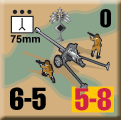 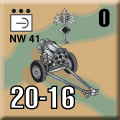 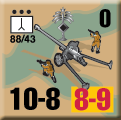
It takes big guns to knock out big tanks, and the 1944 version of the Afrika Korps has them. The 50mm anti-tank gun had been the backbone of German tactics in 1942, and its big brothers are here for 1944: two models of the 75mm gun, plus the huge 88mm anti-tank gun. This last weapon is as potent as the 88mmanti-aircraft gun found in 1942 scenarios, but has the low silhouette of an anti-tank gun for its own defense.
The Germans also wield the Nebelwerfer rocket launcher and 120mm heavy mortar. These add considerable firepower to infantry assaults, but their relatively short range leaves them vulnerable in mobile warfare.
Click right here to order Afrika 1944 right now.
Sign up for our newsletter right here. Your info will never be sold or transferred; we'll just use it to update you on new games and new offers.
Mike Bennighof is president of Avalanche Press and holds a doctorate in history from Emory University. A Fulbright Scholar and NASA Journalist in Space finalist, he has published an uncountable number of books, games and articles on historical subjects; a few of them were actually good.
He lives in Birmingham, Alabama with his wife, three children and his dog, Leopold. Leopold enjoys gnawing his deer antler and editing Wikipedia pages.
|