First Air Fleet:
Publisher’s Preview
by Mike Bennighof, Ph.D.
February 2026
Admiral Isoroku Yamamoto was a man of profound contradictions: a strategic genius who predicted his nation’s defeat yet planned its most audacious military operations; an innovator who revolutionized naval warfare while serving a doomed strategy; a realist who understood American power better than any Japanese officer yet could not prevent the catastrophic war he opposed.
— Masters of War: Isoroku Yamamoto, by J. F. Atkinson (2025)
He who can concentrate his forces against the enemy’s weakness will be victorious.
– Sun Tzu, The Art of War (approx. 500 BC)
 Atkinson’s hagiography aside, Isoroku Yamamoto, commander of Japan’s Combined Fleet in the first years of the Pacific War, committed some of military history’s worst blunders and, far from a “strategic genius,” was a miserable failure. Atkinson’s hagiography aside, Isoroku Yamamoto, commander of Japan’s Combined Fleet in the first years of the Pacific War, committed some of military history’s worst blunders and, far from a “strategic genius,” was a miserable failure.
Concentration of force is a basic concept held by every influential military thinker: Sun Tzu, Napoleon, Clausewitz. Even Nathan Bedford Forrest. Japan’s great advantage at the war’s outset, the concentrated force of the six heavy carriers of First Air Fleet, could not be matched by the U.S. Pacific Fleet. The only real hope the Americans had would be to fight and defeat the Japanese carriers in detail. Yamamoto proceeded to give them exactly that opportunity.
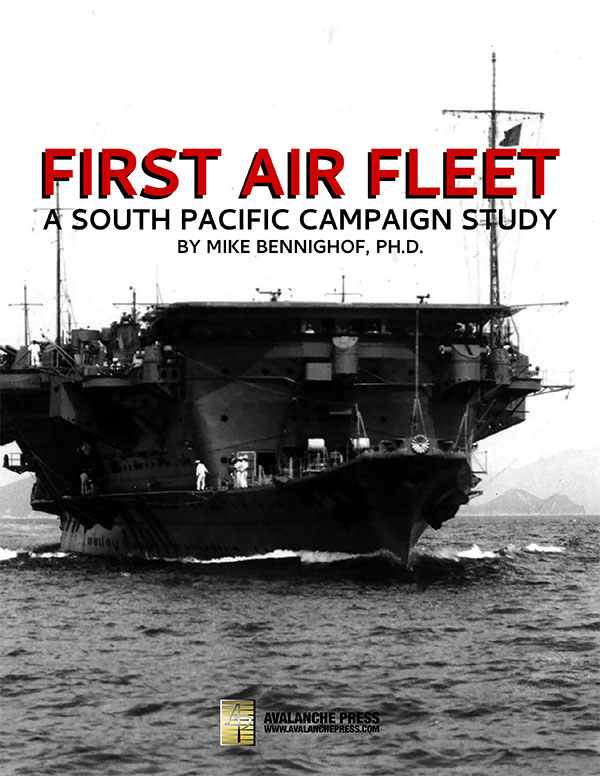
That failure is the focus of our Campaign Study, Coral Sea: First Air Fleet. The action takes place on the operational map from Second World War at Sea: Coral Sea; you’ll also need pieces from Second World War at Sea: Midway.
At the May 1942 Battle of the Coral Sea, Yamamoto detached two of the First Air Fleet’s six carriers to cover the invasion convoy headed to Port Moresby, on the southern coast of New Guinea. The American commander in the Pacific, Chester Nimitz, sent everything he had to stop them: initially two heavy carriers of his own. In the resulting more or less even fight, the Americans lost one of their carriers, but the Japanese had both of theirs put out of action for many weeks, leaving them unavailable for the Battle of Midway in June. And so, the Japanese would fight, and lose, that battle with only two-thirds of the First Air Fleet (the situation was worse than that, as the two carriers disabled at the Battle of the Coral Sea were the largest and newest of the six).
The commander of the Japanese Fourth Fleet, Shigeyoshi Inoue, had charge of the Port Moresby operation. Inoue had been the pre-war head of naval aviation and recognized that one carrier would not be enough. Combined Fleet gave him two (Shokaku and Zuikaku), and these ships fought the Battle of the Coral Sea.
Initially, Yamamoto had offered him just one, Kaga, to provide cover for the invasion fleet. Kaga had been damaged by grounding in February and gone to Sasebo Navy Yard for repairs in March. On 8 April Combined Fleet asked that repairs be expedited, but she did not return to full capability until 4 May, the day the Batte of the Coral Sea commenced.
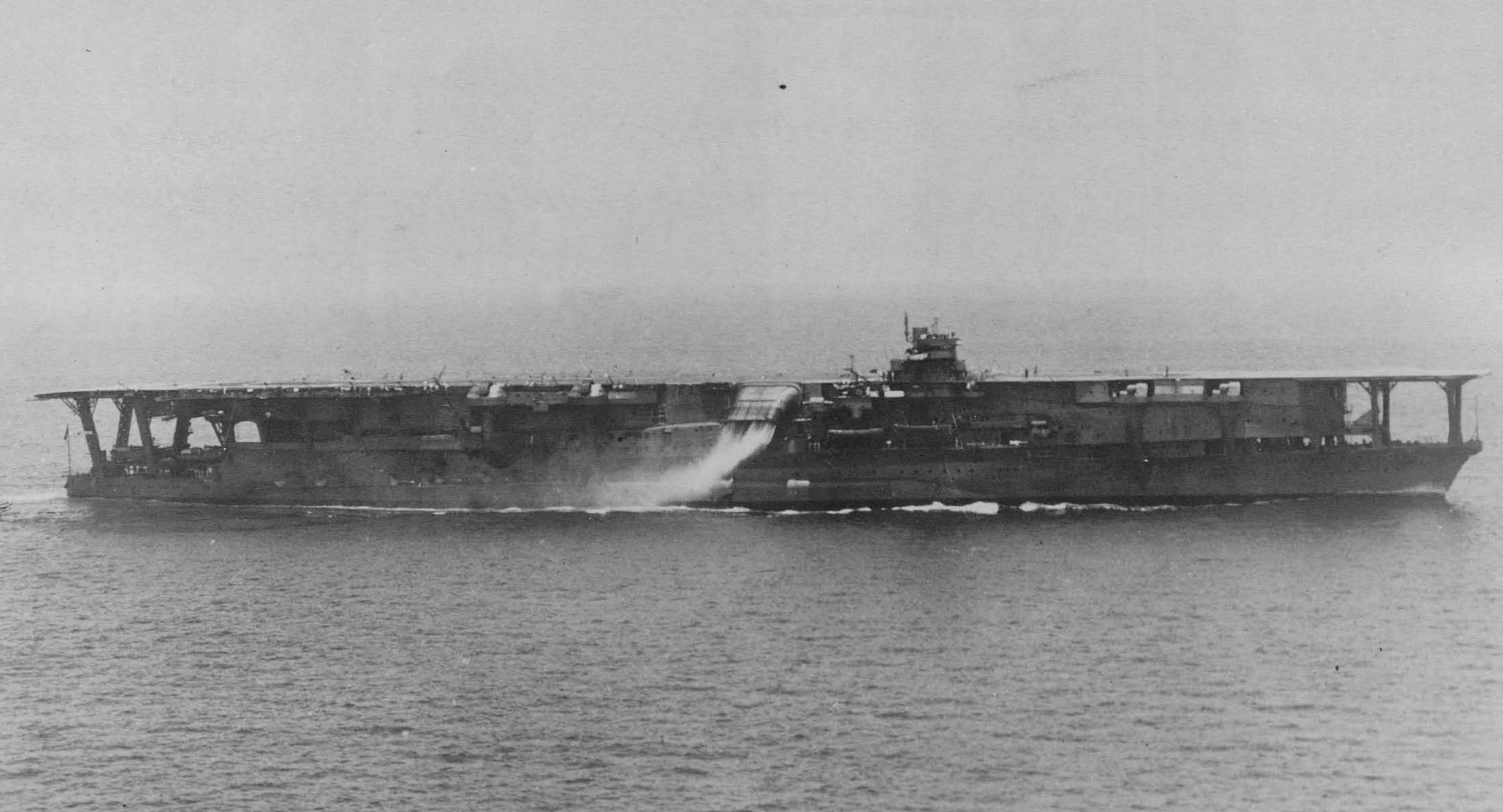
The venerable Kaga.
Our six scenarios in First Air Fleet give the Japanese just the one carrier, against a limited American response. It highlights another aspect of Yamamoto’s poor grasp of the strategic reality of 1942: Kaga would have been tied to the invasion convoy as an escort, not deployed as an independent asset to seek and destroy any American threat. This was also the case for Zuikaku and Shokaku during the actual battle, which were also hampered by a ridiculous list of ancillary missions (such as delivering fighter planes to Rabaul).
The Americans are rightly criticized for having a less-advanced carrier doctrine at this point in the war. They kept their flattops in separate task forces and lacked the ability to combine their air groups for mass strikes against enemy targets. American carrier strikes arrived over their targets in waves, which allowed Japanese Combat Air Patrol fighters to engage each wave separately.
But the Americans aren’t usually given credit for what they did understand from the war’s start: the carriers existed as a striking arm of the fleet, not an auxiliary to be tied to convoys or other missions. Their first priority was to find and destroy the enemy carriers. Yamamoto continually detached his light carriers for secondary or tertiary missions that they lacked the striking power to complete. When the Naval General Staff developed a useful doctrine for the smaller flattops after Midway – packing them with fighters to bulk up the Combat Air Patrol over the big carriers – Yamamoto still insisted on sending them away to be picked off and destroyed without accomplishing anything.
In First Air Fleet, we also explore this Japanese fighter-carrier concept. Kaga may be out-numbered, but with the light carrier Shoho adding to her defenses instead of giving American dive-bomber pilots live-fire target practice, she’s going to be tougher to knock out of the game.
On 19 April, Combined Fleet ordered the Fifth Carrier Division (Shokaku and Zuikaku) to join Fourth Fleet for the operation. At this point, the naval staff still had hopes that Kaga’s repairs might be completed in time to join the mission as well. So our next two scenarios look at the Japanese Fourth Fleet with three heavy carriers, a substantial accretion of strength. Enough to overcome the Americans and accomplish the mission to Port Moresby? It depends on how they’re used – the bigger difference here is that the secondary missions have been stripped away and the Japanese have a clear goal.
Over the decades since the Pacific War, popular histories have made much of Yamamoto’s love for the game of poker. What they’ve usually missed, is that when the key moments arrived to push all of his chips into the pot, Yamamoto hedged. Chester Nimitz, often under-rated in comparison, knew when to go all in. Our final pair of scenarios lets you play with the force Yamamoto should have sent to the Coral Sea: all six heavy carriers of the First Air Fleet. The Americans match them with the force Nimitz intended to dispatch: initially the two carriers that could reach the area quickly, followed by the other two then operating in the Pacific, Enterprise and Hornet. Six Japanese carriers against four American flattops, with the Americans operating more planes from their decks.
This, to my mind, is what wargames are all about: exploring the decisions made by historical figures, why they were made, and what other outcomes might have developed from different decisions. Yamamoto’s poor strategy doomed his Emperor to defeat. Would sound judgement have made a difference? We get to play with that question in First Air Fleet.
Order First Air Fleet Here.
Use coupon code DANA to take 20 percent off.
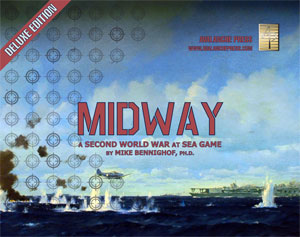
Order Midway Here.
Order Midway (Anarchy Edition) Here.
No rules! You’ll need the Second Edition rules from another Second World War at Sea game. Earlier edition rules will not work with this game.
Order Coral Sea Here.
Sign up for our newsletter right here. Your info will never be sold or transferred; we'll just use it to update you on new games and new offers.
Mike Bennighof is president of Avalanche Press and holds a doctorate in history from Emory University. A Fulbright Scholar and NASA Journalist in Space finalist, he has published an unknowable number of books, games and articles on historical subjects.
He lives in Birmingham, Alabama with his wife and three children.
Want to keep Daily Content free of third-party ads? You can send us some love (and cash) through this link right here.
|