Golden Journal No. 55 Flying Carriers
Japan’s Flying Carrier
by Mike Bennighof, Ph.D.
May 2026
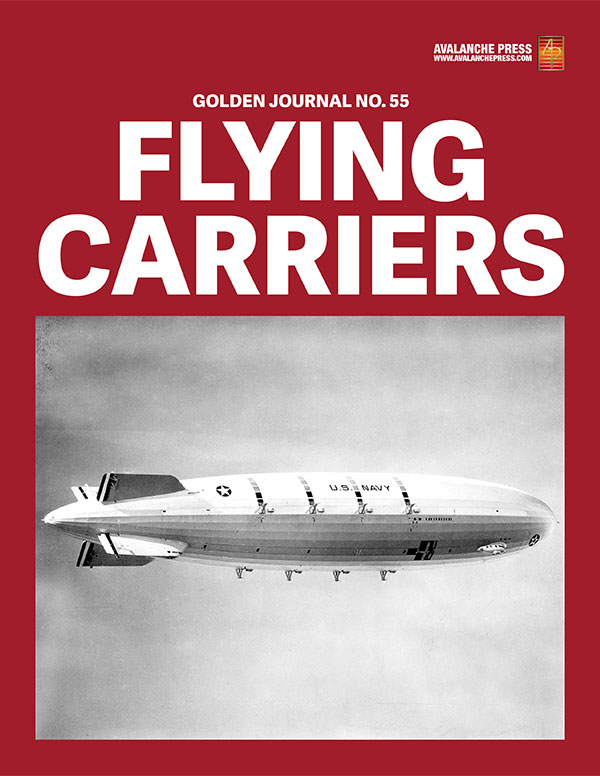 Note: Golden Journal No. 55: Flying Carriers brings both American and Japanese projects for aircraft-carrying airships to Second World War at Sea (plus some airships that actually existed). We looked at the American flying carriers in an earlier installment. Note: Golden Journal No. 55: Flying Carriers brings both American and Japanese projects for aircraft-carrying airships to Second World War at Sea (plus some airships that actually existed). We looked at the American flying carriers in an earlier installment.
Facing a hostile United States across the broad, empty Pacific Ocean, the Imperial Japanese Navy saw a crucial need for long-range aerial reconnaissance. That role would eventually be filled by ultra-long-range flying boats, but through the 1920’s the Navy built a series of airships that attempted to provide the same capability.
The Imperial Army had experimented with airships starting in 1910, with both local designs and a Parseval ship imported from Germany in 1912. With the outbreak of war in August 1914, the Japanese could no longer import spare parts or access expertise regarding their airship. Japanese engineers replaced her engines and rebuilt her to be much larger, christening her Yuhi-go (Majestic Flight). Majestic Flight ended up as anything but, and after her final test flight in January 1916 had to be returned to her base at Torokozawa by train. The repaired ship flew again in July 1917, but disappointing results led to the program being dissolved early the next year.
Airship development moved to the Imperial Navy with the end of the First World War. The subsequent reparations doled out a zeppelin and a hangar for it to the Japanese. The airship, LZ75/L37, had been built for the Imperial German Navy at Zeppelin’s new factory in Staaken near Berlin. The new factory delivered a weak ship, and flaws emerged in bombing raids and recon flights. When repairs failed to make her acceptable, she went into storage. The Japanese seem to have known of her history, and had her scrapped but retained her engines, gondolas, specialized equipment, and parts of her frame.
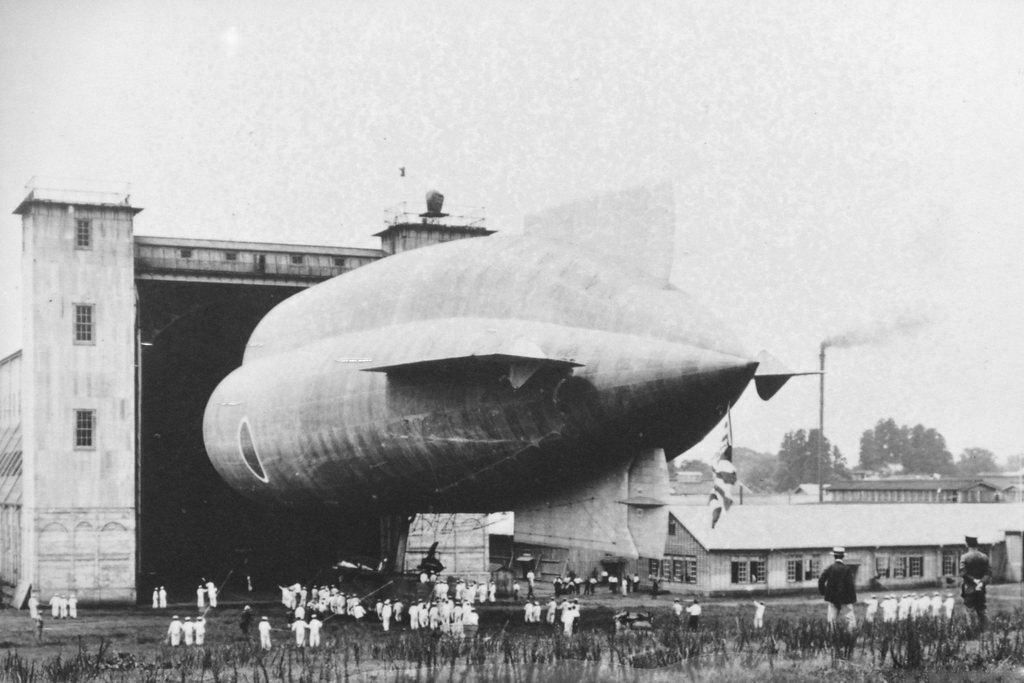
Airship Number Two, the French-built failure.
They still had that hangar, a massive zeppelin shed 240 meters long that had originally been built at Juterbog outside Berlin. They had it disassembled, shipped to Japan, and erected at Kasumigaura outside Tokyo. Now that they had a hangar, they just needed an airship to put inside it.
They began by dispatching an officer to the United States for airship training: Lt. Commander Takijiro Onishi, later remembered as both the first man to conduct a parachute jump in Japan, and the first Japanese commander to order kamikaze suicide attacks.
In 1921, the Navy bought their first airship, a Vickers Sea Scout built in England; the type had been used successfully during the Great War to look for enemy submarines. Airship Number One arrived in Japan in 1922, along with a specially-made mooring mast which was erected at Yokosuka. She made one flight in May 1922, and in July she exploded in her hangar, probably due to static buildup.
Undeterred, the Navy ordered a new airship from Nieuport in France. Airship Number Two, an Astra-Torries non-rigid ship, carried a 75mm cannon but otherwise appears to have left the Japanese unimpressed. She made a few flights, including an appearance over the 1924 Fleet Review, and then was broken up in late 1924.
Meanwhile, the Navy had also ordered a copy of Number One, with Mitsubishi providing the gondola and Fujikura Composite Company, a manufacturer of rubberized, fireproof fabrics, the gasbag. Airship Number Three made her first flight in June 1923, and on 19 March 1924 she exploded in mid-air, killing all of her crew.
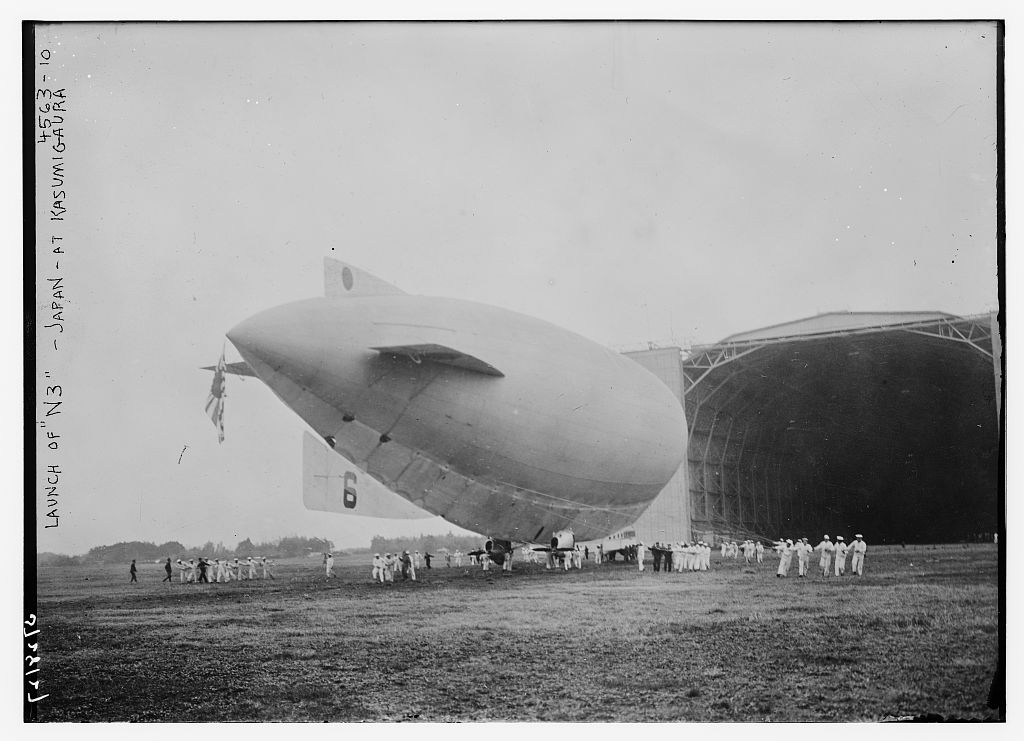
Airship Number Six prepares to take off from Kasumigaura.
After two of their first three airships blew up, the Imperial Navy responded by ordering another copy of the Vickers Sea Scout from Fujikura. Airship Number Four, given a new aluminum-based coating on her gasbag to lessen the chance of static buildup, performed well in tests following her first flight in March 1926. Pleased by this, the Navy ordered three more of them, Numbers Five, Seven, and Nine. But these were all small ships, and the Navy needed something larger, with greater range and endurance, to scout for the fleet.
The Navy ordered a new airship from Italy’s State Aircraft Works, which built the semi-rigid airships designed by the famed Umberto Nobile. N-1 (Norge) and N-4 (Italia) would become famous for their attempts to reach the North Pole by air. Nobile sold their sister ship N-3 to the Japanese, apparently to help fund his expeditions. The Japanese bought the airship in June 1925, and she arrived in Japan in August 1926, where she became Airship Number Six.
Nobile himself traveled to Japan to oversee the ship’s re-assembly, and she made her first flight in April 1927 with Nobile at the controls. With her Japanese crew, she participated in fleet maneuvers in October 1927. Returning to base on 23 October, strong headwinds kept her from making any progress. Running out of fuel, her captain chose to make an emergency landing to save his crew, a move Nobile would later endorse as the correct decision. The crew got off safely, with one man injured in a fall, before the winds caught Number Six and blew her out to sea, where she exploded.
Airship No. 8
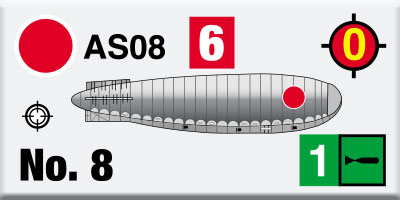
Following the loss of Number Six, the Naval General Staff decided to replace her with a domestically-built copy. The engineers at the Kasumigaura proposed a much larger Zeppelin-style ship, 180 meters long with a gas volume of 20,050 cubic meters – roughly twice the length and three times the volume of the lost Number 6, but with much greater capabilities. She still would have been smaller than the early-war German zeppelins.
The Navy chose to instead use the blueprints provided by Nobile to build a copy of Number Six. They contracted Tokyo Gas & Electric to provide the engines (apparently unlicensed copies of the Daimler-Benz 130 horsepower model), Mitsubishi to provide the gondola and the frame, and Fujikura Composite Company for the gasbag. All the parts came to Kasumigaura, where Fujikura put them together to build a new airship.
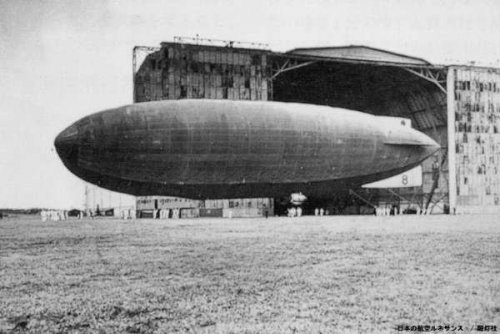
Number Eight rolls out of the Kasumigaura hangar.
Number Eight made her first flight on 29 July 1929, and remained at Kasumigaura for tests and training. On 10 March 1931 she flew to Tokyo with two smaller ships, No. 7 and No. 9 (both also made in Japan) for a three-ship flyover to celebrate the birth of Princess Atsuko. Upon her return, she carried out a three-day long-endurance flight, remaining in the air for 60 hours and one minute; at the time, a record for a semi-rigid airship.
That would be her last hurrah. In November of that year, the Naval General Staff decided to dismantle its small, inefficient semi-rigid airships, and the ground crew took apart Number Eight in February 1932. Japan would float into the future with big, Zeppelin-style fully-rigid airships.
Airship No. 10
The big German commercial airship Graf Zeppelin flew around the world in 1929, stopping for four days in Tokyo in August 1929. She made use of the zeppelin shed at Kasumigaura for maintenance and refilling with hydrogen (provided by Nippon Soda). The Imperial Japanese Navy had an observer aboard for the entire flight, and the ship caused a sensation in the capital when she flew over at sunset, the ship bathed in orange light. The crew received the rare honor of a reception at the Imperial Summer Palace, and over 300,000 people took special trains from Tokyo to see her at Kasumigaura. The German crew gave detailed tours to Japanese naval aviators.
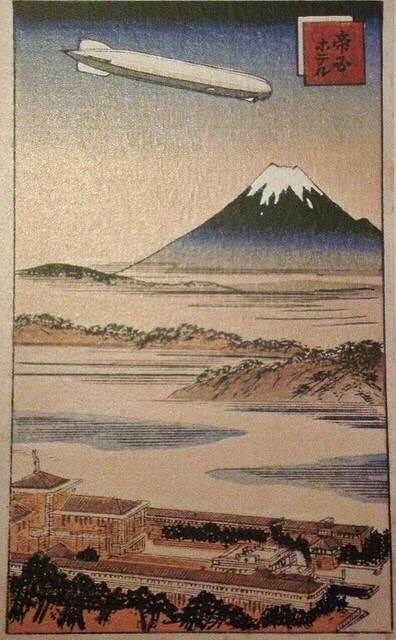
Postcard from the visit of Graf Zeppelin to Tokyo. |
The Japanese wanted airships like Graf Zeppelin of their own, both military and civilian. Two different, newly-founded companies each sought to acquire two ships similar to Graf Zeppelin and establish a route between Tokyo and San Francisco. One would have flown via the Aleutian Islands, and the other by way of British Columbia. Neither had gone beyond the planning stages when the Hindenburg exploded in May 1937 and brought an abrupt end to commercial airship travel.
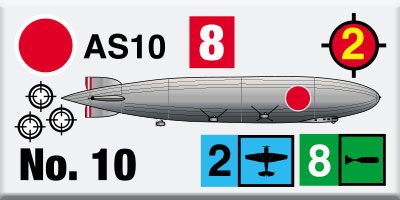
Graf Zeppelin’s visit also spurred the Imperial Navy to look again at rigid airships. The London Naval Treaty of 1930 put limits on the allowable numbers of smaller warships, like cruisers, destroyers, and submarines, that had not been restricted (other than size and armament) under the 1922 Washington Naval Treaty. And while aircraft carriers fell under treaty limits, flying carriers did not. Later in 1930, the Naval Aviation Branch added an airship to its list of aircraft requirements: a flying carrier able to operate six aircraft, also capable of carrying 10 tons of bombs, armed with 20 machine guns, able to make 80 knots with a flight endurance of 150 hours.
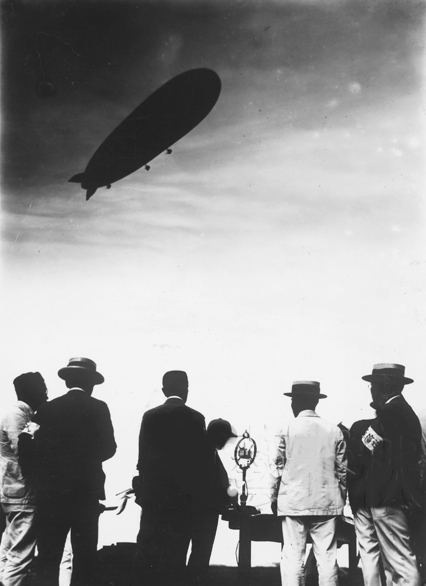
Graf Zeppelin comes in for a landing at Kasumigaura. |
Design work began, with the Naval Technical Research Institute working on the ship itself and the Hiro Naval Arsenal (the Navy’s munitions works) developing fuels, girders, engines, and the aircraft launch and recovery systems. The Naval General Staff issued revised requirements in November 1934, raising the top speed to 90 knots (with a sustained cruising speed of 60 knots), but dropping the number of aircraft to be carried to four and the number of machine guns to eight. She would be designed to fit the maximum dimensions of the existing hangar at Kasumigaura, putting her length at 224 meters (15 meters shorter than the American flying carrier Akron) and a diameter of 35 meters (not as fat as Akron’s 40 meters), and a gas volume of 154,660 cubic meters (Akron measured 180,000).
The engineers at the Arsenal crafted girders from steel and duralumin; since they used steel, these probably came in heavier than Akron’s purely duralumin (the aluminum-copper allow used by the Zeppelin Works) framework. The designers at first planned to use helium as the ship’s lifting gas, but when the supply from the United States turned out to be too pricey for their budget (and insecure during wartime), they switched to hydrogen.
That required some shifts in the airship’s design. Even though hydrogen would provide greater lift, she could not retain her internal hangar because of the risk of sparks from the aircraft engines setting off an explosion. The planes moved to a parasite arrangement along her keel, which provided faster launch but meant that maintenance and re-armament could not be performed, and re-fueling would be more difficult.
Before any actual work began on building the airship, the Navy General Staff cancelled the project. The big hangar would house prototype aircraft for testing until it was dismantled in 1943.
In 1930, the idea of slipping past treaty restrictions with a series of flying carriers probably seemed reasonable. They could take over reconnaissance duties, and even deliver a modest strike capability (all of the design requirements specified that the flying carrier would deploy “light bombers”). Within a few years, conventional carriers had become far more capable as they worked out new procedures, while fixed-wing aircraft made geometric leaps in performance. And then there was the simply reality that operating a hydrogen-filled flying carrier meant taking a gigantic bomb into a combat zone – this, after fully one-third of the Imperial Navy’s airships had ended their service life in a ball of flame.
Order Flying Carriers Here.
Sign up for our newsletter right here. Your info will never be sold or transferred; we'll just use it to update you on new games and new offers.
Mike Bennighof is president of Avalanche Press and holds a doctorate in history from Emory University. A Fulbright Scholar and NASA Journalist in Space finalist, he has published a great many books, games and articles on historical subjects; people are saying that some of them are actually good.
He lives in Birmingham, Alabama with his wife and three children. He misses his lizard-hunting Iron Dog, Leopold.
Daily Content includes no AI-generated content or third-party ads. We work hard to keep it that way, and that’s a lot of work. You can help us keep things that way with your gift through this link right here.
|