Midway:
Carrier Akagi, Part Two
by Mike Bennighof, Ph.D.
October 2025
 As rebuilt, Akagi acquired a small island (formerly fitted to Kaga), placed on the port side unlike almost every other carrier ever built, to keep it away from the noxious fumes and smoke pouring out of the funnel. Her air group consisted of 66 planes (though larger and heavier than those she originally operated), plus 25 more in storage but not available for operations (this is why some sources claim she carried 91 aircraft, which is technically true but misleading). The Imperial Navy apparently told the Ministry of Finance that she carried 120 planes, 80 of them operational. As rebuilt, Akagi acquired a small island (formerly fitted to Kaga), placed on the port side unlike almost every other carrier ever built, to keep it away from the noxious fumes and smoke pouring out of the funnel. Her air group consisted of 66 planes (though larger and heavier than those she originally operated), plus 25 more in storage but not available for operations (this is why some sources claim she carried 91 aircraft, which is technically true but misleading). The Imperial Navy apparently told the Ministry of Finance that she carried 120 planes, 80 of them operational.
Akagi retained the other six 20cm guns, in their casemates down near the waterline. The shock of their firing rattled the entire ship; they could not be fired at much of an angle, yet their crews expended 54 rounds during the Battle of Midway. Akagi kept the same heavy anti-aircraft battery she’d had before the reconstruction, but added more of the nearly-useless 25mm automatic cannon. Of the six heavy carriers that made up the First Air Fleet, Akagi had the weakest anti-aircraft battery.
She finished work on the last day of August 1938, and returned to service in mid-December. In January 1939 she set out for her first combat operation, the invasion of the Chinese-held island of Hainan. Nobutake Kondo, commanding the Fifth Fleet charged with covering the invasion, believed that France, due to her long-standing interests in Hainan and position in Indochina on the other side of the Gulf of Tonkin, might intervene. The French had no substantial naval forces in the region, and Akagi would not see her first naval battle. Instead, her planes provided air support as the Japanese quickly crushed opposition from the third-line Chinese forces garrisoning the island.
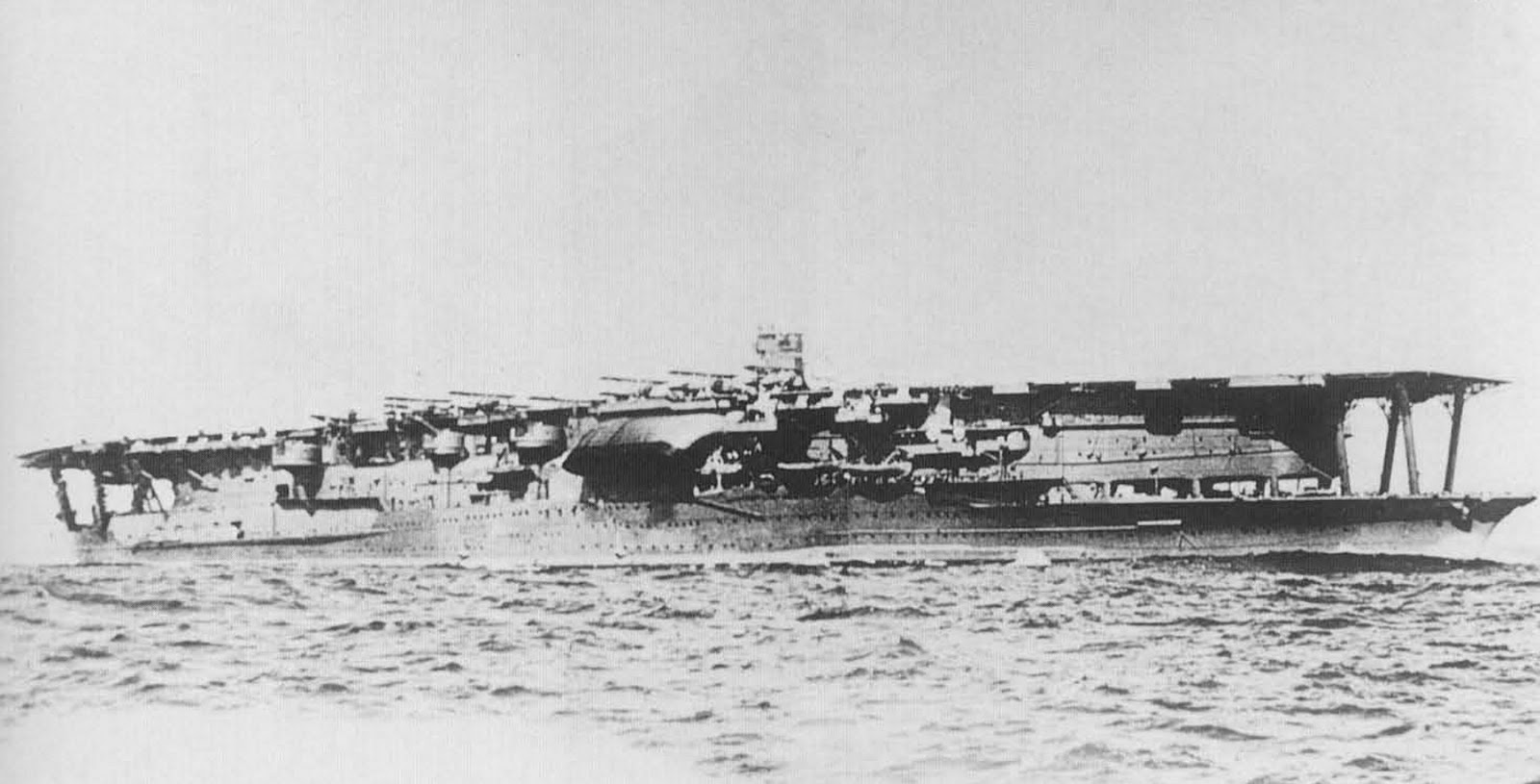
Akagi with a load of biplanes, soon after re-commissioning.
More training, and an overhaul to make some corrections, followed. Experience with other carriers in the China war (Kaga, Hosho, and Ryujo) showed the value of concentrated airpower. Small driblets of planes made little difference to ground operations and proved vulnerable to enemy fighters. To be truly a potent weapon, carrier air power needed mass. In April 1941, the Imperial Navy’s four heavy carriers formed into the First Air Fleet. The new Shokaku and Zuikaku joined that autumn following their commissioning. Akagi served as flagship for Chuichi Nagumo, as the new fleet worked out methods of combining the planes from multiple carriers into overwhelming air strikes.
Akagi had no flag bridge; the fleet staff, carrier division staff, and the ship’s bridge crew all crammed into the tiny island. The noise and over-crowding may have contributed to Nagumo’s mistakes at Midway. Shokaku offered much better facilities, but the naval air service looked down on the new carriers, and in any event, Shokaku did not participate in the Midway operation.
Akagi remained the First Air Fleet’s flagship for the Pearl Harbor attack, and afterwards for the January air strike against Rabaul and in February against Darwin, Australia. The fleet then went to Stirling Bay on the island of Celebes (Sulawesi) to prepare for a large-scale incursion into the Indian Ocean. When a sailor from the destroyer Tanikaze was injured in an accident, Akagi’s sick bay (far more capable than the rudimentary facilities aboard a destroyer) refused to treat him – the facility was already filled with dysentery cases (he ended up going to Zuikaku for treatment).
Akagi again led the fleet for the Indian Ocean raid, and afterwards (on 1 April 1942), her air group would be reduced from 66 to 54 planes (18 each of fighters, dive bombers, and torpedo planes) thanks to the continuing attrition of aircraft and the inability of Japanese industry and the training establishment to provide an adequate flow of replacement planes and aircrew.
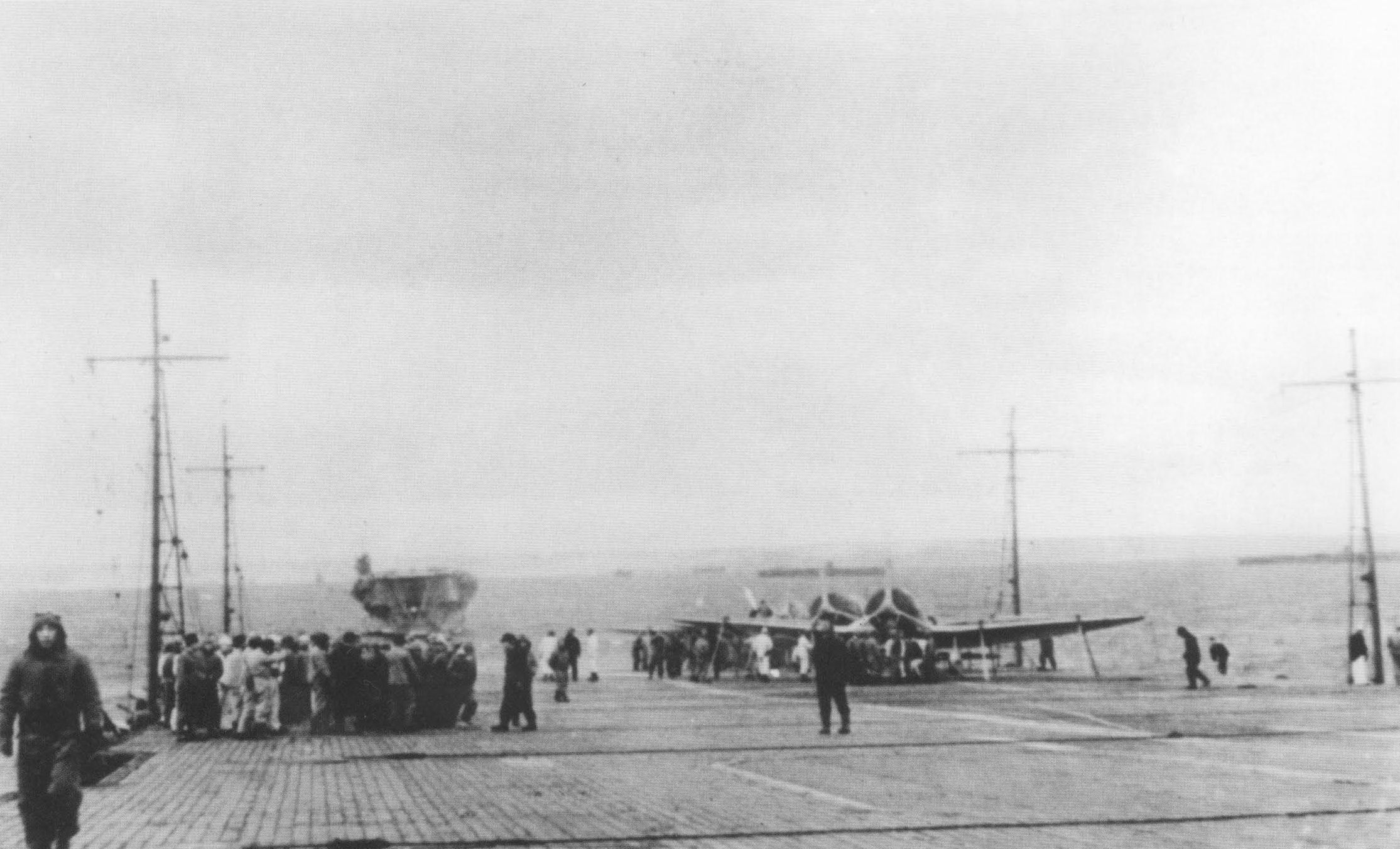
Akagi at Hitokappu Bay in the Kuriles, November 1941. Kaga directly behind her, the other carriers of First Air Fleet in the distance, as they prepare for the Pearl Harbor attack.
Akagi returned to Yokosuka on 24 April, and departed again on 27 May for the Midway Operation, carrying her own air group plus six fighters from the 6th Air Group intended to operate from Midway once it was captured, plus the staff and ground echelon. The crew painted a large hinomaru (Rising Sun symbol) on the flight deck to warn off friendly planes from attacking the own ships; this turned out to be a rather serious mistake.
Like the other carriers, Akagi sent off a strike package on the morning of 4 June 1942, to attack the installations on Midway Island. It failed to knock out the airfield, and Nagumo ordered the torpedo planes held ready in case enemy carriers appeared to be armed with bombs (this was a direct contravention of Yamamoto’s orders). While the deck crews prepared the planes for this second strike, word came that enemy carriers had been sighted, and Nagumo ordered the planes re-armed again, this time with torpedoes.
And that’s when things went wrong. Very wrong.
When the American strike arrived, the combat air patrol handled the torpedo bombers, but the dive bombers had little opposition as 28 of them dove on the nearby Kaga. Seeing the converted battleship clearly doomed, Enterprise squadron commander Dick Best and his two wingmen veered off to attack the nearby Akagi. They found the flagship, despite the ongoing air-sea battle all around her, utterly unprepared to repel them. Diving through half-hearted anti-aircraft fire, Best placed his bomb directly amidships, where it penetrated the flight deck and exploded in the upper hangar deck. The other two planes dropped theirs right off the carrier’s port side.
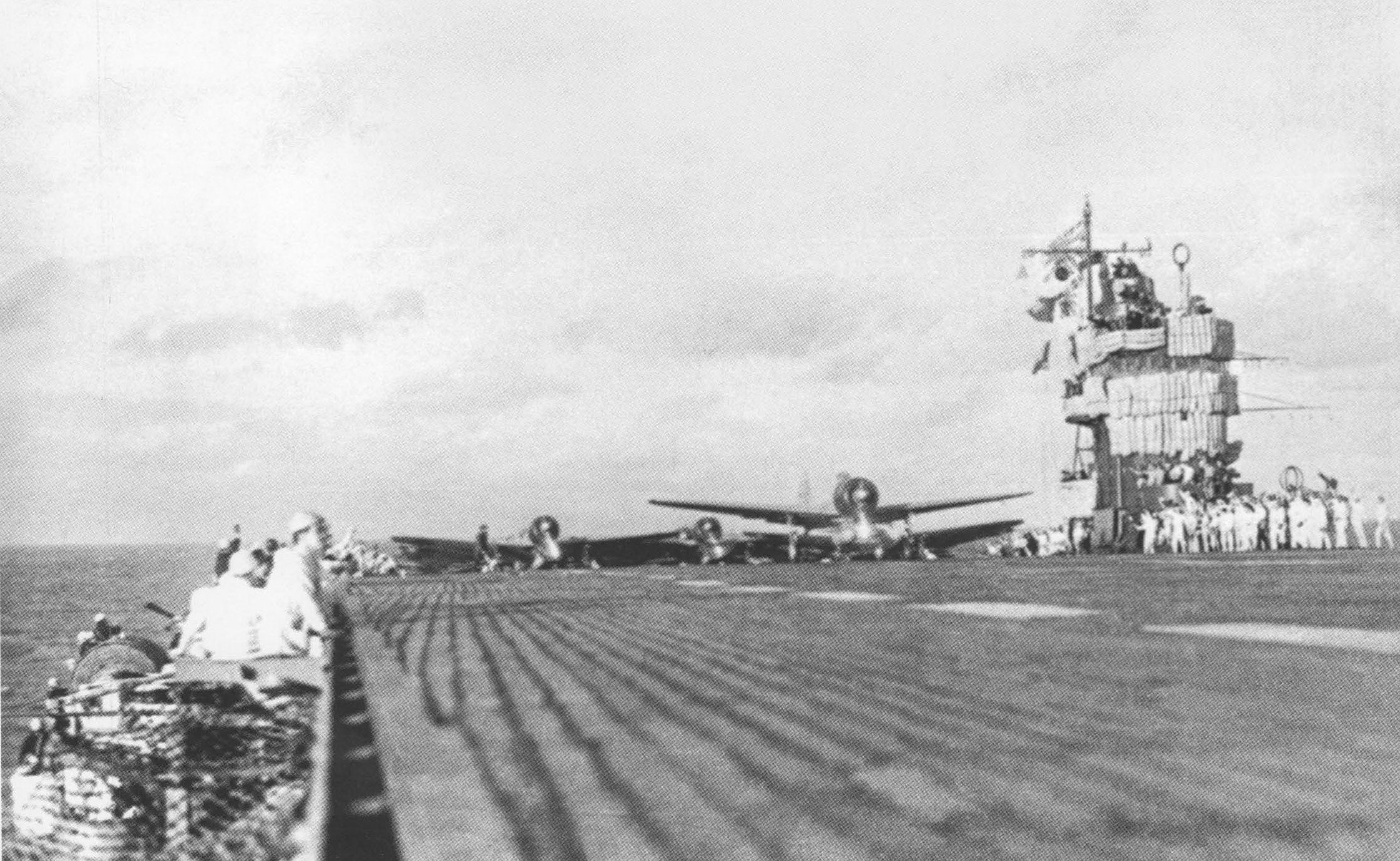
Akagi launches the second Pearl Harbor attack wave. 7 December 1941.
One of the near-misses came very near, and the shock wave damaged Akagi’s rudder. This was bad enough, but Best’s bomb struck in the worst possible place for the carrier and her crew. It exploded just aft of the amidships elevator, shredding the steel fireproof curtain separating the elevator well from the hangar deck and blowing flaming debris down into the middle hangar. It blew open the ready-ammunition lockers for the port-side 127mm anti-aircraft guns. But worst of all, it started fires among the torpedo planes waiting to be rolled onto the elevator. Not only were these planes fueled and armed with torpedoes, the heavy bombs they had carried had not yet been returned to the magazines.
Akagi’s captain, Taijiro Aoki, had only come aboard on 25 April. This was his first experience leading his ship into battle. He promptly ordered the magazines flooded before the flames could reach down the bomb hoists, and the one-shot carbon-dioxide fire-suppression system deployed. But the aft magazines could not be flooded due to shock damage from the near-miss, and the elevator’s fall to the bottom of the shaft appears to have ruptured the carbon-dioxide flasks. As soon as it became evident that Akagi’s steering had failed, Aoki ordered the engine rooms evacuated.
Damage-control crews tried to fight the fires, which now engulfed both hangar decks, but could not get at the burning planes. And then the ordnance started exploding. As the fires raged out of control, the black gang had to evacuate the engine rooms; only those on the port side made it out, as the heat overcame those in the starboard spaces before they could escape.
Aoki sent the carrier’s wounded and its air department personnel to waiting destroyers, and continued to fight the fires with his remaining crew for the next nine hours. With the engine spaces apparently intact, though manned only by the dead, they hoped to regain control of the ship if only they could douse the flames. It’s nearly impossible, however, to put out a gasoline fire with water only, and water was all that they had – soon limited to hand-driven pumps. Japanese practice did not include the widespread training of crewmen in damage control procedures as was true for American carriers, and provided far less specialized equipment for them. The chaotic compartmentalization of Akagi’s lower decks did them no favors, either – particularly in the dark.
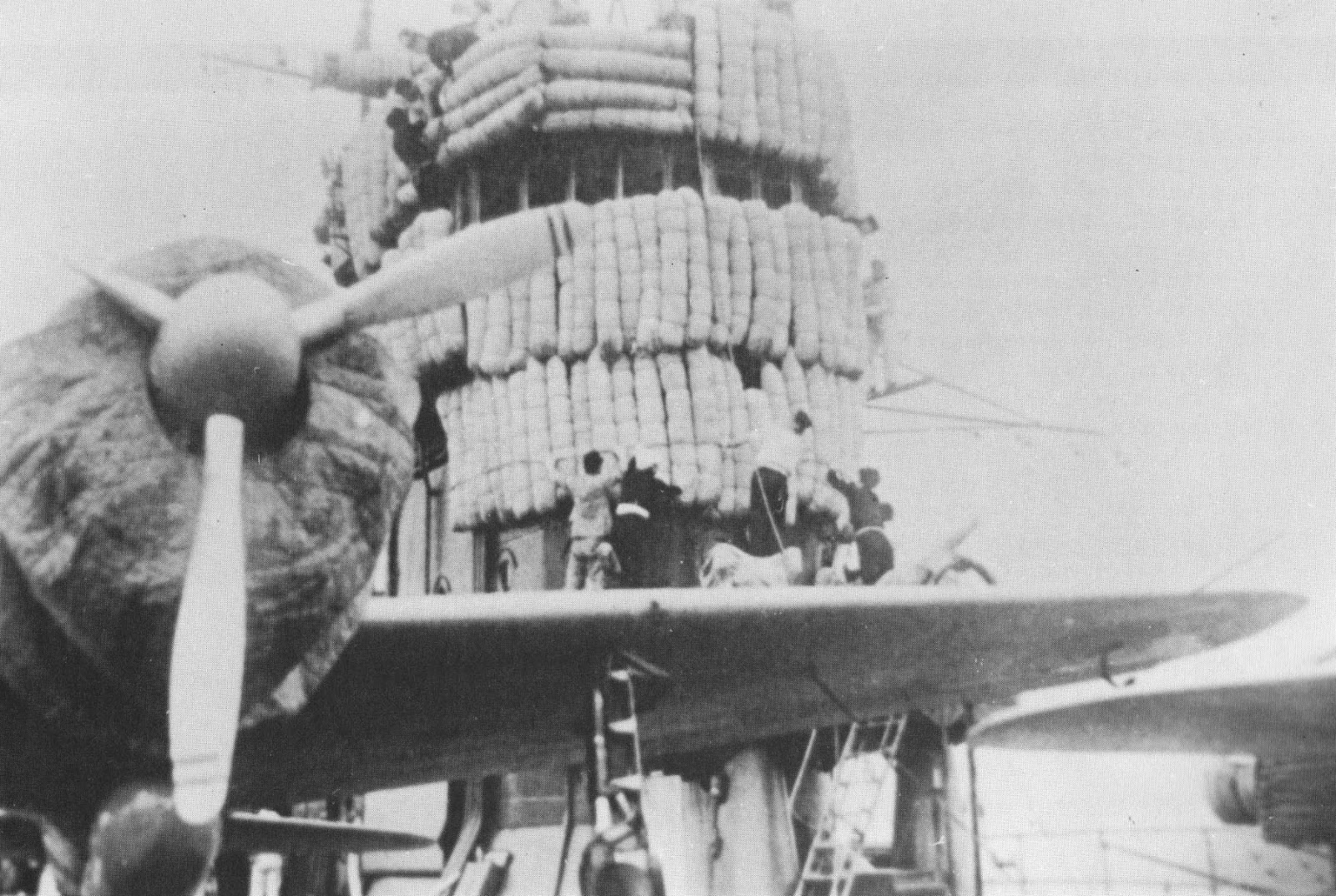
Akagi crewmen affix rolled hammocks to her island, to provide additional protection.
Someone must have survived in Akagi’s engine spaces, as power returned about 90 minutes after the bomb hit, and the carrier began circling of her own volition. Someone, perhaps the same person or group, also flooded the aft magazines at about the same time. But it would not be enough. That evening, Aoki ordered Akagi abandoned. Determined to go down with the ship, he tied himself to the anchor capstan and ordered his officers to leave him. Captain Kosaku Aruga, commander of Destroyer Division 4, boarded the now-empty carrier and gave Aoki a direct order to abandon his post. Aoki obeyed, and survived the war to be accused of cowardice at its very end when he abandoned his men to be captured by the Soviets; Aruga would command the battleship Yamato on her suicidal final mission. Thanks to the quick evacuation of the engineering spaces, only 267 of Akagi’s 1,630 crew were killed (a far lower proportion than the other Japanese carriers lost at Midway).
Just before dawn on 5 June, Yamamoto overruled his staff and ordered his old command scuttled. Four destroyers each launched one torpedo, finishing off Akagi. She sank stern-first, emitting plenty of noise as the tortured steel gave way and air escaped.
“It sounded,” recalled Capt. Seiji Nakasugi of the destroyer Maikaze, “like the scream of a living creature.”
Order Midway Here.
Pacific Inferno
• Midway
• Midway: Aftermath
• Midway: Rising Sun
• SWWAS: Islands
• Journal 42: Battleship-Carriers
Retail Price: $200.95
Package Price: $160.00
Gold Price: $128.00
Ignite the Inferno Here.
Gold Club members can apply their standard discount.
Sign up for our newsletter right here. Your info will never be sold or transferred; we'll just use it to update you on new games and new offers.
Mike Bennighof is president of Avalanche Press and holds a doctorate in history from Emory University. A Fulbright Scholar and NASA Journalist in Space finalist, he has published a great many books, games and articles on historical subjects; people are saying that some of them are actually good.
He lives in Birmingham, Alabama with his wife and three children. He misses his lizard-hunting Iron Dog, Leopold.
Daily Content includes no AI-generated content or third-party ads. We work hard to keep it that way, and that’s a lot of work. You can help us keep things that way with your gift through this link right here.
|