Midway:
American Battleships, Part One
by Mike Bennighof, Ph.D.
October 2025
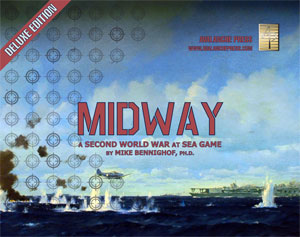 The Japanese air attack on Pearl Harbor aimed to eliminate the U.S. Pacific Fleet as a major factor in the war that would follow. While the Japanese sought out the American aircraft carriers, they also targeted the battleships. Not everyone in the U.S. Navy had yet accepted that the battleship’s day as arbiter of naval power had passed. The Japanese air attack on Pearl Harbor aimed to eliminate the U.S. Pacific Fleet as a major factor in the war that would follow. While the Japanese sought out the American aircraft carriers, they also targeted the battleships. Not everyone in the U.S. Navy had yet accepted that the battleship’s day as arbiter of naval power had passed.
We let you re-create the attack on Pearl Harbor in our Second World War at Sea: Midway Deluxe Edition, including a special tactical display of the famed American base. “Battleship Row” on the morning of 7 December hosted seven battleships, plus one more in drydock. All of them are of course present in Midway Deluxe Edition, so let’s have a look at them.
The Oldest
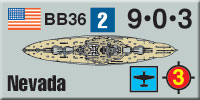
When new, Nevada and her sister Oklahoma represented an enormous leap forward in battleship design. On paper they differed little from the preceding New York class, with the same displacement (27,000 tons), armament (ten 14-inch guns) and speed (21 knots). Internally, they introduced a new age of battleship construction.
Famously, they inaugurated the “all-or-nothing” armor scheme with a thickly-armored citadel around their magazines and machinery spaces, and no armor at all protecting the rest of the ship. That in turn required concentrating the armament, using triple turrets for the first time in an American battleship. Reconstructed in the late 1920’s, by 1941 both ships were showing their age.
Struck by at least five torpedoes in the opening moments of the Pearl Harbor attack, Oklahoma rolled over and sank at her moorings, taking 429 of her crew with her. Beyond salvage, her hulk was raised in 1943 and after weapons and machinery had been stripped from the wreck, she was sold for scrap but broke her tow line and sank in 1947 while on her way to the breakers.
Nevada was the lone battleship to get under way on 7 December, but struck by six bombs and a single torpedo she could not escape Pearl Harbor and was intentionally run aground on a coral shelf; due to progressive flooding she slid off an sank to the harbor bottom. She was refloated, rebuilt again and saw a great deal of service in the second half of the war. She lost 60 men killed during the attack.
Greater Firepower
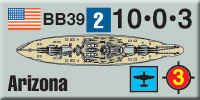
The Navy had wished to establish a “standard” battleship type with Nevada, but South Carolina Sen. “Pitchfork Ben” Tillman, an equally bitter foe of increased naval spending and the existence of African-Americans, fought against further construction. After intense wrangling the Navy emerged with authorization for two ships over two years rather than the desired two per year, with an increase in size (to 29,000 tons) and armament (to a dozen 14-inch guns).
Pennsylvania and Arizona were commissioned in 1916, and reconstructed fifteen years later with new turbines and boilers and refurbished armament. Pennsylvania, the Pacific Fleet flagship, was in drydock when the Japanese attacked. Struck by a single bomb, she suffered fifteen dead and was ready for sea five days after the attack. She went to San Francisco for further repairs, joining Task Force One based there.
Arizona was also struck by four bombs, 16-inch shells from Japanese battleships modified to serve as armor-piercing warheads. The last of them penetrated the magazine under B turret, touching off a massive explosion that broke the ship’s back and killed 1,177 sailors. The ship remains on the harbor floor as a memorial; two of her main turrets were salvaged and installed in coastal artillery batteries on Oahu.
The Big Five, Part One
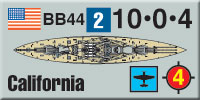
Tennessee and California built on the previous New Mexico class battleships (which were not present at Pearl Harbor), as the Navy continued to build “standard type” battleships despite a desire for larger and more capable ships. Even so, each class gained in size and with the two Tennessee-class ships, in capability. These continued to carry a main armament of a dozen 14-inch guns and making 21 knots (though unlike the earlier ships, actually achieving their designed speed).
They were, however, enormously more survivable than previous American battleships and thereby marked another step forward. They had far more extensive internal subdivision than previous classes, and turbo-electric drive - rather than turning the drive shafts directly, the turbines produced electricity which powered electric motors which powered that shafts. That allowed each element to be encased in its own separate armored compartment, eliminating the threat of massive flooding from an unlucky torpedo hit to the drive shaft tunnel.
Both Tennessee and California were present at Pearl Harbor. Tennessee suffered two hits from armor-piercing bombs, neither of which inflicted crippling damage. More extensive harm came from the burning oil that showered Tennessee when Arizona exploded, the fires fed by more fuel leaking from West Virginia moored alongside. West Virginia’s presence shielded Tennessee from torpedo attack, but she was pinned in position for several days by her sunken neighbor. She eventually went to Puget Sound Naval Yard for repairs which lasted until late February 1942. She then joined Task Force One.
California, the “Prune Barge,” was moored alone at the southern end of Battleship Row and suffered two near-simultaneous torpedo hits and two more from armor-piercing bombs. All of that subdivision could not save the ship; her water-tight doors had been opened for inspection and with two huge holes torn in the hull at once the crew could not close them in time to prevent widespread flooding. The Prune Barge eventually settled onto the harbor bottom, and was finally re-floated in March 1942. After extensive repairs she finally saw action in the June 1944 invasion of the Mariana Islands.
The Big Five, Part Two
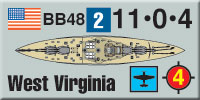
Along with the two Tennessees, the three ships of the Colorado class made up the Pacific Fleet’s “Big Five.” They were very similar to the preceding class, the significant difference being four twin turrets for 16-inch guns in place of the triple turrets with 14-inch guns carried by the Tennessee class. The class originally numbered four ships but one, Washington, had been sacrificed in the Washington naval limitations talks.
Colorado left the Pacific Fleet in June 1941 for a lengthy overhaul at Puget Sound, and so missed the Pearl Harbor attack. Inboard of Oklahoma and thus screened from torpedo attack, Maryland suffered two hits from armor-piercing bombs, losing four of her crew killed. The damage was repaired well enough to allow her to leave Pearl Harbor by the end of the month for Puget Sound, and full repairs had been completed by the end of February.
West Virginia, in contrast, took enormous punishment with hits from two armor-piercing bombs and seven torpedoes. Only prompt counter-flooding stopped her from capsizing like Oklahoma. Her crew fought back with notable gallantry, following the example of her mortally wounded captain, Mervyn S. Bennion, who posthumously received the Congressional Medal of Honor. Mess steward Doris Miller, who fired on the Japanese planes despite a total lack of training, carried Bennion out of harm’s way.
One hundred six men died in West Virginia, including three who survived in an air pocket for sixteen days before succumbing. The ship would be re-floated and re-constructed, when she re-entered service in September 1944, she resembled a slower version of the new battleships with a new superstructure and secondary armament. She was the first ship to hit the Japanese battleship Yamashiro at the Battle of Surigao Strait, the last action between battleships.
And those are the older American battleships. Next time, we’ll look at the rest of the American battleships.
Order Midway Here.
Pacific Inferno
• Midway
• Midway: Aftermath
• Midway: Rising Sun
• SWWAS: Islands
• Journal 42: Battleship-Carriers
Retail Price: $200.95
Package Price: $160.00
Gold Price: $128.00
Ignite the Inferno Here.
Gold Club members can apply their standard discount.
Sign up for our newsletter right here. Your info will never be sold or transferred; we'll just use it to update you on new games and new offers.
Mike Bennighof is president of Avalanche Press and holds a doctorate in history from Emory University. A Fulbright Scholar and NASA Journalist in Space finalist, he has published a great many books, games and articles on historical subjects; people are saying that some of them are actually good.
He lives in Birmingham, Alabama with his wife and three children.
Daily Content includes no AI-generated content or third-party ads. We work hard to keep it that way, and that’s a lot of work. You can help us keep things that way with your gift through this link right here.
|