| War of the States, Wars of the Empires:
A Series Rules Preview
By Mike Bennighof, Ph.D.
November 2015
Once upon a time, a wargame artiste told me that game rules don’t matter, that players just care about what the game looks like. They’ll figure out how to play the game if it looks good enough to interest them.
While gamers like that certainly exist, I still hold that the rules are the essence of the game, to the extent that I really try to avoid issuing new editions of rules for existing games. There are plenty of other designers and publishers who offer up a new way to play each time out; I want Avalanche Press to be the place for “the game you already know how to play.”
 Even so, sometimes the rules need updating. We hadn’t published a game in the War of the States/Empires series in years when we brought out Battles of 1866: Frontier Battles, and in the interim many changes had been made to its two sister series, the now-defunct Napoleonic Battles and the reviving Rome at War. It seemed logical that equivalent updates should be made to the War of the States/Empires rules as well. Even so, sometimes the rules need updating. We hadn’t published a game in the War of the States/Empires series in years when we brought out Battles of 1866: Frontier Battles, and in the interim many changes had been made to its two sister series, the now-defunct Napoleonic Battles and the reviving Rome at War. It seemed logical that equivalent updates should be made to the War of the States/Empires rules as well.
The most noticeable change is in the concept of “Command Radius” – the distance over which a leader can transmit his orders. In the earlier editions, each leader had his own radius; this represented a better leader’s ability to formulate his orders more quickly, thus giving dispatch riders more time to carry said orders over a broader area.
That seemed too intricate a detail for a game on this scale, and also appeals to an antiquarian sense of history more common two centuries past. In that world-view, it’s personalities that matter and every general is described as “acerbic” or “witty” or “dour” or some such nonsense. Differences in performance between different generals are very difficult to generalize, so to speak, in such a blithe fashion. Everyone has good days and bad days; some of us have more of one than the other. Quantifying that is an exercise in pure guesswork.
So like their brothers in Rome at War and the now-out-of-print Napoleonic Battles, leaders in War of the States and Wars of the Empires have a standardized Command Radius which makes the game flow a little faster and takes nothing away from historical veracity.
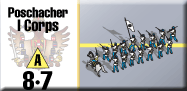
There are still two numbers left on the leader pieces, and that Initiative Rating is now even more important than before. Previously, an Army Commander automatically placed all subordinates within his Command Radius into command – with variable radii, that made a certain amount of sense. With the standardized ones, not so much. Instead, now an Army Commander can place in command a number of Formation Leaders equal to his Initiative Rating, provided they are within his command radius.
The Pursuit rules seemed sort of confused, at one point talking about the pursuing player getting to choose whether to chase the fleeing enemy or not, and at another proclaiming that the pursuit must go on. I went with no choice, as it seemed much easier to handle from a player’s perspective and fit with the historical evidence particularly at Custoza.
Otherwise, the editorial team – Aaron Silverman, Paul Aceto and Mike Bowen – made many other corrections, and I think the result is a much smoother set of rules that’s even easier to play than the previous edition. I went with a set usable in either the American Civil War (War of the States) or European warfare (Wars of the Empires), with special rules in each game to show the differences in the two theaters.
The game system works fine in both areas, and should handle South American battles like Tuyuti as well. The special rules are all a result of differing army organizations or cultures. Frontier Battles has many more special rules than I usually like to put in a series game, but we’re stretching one set of series rules to cover battles in both Europe and North America. And as a Holy Grail game it gets a little special dispensation.
First off, there’s a special “Cold Steel” rule to cover the stosstaktik, the Austrian bayonet attack (though anyone can do it; the French will likely use it should we ever do an 1859 game). Such an attack can inflict massive harm on the defenders if successful, but should it fail the results can be catastrophic. Even so, it’s not a bad choice against a defender who lacks breechloading weapons. Unfortunately for the Austrians, just about all of the Prussians have breechloaders. The regular rules just weren’t generating the astronomical casualties of the actual battles without some special dynamic.
 That raises the question of why any sane player (or his historical counterpart) would order an unsupported mass bayonet attack. Prussian defensive prowess can be overcome by striking them in the flank as well as head-on, so the judicious Austrian player will only launch such attacks after setting up flanking attacks and subjecting the Prussians to serious bombardment to take away their advantages. After all, that’s what Ludwig von Gablenz did at Trautenau against the Prussians and at Oeversee against the Danes, with great success. That raises the question of why any sane player (or his historical counterpart) would order an unsupported mass bayonet attack. Prussian defensive prowess can be overcome by striking them in the flank as well as head-on, so the judicious Austrian player will only launch such attacks after setting up flanking attacks and subjecting the Prussians to serious bombardment to take away their advantages. After all, that’s what Ludwig von Gablenz did at Trautenau against the Prussians and at Oeversee against the Danes, with great success.
Sometimes, the Austrian player will have no choice: if an attempt to place a Formation Leader in command goes awry, he might just decide to attack all on his own. In those cases, his brigades have to attack the nearest enemy as quickly as possible. If flank attacks aren’t possible, the assault goes in anyway whatever the consequences. And the consequences are immense.
Rapid firepower and Austrian impulsiveness are about the only special power possessed by the Prussians, and that’s really all they need. Prussian infantry brigades already have awesome printed firepower and very good morale. Balancing that a little, Austrian light infantry has a number of special powers: it can, in very limited circumstances, retreat before combat much like light cavalry in the standard game. Actually, all light infantry can try to do so, but the Austrian battalions have such good morale that they are unlikely to fail. The Austrian player can choose to use his light infantry as shock troops leading their associated brigade in a bayonet charge (the way many Austrian corps commanders deployed them in the actual battles), raising the odds of success but requiring that the light infantry take the first casualties.
As in previous editions, there’s a limit to how much artillery can bombard out of one area; thanks to better coordination the Austrians can bring a little more firepower to bear (otherwise, it’s impossible to re-create the “gun lines” the Austrians formed at Jicin, Trautenau and Königgrätz).
The Prussians have Subordinate Commanders in each corps (division commanders) which the Austrians lack, but the Austrians do have an ad latus with each corps, a special type of leader who can aid the corps commander. That helps a little but it's still usually easier to handle a Prussian corps than its Austrian equivalent.
 It won’t be unique to the Battles of 1866 games; any subsequent War of the Empires games will also require that infantry attempt to form squares when charged by cavalry – this was part of every European army’s doctrine during the period. It won’t be unique to the Battles of 1866 games; any subsequent War of the Empires games will also require that infantry attempt to form squares when charged by cavalry – this was part of every European army’s doctrine during the period.
The new rules greatly improve the old ones, which weren’t bad at all. They do what I want them to: provide a smooth-playing game showing the basic precepts of battlefield command in the mid-19th Century. They are by no means a detailed simulation; I don’t really have an interest in trying to create such a game. In the Battles of 1866 games, the brigades move across the map just like they do in old-style military history maps, and combat’s resolved quickly without a bunch of tables and markers. The perspective’s that of an army commander, and the rules put the player in charge of the things an army commander worried about – where do the troops go, do they attack or not and so on. Tactical considerations are the worry of brigade and regimental commanders, and out of the scope of the game rules.
I’m very pleased with the way these rules turned out, and if these battles interest you then I think you’ll find them very player-friendly.
You can see the rules for yourself right here.
Put the new rules to use! Order Chickamauga & Chattanooga today!
Fight out the Clash of the Teutons! Order Frontier Battles right now!
Mike Bennighof is president of Avalanche Press and holds a doctorate in history from Emory University. A Fulbright Scholar and award-winning journalist, he has published over 100 books, games and articles on historical subjects.
He lives in Birmingham, Alabama with his wife, three children and his dog, Leopold. Leopold has a very high initiative rating.
|