| Race in America:
The Man Who Made Juneteenth
By Mike Bennighof, Ph.D.
June 2026
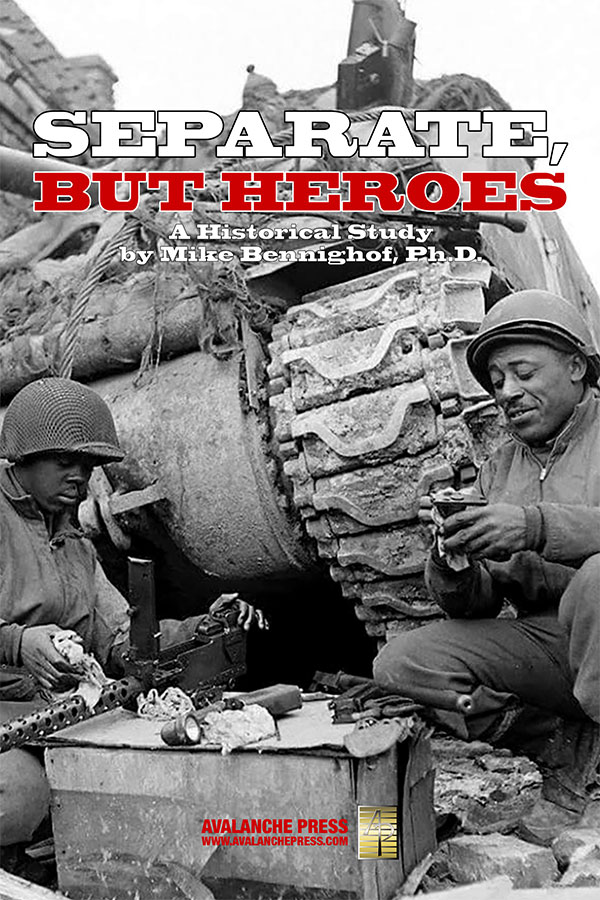 Galveston Texas June 19th 1865. Galveston Texas June 19th 1865.
General Orders No. 3.
The people of Texas are informed that, in accordance with a proclamation from the Executive of the United States, all slaves are free. This involves an absolute equality of personal rights and rights of property between former masters and slaves, and the connection heretofore existing between them becomes that between employer and hired labor.
The freedmen are advised to remain quietly at their present homes and work for wages. They are informed that they will not be allowed to collect at military posts and that they will not be supported in idleness either there or elsewhere.
By order of Major General Granger
It may be one of the most radical statements in American history, and it was written by a U.S. Army general: This involves an absolute equality of personal rights and rights of property between former masters and slaves. Absolute equality. No reservations. No special conditions. Absolute equality. One hundred and sixty-one years later, it’s still one of the most powerful definitions of what it’s supposed to mean to be an American. Absolute equality.
From his days as a 17-year-old school teacher in upstate New York, Gordon Granger had never sought popularity. This was probably a good thing, because the short, short-tempered and short-spoken Granger lacked the personality to ever become widely liked. Given the reactions of the leading white citizens of his new command in Texas, he was probably the best-suited general in U.S. Army for the task of telling them that slavery had come to an end.
Granger would not be the first general to declare slavery at an end in a Confederate state (Edward McCook had already done so in Tallahassee, Florida). His wasn’t even the first proclamation read out in Galveston (Capt. Benjamin Sands of the U.S. Navy had done so two weeks earlier, though he apparently did not explicitly address slavery). It didn’t take two years for the slaves to learn of the Emancipation Proclamation (they were already well aware). It didn’t free the last slaves still held in the United States; slavery continued in Kentucky and Delaware until December 1865. But it would be the moment celebrated by Black Americans in Galveston and later across Texas as Juneteenth, a federal holiday since 2021 (and still one as of this writing), making Gordon Granger an unlikely American hero.
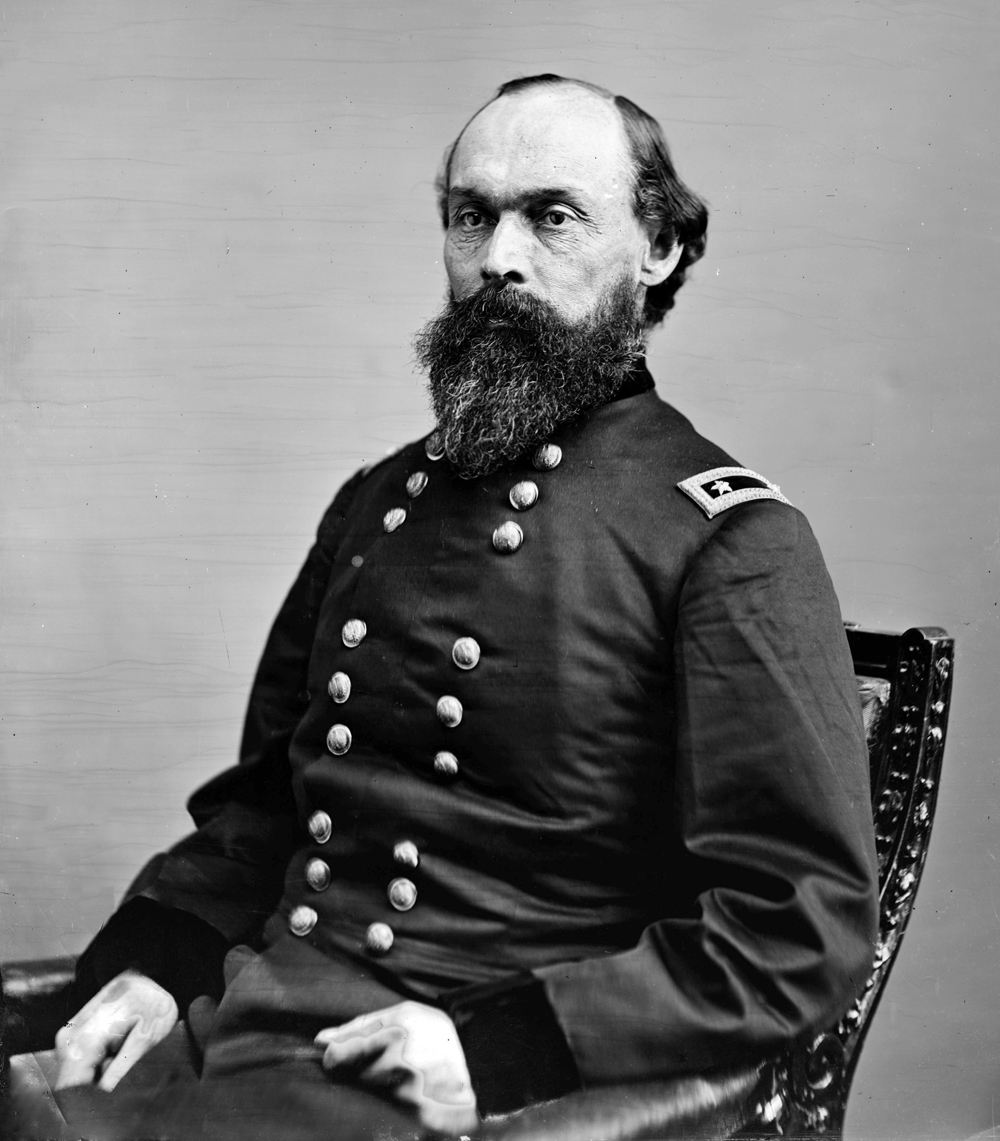
Brig. Gen. Gordon Granger, taken sometime during the Civil War. |
Granger’s personality, or lack of one, held back his military career from the time he enrolled at West Point in 1841 as a 19-year-old cadet (apparently as an at-large appointment). He usually finished in the lower half of his class academically, though he did finish, and near the top in demerits – thanks to a habit of speaking what he felt to be the truth to anyone, including his superiors. His ever-present cough repelled other people, and left him with a raspy voice.
At West Point, he also acquired a life-long enemy, fellow cadet Ulysses S. Grant, two years ahead of him in school but five months younger. Just what sparked the feud isn’t recorded, except that it was felt by Grant much more deeply than by Granger. Granger did make friends, including John Pope and George McClellan.
Granger graduated in 1845 and soon found himself in combat in Mexico as a second lieutenant in the (dismounted) Mounted Regiment of Riflemen. He received two awards for bravery, and also extended his ornery reputation, objecting to short rations for his men and the loss of their horses. Afterwards, he remained in the Army, mostly with the Mounted Rifles (later re-christened the 3rd Cavalry), seeing no promotions above his permanent rank of lieutenant until 1861.
His luck began to change with the outbreak of the Civil War. After a short spell on McClellan’s staff, he took command of the 2nd Michigan Cavalry as a colonel of volunteers, where he fostered the career of Capt. Philip Sheridan. His old friend John Pope gave him command of a cavalry brigade in the Army of the Mississippi, keeping the post as his command expanded to a cavalry division and then the small Army of Kentucky. That command merged into the Army of the Cumberland as its Reserve Corps, and it was in that role that Granger fought in the Battle of Chickamauga in September 1863.
It would be Granger who, without orders, brought his corps to Snodgrass Hill to rescue George Thomas’s XIV Corps, counterattacking and blunting the Confederate advance. But in October 1863, a new commander took over Union forces in Tennessee: Granger’s ancient enemy, Ulysses S. Grant. Granger commanded IV Corps in the Battle of Chattanooga, driving the Confederates off Missionary Ridge in late November 1863. But as Grant watched, Granger became absorbed in directing the fire of a single battery of artillery, ignoring the rest of his command until a second direct order from Grant. Despite that odd interlude, it was a stirring string of successes, and might have propelled any other officer to the heights of military command.
Grant ordered Granger to bury the American dead on Missionary Ridge, count the Confederate dead, and collect captured weapons and battle flags. Grant then reversed himself, telling Granger to march on Knoxville and relieve the siege then ongoing there. Granger objected, apparently forcefully, that his men needed food, winter clothing, and above all new shoes. Grant ridiculed those concerns, and Granger shot back that Grant had other formations that had not fought in the battle and were far more capable of executing the quick march to Knoxville. Grant did not fire Granger on the spot, but did assign the relief operation to William Sherman with many more forces, including Granger’s corps. Granger’s troops did not march until two days after the battle on Missionary Ridge, having paused to collect food for the march, bringing a rebuke from Grant as well as an order to share the provisions with Sherman.
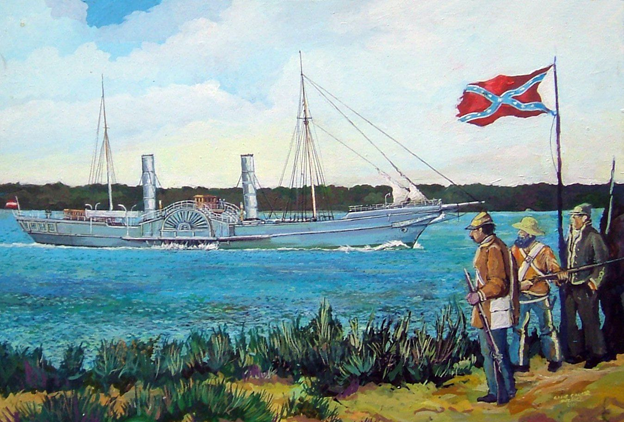
Union steamer Cornubia enters Galveston Bay. The Confederates are sad.
Granger continued to argue with his superiors throughout the winter campaign in East Tennessee, seeking better food, clothing, and shelter for his men. An odd Christmas Day telegram to Grant, apparently composed while Granger was quite drunk, did little to build confidence in him. He also appears to have suffered greatly in the harsh weather, aggravating his lifelong issues with chronic bronchitis. In April 1864 he left his command; whether he was relieved by Sherman or requested a medical leave is not clear, as both Grant and Sherman would later make both claims and Granger left no memoir. Edward Canby, commanding the Union Army of the Gulf, appointed him to command XIII Corps, over Grant’s objections. Granger led the corps in the Mobile campaign, including the last battle west of the Mississippi at Fort Blakeley east of Mobile.
Granger’s old friend Philip Sheridan, then commanding the Military Division of the Southwest, selected Granger to command all U.S. forces in Texas. Granger had 6,000 men from XIII Corps ready to sail from Mobile, and immediately dispatched transports to Brazos Island, Corpus Christi, and Indianola (a small port on Matagorda Bay, about halfway between Corpus Christi and Galveston). Other troops would come from the Black USCT regiments of the XXV Corps, part of the Army of the James and sailing from the big Union base at City Point, Virginia.
“There is not a very wholesome state of affairs in Texas,” Sheridan telegraphed Granger on 10 June. “The Governor, all the soldiers, and the people generally are disposed to be ugly.”
Other than Brazos Island at the mouth of the Rio Grande (sealing the port of Brownsville on the Mexican border) and El Paso (captured by California troops in 1862), the Union held none of Texas when the Confederacy collapsed. Confederate President Jefferson Davis dissolved his government on 5 May 1865, and Union soldiers captured him five days later, allegedly finding him disguised in a woman’s shawl. What little control Confederate commander Edmund Kirby Smith and his subordinates had over their roughly 65,000 troops in Texas quickly dissolved despite the generals’ vows to fight on.
Desertion had already become rife, and accelerated as white Texans began to riot and sack government warehouses and arsenals. With the collapse of Confederate currency, now literally not worth the paper on which it was printed, the rebel government had resorted to what it called “impressment,” the taking of goods it deemed necessary to the war effort. Now mobs of civilians looked to impress them right back. The state’s gold reserves disappeared as well.
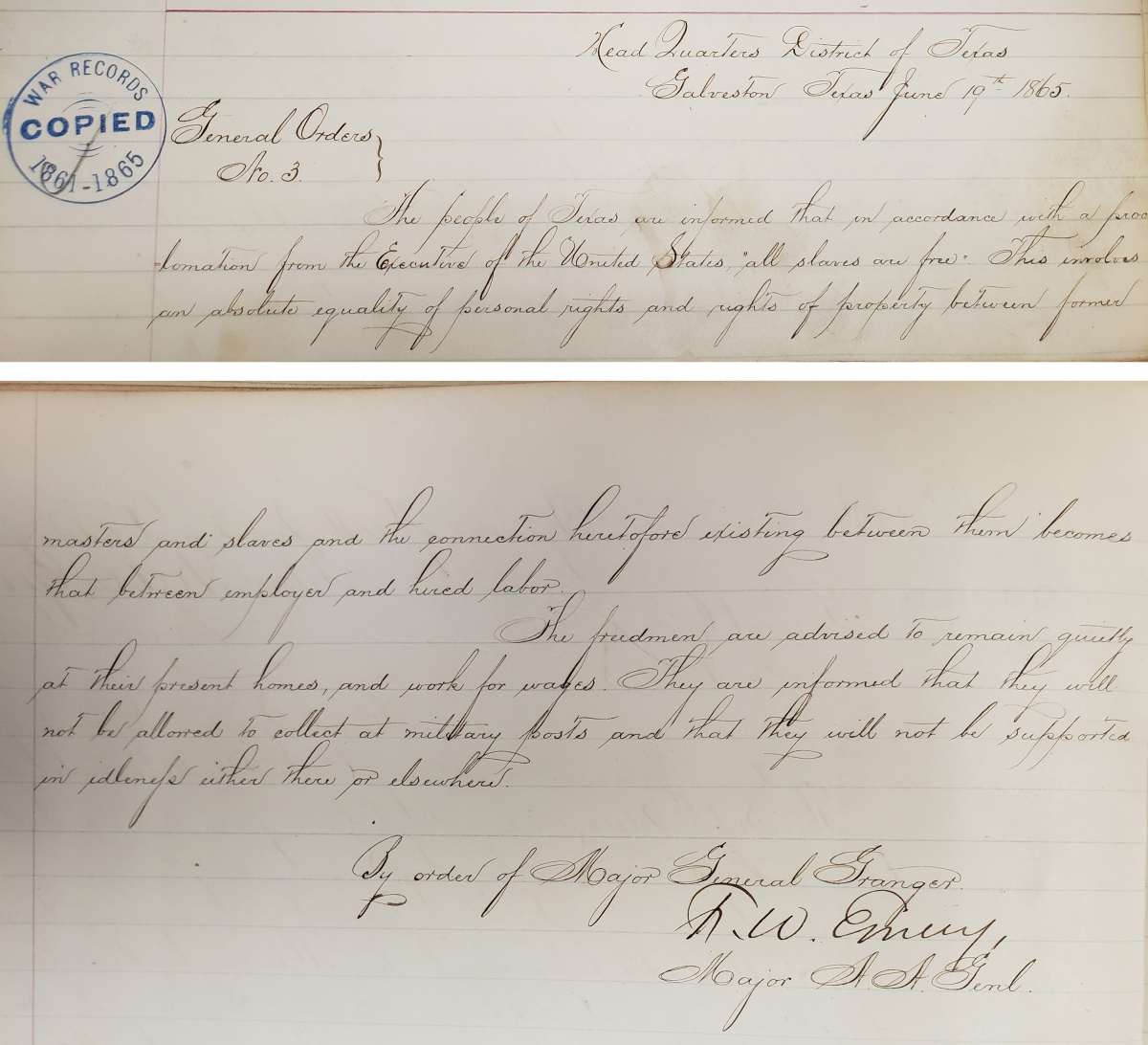
The handwritten version of Geneal Order No. 3, as copied by staff officer F.A. Emery.
After rejecting multiple calls to surrender, Kirby Smith finally agreed to do so on 2 June. He then took off for Mexico, urging his commanders to do the same and to take whatever weapons and equipment with them that they could, especially artillery. They then hoped to join up with either the French-supported Emperor Maximilian, or the Mexican opposition, without a great deal of preference for either side.
Sheridan, on orders from Grant, had his focus on the French presence in Mexico. He told Granger to demand that the French return the weaponry brought into Mexico by the ex-Confederates, specifically the 14 cannon from Brownsville. Active intervention in the ongoing civil war across the Rio Grande seemed likely, and it would be Granger in command of the front-line forces.
First, though, Granger would have to arrive in Texas. Galveston in 1865 was the only deep-water commercial port in Texas, and one of the largest cities in the state (San Antonio was roughly the same size, but population figures had shifted greatly under wartime stress since the 1860 census). It was the commercial center of Texas, where cotton was stored and exported, a center of banking and communications and where cotton traders made their deals. It would retain its importance after the war, until the Great Hurricane of 1900 devastated the city.
On 5 June, Capt. Benjamin Sands of the West Gulf Blockading squadron took two U.S. Navy steamers, Cornubia and Preston (both of them former Confederate blockade runners), into Galveston harbor. Sands landed with a small detachment of armed sailors (including Black and white men), and met with Mayor Charles Henry Leonard in the mayor’s office. Sands and Leonard addressed a small crowd outside, then went to the Customs House, the center of federal authority in the port city. Sands ordered the Confederate flag lowered, the Starts and Stripes raised, and read out a proclamation declaring the war over and federal authority restored. The crowd stood silently, while the American sailors cheered.
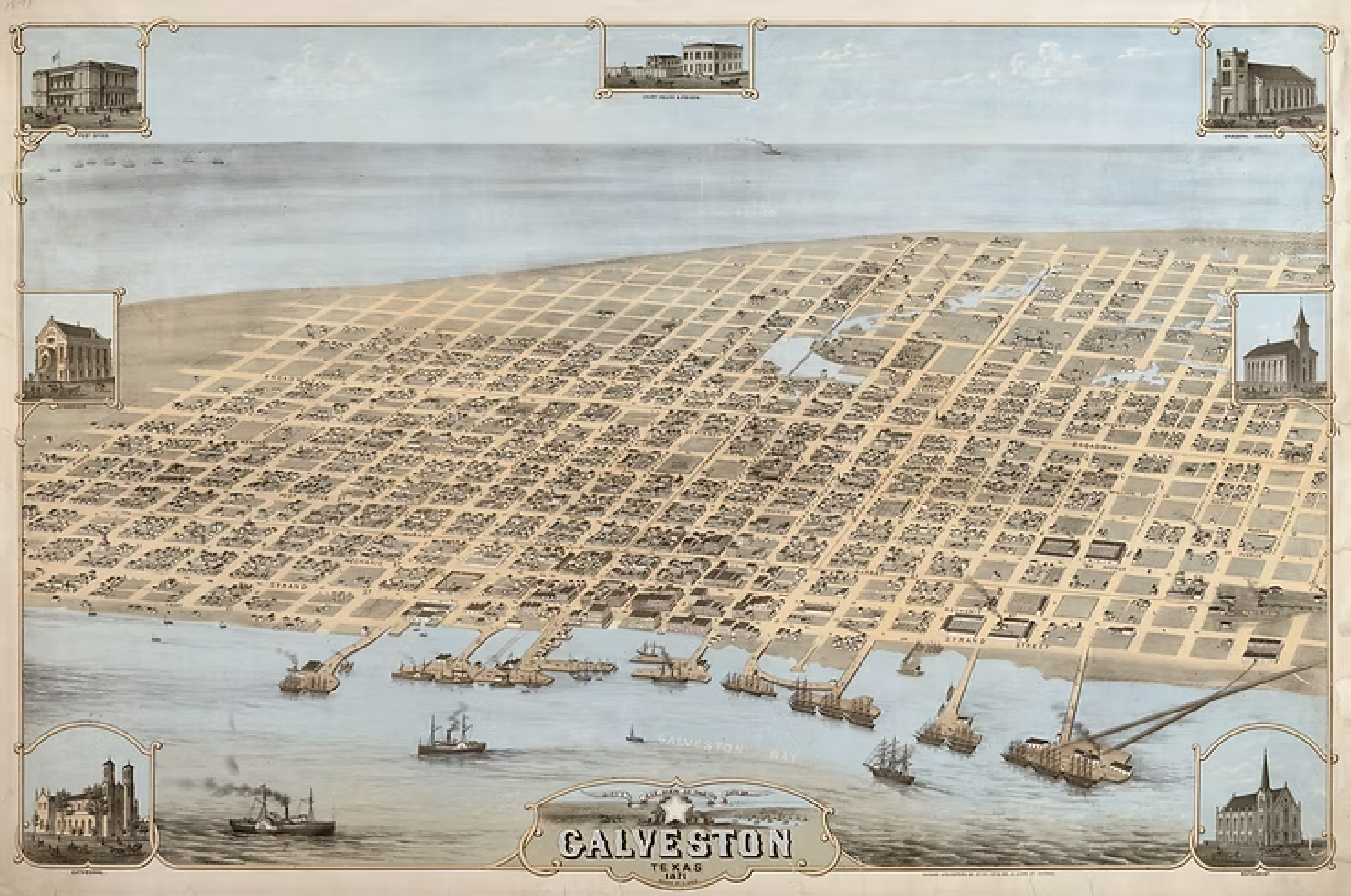
Galveston as a thriving commercial port, 1871.
Granger, meanwhile, received further orders from Sheridan on 13 June:
“On your arrival at Galveston assume command of all troops in the State of Texas; carry out the conditions of the surrender of General [Edmund] Kirby Smith to Major-General [Edward] Canby (commander of the Army of West Mississippi); notify the people of Texas that in accordance with the existing proclamation from the Executive of the United States ‘all slaves are free’; advise all such freed-men that they must remain at home; that they will not be allowed to collect at military posts, and will not be supported in idleness. Notify the people of Texas that all acts of the Governor and Legislature of Texas since the ordinance of secession are illegitimate. Take such steps as in your judgment are most conducive to the restoration of law and order and the return of the State to her true allegiance to the United States Government.”
Slavery would not be formally outlawed in all of the United States until December 1865, when the XIII Amendment was ratified by the 27th required state (Georgia putting the amendment over the top; a few states held out and Mississippi would not finally ratify the amendment until 2013). Sheridan based his order to Granger on the Emancipation Proclamation, issued in its final form on 1 January 1863 as an executive order of President Abraham Lincoln. The Proclamation only applied to areas “in rebellion against the United States,” and did not free anyone enslaved in Kentucky and Delaware, which had not seceded, and in areas of other rebel states controlled by U.S. forces.
Texas, wholly under Confederate control at the time of the Proclamation, qualified by Sheridan’s reasoning. Texas slave-holders and newspapers would later object that, as the XIII Amendment had not been ratified, U.S. Army actions freeing slaves constituted an illegal seizure of property. Granger and his boss ignored them.
Granger himself arrived in Galveston on 17 June, bringing with him 1,800 troops from XIII Corps, mostly white volunteer regiments from the Midwest that had fought under his command in the Mobile Campaign. He re-worked Sheridan’s draft (which did not require him to use the exact language provided and told him to use his own judgement), softening it in places, such as making the phrase telling ex-slaves that they “must remain at home” a suggestion instead. And he added that perfect summation of why the war had been fought, and what it’s supposed to mean to be an American:
This involves an absolute equality of personal rights and rights of property between former masters and slaves.
One of his staff officers, Major F.A. Emery, issued the written version of General Order No. 3 two days later. Granger himself stepped out onto the balcony of Ashton Villa, a requisitioned mansion that had served as Confederate Army headquarters in Galveston, and read out his proclamation (some sources claim that he did this at the Ostermann Building). Granger sent officers throughout the city to read it aloud at the Custom House and the court house, and at the Negro Church on Broadway (today’s Reedy Chapel AME Church).
Celebrations began among the dockyard workers, and spread throughout the city under the watchful eye of Granger’s troops. As word spread outside Galveston, whites reacted violently, and slave patrols – still in existence where U.S. troops had not yet arrived – savagely beat the jubilant ex-slaves, while some plantation owners held their former property at gunpoint. What made Juneteenth in Galveston different, what made it take hold as a widespread tradition, was the protection offered to these initial joyful outbursts by Granger’s soldiers.
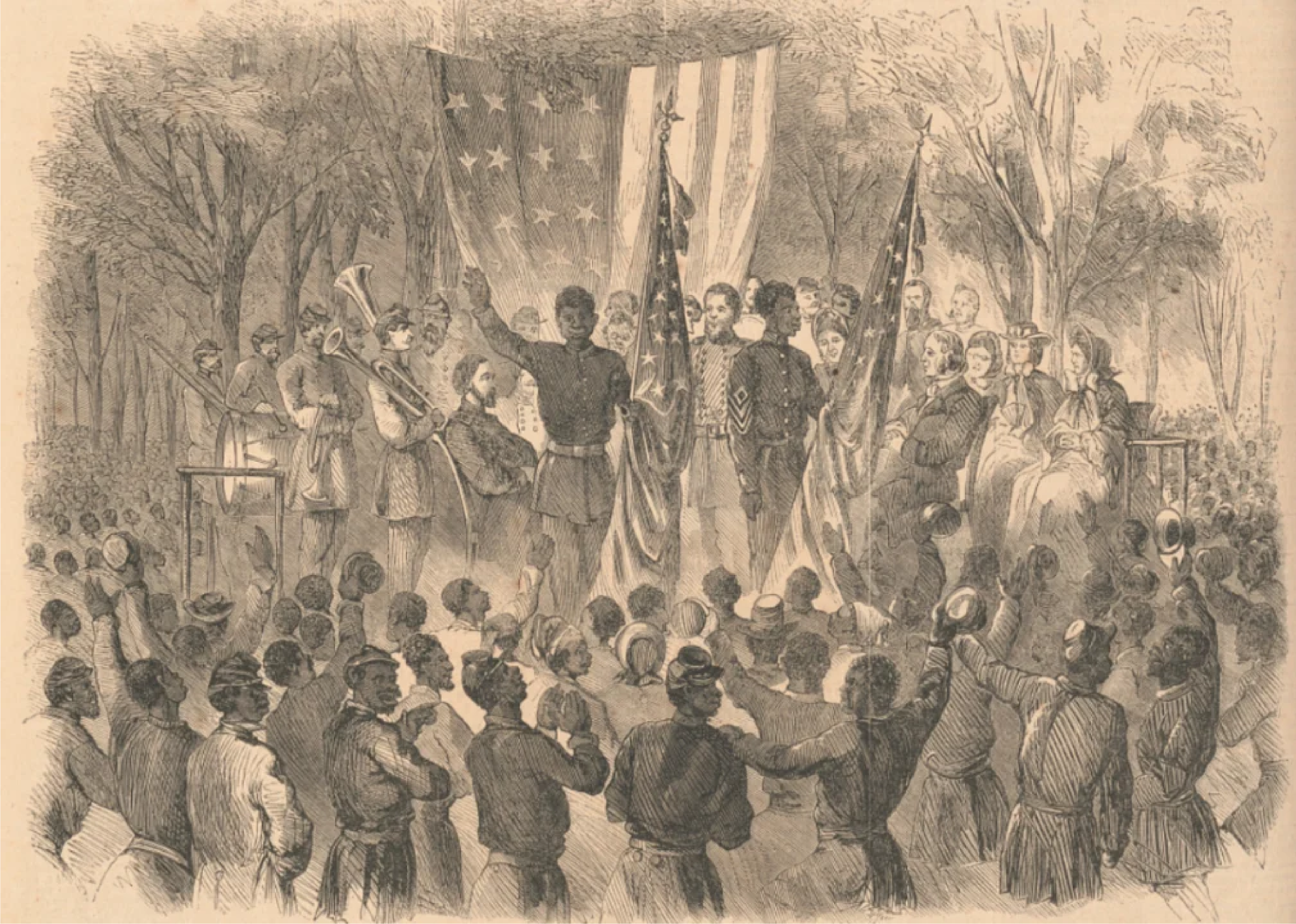
One year later, Juneteenth is celebrated in Galveston. 19 June 1866.
By the next year, the celebrations took place across Texas, though racist whites would disrupt them for decades afterwards. Juneteenth became an informal holiday across the old Confederate South over the years that followed. Jim Crow laws helped suppress the remembrance, and it faded as Black populations shifted from rural to urban areas. But in 1938, Texas Gov. James Allred declared the day a state holiday and wrote that he “urge[d] all members of the Negro race in Texas to observe the day in a manner appropriate to its importance to them.” The legislature made that official in 1980, and a few other states followed. The holiday had begun to regain notice in the 1970’s; efforts to make it a federal holiday began in 1996 and reached fruition 25 years later.
As for Gordon Granger, Grant (now the U.S. Army’s Commanding General) fired him as commander in Texas exactly one month after General Order No. 3’s proclamation. Granger held smaller commands in the South and West, married, and drew close to President Andrew Johnson, at one point serving as his personal military advisor. But Johnson did not give Granger the posts he sought (as commandant of the Port of New York, or as a military observer in the 1866 Austro-Prussian War – the latter plum went to Phil Sheridan). He commanded the Military District of New Mexico, overseeing the Comanche War, and died at his post in 1876, just 54 years old.
Gordon Granger had been a difficult man in life, not least because of his outspoken concern for those who could not speak for themselves, whether soldiers freezing in the Smoky Mountains or recently-freed slaves facing a hostile white ruling class. He spoke his mind, he made a difference, and he paid the professional price for it.
This involves an absolute equality of personal rights and rights of property between former masters and slaves.
The full series is here:
• Race in America: Founded on Slavery
• Race in America: Civil War
• Race in America: Jim Crow
• Race in America: The Black Doughboys, Part One
• Race in America: The Black Doughboys, Part Two
• Race in America: Red Summer
• Race in America: Tulsa
• Race in America: Klan Scam
• Race in America: Strange Fruit
• Race in America: Canada’s Shame
• Race in America: They Said No
Order Separate, But Heroes Here.
Please allow an extra six weeks for delivery. Use coupon code DANA for 20-off
Sign up for our newsletter right here. Your info will never be sold or transferred; we'll just use it to update you on new games and new offers.
Mike Bennighof is president of Avalanche Press and holds a doctorate in history from Emory University. A Fulbright Scholar and NASA Journalist in Space finalist, he has published a great many books, games and articles on historical subjects; people are saying that some of them are actually good.
He lives in Birmingham, Alabama with his wife and three children.
Daily Content includes no AI-generated slop or third-party ads. We work hard to keep it that way, and that’s a lot of work. You can help us keep things that way with your gift through this link right here.
|