| 1940 The Fall of France:
Scenario Preview, Part Four
By Mike Bennighof, Ph.D.
August 2026
.jpg) I designed the Panzer Grenadier game system to simulate all theaters of World War II, and all types of combat within them. And it does a pretty good job of meeting that goal and Philippe Léonard’s upcoming Cityfight expansion will address the one obvious weak area, large-scale urban combat. I designed the Panzer Grenadier game system to simulate all theaters of World War II, and all types of combat within them. And it does a pretty good job of meeting that goal and Philippe Léonard’s upcoming Cityfight expansion will address the one obvious weak area, large-scale urban combat.
But firstly, Panzer Grenadier is a game of armored combat. You know, tank battles. And 1940: The Fall of France delivers them. The French have better tanks, with thicker armor and better weapons. But they Germans have better coordination, and that’s the key on the battlefield and in Panzer Grenadier.
Our third chapter is all about the tank battle at Hannut, part of the huge Battle of Gembloux. Let’s have a look at the scenarios:
Chapter Three
Tank Battle at Hannut
Gen. René Prioux’s Cavalry Corps represented the most powerful formation in the French Army: two mechanized divisions with 520 tanks between them, including 176 of the outstanding Somua S35 medium cavalry tank. Prioux advanced into Belgium, but rather than supporting the Belgian Army he placed his corps along an over-extended front to await the attack of the Erich Hoepner’s two panzer divisions, combined in XVI Motorized Corps. Hoeper had more tanks, 618 of them, but 252 were the worthless Panzer I tankettes and another 234 the only slightly more effective Panzer II light tanks.
The Germans kept their divisions concentrated for the attack, but the French struck back promptly and fierce tank battles – the largest ever seen up to that moment – raged for three days. The French had halted the German advance for the moment.
Scenario Thirteen
First Armor Clash
12 May 1940
Crehen, Belgium
 In the early hours of 12 May, 4th Panzer Division advanced quickly through the Belgian plains and up to the Hannut-Huy road. Meanwhile in the village of Crehen, elements of the French 3rd Division Légère Mécanique (DLM) had taken up positions but were unaware that the Germans had gotten so close so fast. The first tank battle on the Western Front began in a mildly-undulating landscape seemingly made for AFVs. In the early hours of 12 May, 4th Panzer Division advanced quickly through the Belgian plains and up to the Hannut-Huy road. Meanwhile in the village of Crehen, elements of the French 3rd Division Légère Mécanique (DLM) had taken up positions but were unaware that the Germans had gotten so close so fast. The first tank battle on the Western Front began in a mildly-undulating landscape seemingly made for AFVs.
Conclusion
Within a few minutes, the quiet village became an inferno when about 50 panzers charged into its streets. Relying on outdated tactics, Capt. Ste-Marie Perrin kept his 20 Hotchkiss tanks in fixed positions, from which they took out a few light panzers. But then the heavier panzers attacked them frontally while the remaining light panzers attacked from the flanks at very close range. The accompanying French infantry broke and ran around 1100, leaving the tanks alone. Ste-Marie Perrin was killed in his tank and 11 out of the 20 Hotchkiss tanks were put out of action, with total German losses at five panzers destroyed. In the afternoon, both sides abandoned Crehen and its smoking streets full of relics.
Notes
We had a version of this scenario in the first edition.
The Germans have a huge mass of tanks trying to drive south on a narrow corridor; the French have about a third as many but 10 of the 13 German tank platoons are the nearly-useless Pz I tankettes and Pz II light tanks. The Germans have more flexibility (not needing tank leaders) but are unaccompanied by infantry. Superior German morale will help, and they have artillery support where the French have none.
Scenario Fourteen
The Witch’s Cauldron
13 May 1940
Merdorp, Jandrenouille and Jandrain, Belgium
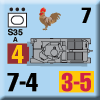 After an easy trip through Belgium, 4th Panzer Division met French armor for the first time near Hannut on 12 May. Maj. Gen. Johann Stever, the panzer division’s commander, halted the advance and waited a day for 3rd Panzer Division to arrive on his northern flank before launching a massed attack on the French line held by the 3rd DLM. The two German divisions committed all of their forces on a narrow front and held nothing in reserve. For their part, the French were well dug-in but scattered along the line, diluting the effectiveness of their much superior Somua tanks. After an easy trip through Belgium, 4th Panzer Division met French armor for the first time near Hannut on 12 May. Maj. Gen. Johann Stever, the panzer division’s commander, halted the advance and waited a day for 3rd Panzer Division to arrive on his northern flank before launching a massed attack on the French line held by the 3rd DLM. The two German divisions committed all of their forces on a narrow front and held nothing in reserve. For their part, the French were well dug-in but scattered along the line, diluting the effectiveness of their much superior Somua tanks.
Conclusion
Though often cited as history’s first large-scale battle of tanks against tanks, this was actually a combined-arms assault, with the panzers having received orders to bypass village strongpoints where possible and leave the mopping up to the infantry. The tactic did not work well, with a counterattack by French tanks from 1st Cuirassiers wreaking havoc among the panzers. Confused armor combat lasted several hours, but in the end brute force and numbers prevailed over tactical skill. The French abandoned their positions all along the line in costly retreats, and by the end of the day 3rd DLM had nearly been destroyed.
Notes
This is what wargaming is all about: 18 French tank units (10 of them the awesome Somua S35) against 20 German tank units (though nine of these are the utterly useless PzKpfw I tankettes). It’s going to be tough on the Germans: the French not only have the better tanks, they have the powerful 47mm APX anti-tank gun (three batteries’ worth) and are dug in on the defensive.
Scenario Fifteen
A Quiet Village
14 May 1940
Grand-Leez, Northeast of Gembloux, Belgium
 It only took an hour for 4th Panzer Division’s engineers to clear a breach in the line of Cointnet anti-tank obstacles just wide enough for the division’s tanks to pass through one by one, single-file. Such a slow procession would have made a prime target for Allied ground-attack aircraft, but none ever showed up. Once past the obstacles, the German tankers entered open fields and charged toward Gembloux. Waiting for them at the edge of a wood were some hidden rearguard forces of the retreating 2nd DLM. It only took an hour for 4th Panzer Division’s engineers to clear a breach in the line of Cointnet anti-tank obstacles just wide enough for the division’s tanks to pass through one by one, single-file. Such a slow procession would have made a prime target for Allied ground-attack aircraft, but none ever showed up. Once past the obstacles, the German tankers entered open fields and charged toward Gembloux. Waiting for them at the edge of a wood were some hidden rearguard forces of the retreating 2nd DLM.
Conclusion
Fire from French anti-tank guns and hidden tanks in the Bois de Grand Leez brought a rapid halt to the advance of 36th Panzer Regiment. Neither air support nor artillery fire could silence the French, and the infantry of 33rd Schützen Regiment remained pinned in the fields and meadows. A furious tank battle developed while the Germans tried to bypass the French positions. More French tanks came into view on the road from Sauveniere, but a German pioneer lieutenant stopped their advance by destroying four French tanks with an anti-tank gun and then personally throwing a demolition charge under the French command tank. But then several panzers bogged down in the marshy terrain, and both sides lost more tanks until the French finally withdrew.
Notes
This time the French DLM is a pre-war regular outfit with the expected morale for such a unit, plus S35 tanks. But the Germans have numbers and firepower on their side, so it’s going to be hard to hold the towns that are the key to their defensive line. There’s just one board in play and not a whole lot of time (just a dozen turns), so the Germans are going to have to come right at the French.
Scenario Sixteen
Delaying Action
14 May 1940
Walhain St-Paul, North of Gembloux, Belgium
 The 3rd DLM had retreated from the Jandrain armor cauldron back to the Wavre-Gembloux road. During that withdrawal, part of the division fought 5th Panzer Regiment at Thorembais while Captain de Beaufort’s squadron of the 2nd Cuirassiers stopped at Walhain some hundred meters east of the main road to Gembloux. In this fluid situation, the German tankers were outrunning their infantry support and ignoring flank security. The 3rd DLM had retreated from the Jandrain armor cauldron back to the Wavre-Gembloux road. During that withdrawal, part of the division fought 5th Panzer Regiment at Thorembais while Captain de Beaufort’s squadron of the 2nd Cuirassiers stopped at Walhain some hundred meters east of the main road to Gembloux. In this fluid situation, the German tankers were outrunning their infantry support and ignoring flank security.
Conclusion
The French brigade HQ at Walhain was suddenly surrounded by German tanks, and the Somuas of the 2nd Cuirassiers engaged them. In the village a Panzer IV knocked out three French tanks at close range, and while the Germans claimed seven more French tanks destroyed, they ended up backing off due to their exposed forward position. In the middle of the afternoon De Beaufort’s tanks pulled back under orders, having lost ten machines at Walhain. It was time for the 3rd DLM to withdraw and let the infantry assume the defense of France.
Notes
Tanks tanks tanks. Nothing but tanks: six German, four French. The Germans have better command and control but the French have the Somua S35. This is a fun little scenario, built for the panzer-pusher that lives inside every wargamer.
And that’s all for Chapter Three; next time we’ll dig into Chapter Four.
Order 1940 The Fall of France Here.
Order 1940 The Fall of France (Anarchy) Here.
No rules! You’ll need the Fourth Edition rules from another Panzer Grenadier game. Earlier edition rules will not work with this game.
1940: The Grand Tour
1940: The Fall of France
1940: Road to Dunkirk
1940: Swallows of Death
1940: The Last Days of May
1940: Polish Exiles
9 April 1940
Retail Price: $341.94
Package Price: $275
Gold Club Price: $220
Take The Full Tour.
Fall of France Playbook Edition: Downloadable Upgrade
Includes Last Days of May Campaign Study
You can transform your old copy of 1940: The Fall of France (the boxed edition) into the splendid Panzer Grenadier: 1940 The Fall of France Playbook Edition, bundled with The Last Days of May. It’s $39.99, but if you’re a Gold Club member, you can download for $27.99 using your Gold Club link (That’s the only way to claim your Gold Club discount).
Sign up for our newsletter right here. Your info will never be sold or transferred; we'll just use it to update you on new games and new offers.
Mike Bennighof is president of Avalanche Press and holds a doctorate in history from Emory University. A Fulbright Scholar and NASA Journalist in Space finalist, he has published an unknowable number of books, games and articles on historical subjects.
He lives in Birmingham, Alabama with his wife and three children
Want to keep Daily Content free of third-party ads? You can send us some love (and cash) through this link right here.
|