Atlantic Breakout 1918
Design Notes
by Mike Bennighof, Ph.D.
June 2025
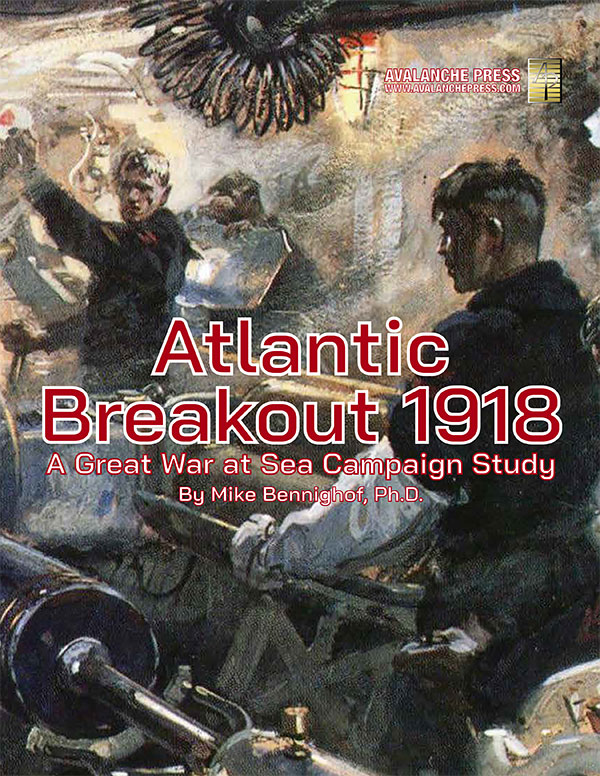 Great War at Sea: Atlantic Breakout 1918 is a Campaign Study focused on the possibility of German battle cruisers entering the North Atlantic to prey on enemy shipping. Specifically, the troop convoys bearing tens of thousands of American Doughboys from East Coast ports to the battlefields of France. Great War at Sea: Atlantic Breakout 1918 is a Campaign Study focused on the possibility of German battle cruisers entering the North Atlantic to prey on enemy shipping. Specifically, the troop convoys bearing tens of thousands of American Doughboys from East Coast ports to the battlefields of France.
At some point, I’ll probably want to write more on this topic. It’s a vastly under-covered aspect of the Great War at sea; Paul Halpern, in his otherwise authoritative A Naval History of World War I, gives it a single paragraph tucked into his chapter about the German submarine campaign and Allied response. There’s definitely a full book in there. For now, though, we’ll have to make do with a Campaign Study.
Atlantic Breakout 1918 is built on primary-source research; it sort of had to be, given the paucity of coverage in the otherwise deep historiography of the 1914-1918 naval war. That alone makes it unusual in the world of historical wargames, though it’s the sort of thing I want to see in our own products as much as possible. It’s a mix of history and scenarios; we usually aim for ten scenarios in one of these little books, but this time we only managed to wedge eight of them in there, as the history ran long.
The naval historiography of the Great War is an odd field; it has enormous coverage of the Battle of Jutland and the German submarine war. And then it drops off precipitously regarding other topics, to the point that some areas are simply ignored. We’ve covered one of these before in Dogger Bank 1915; nearly all histories of the naval war pretend that operations in the North Sea ceased after the Battle of Dogger Bank and did not start up again until April 1916, and this is simply not true. Likewise, the United States Navy did not sit by passively and watch the naval war from afar: it jumped into the war effort with everything it had.
When the United States entered the First World War, she possessed the world’s third-largest surface fleet, after those of Britain and Germany. Many of these ships had been in reserve status with skeleton crews only, while others had just joined the fleet. That meant a huge influx of new sailors would be needed to man them all. The Navy increased in just 19 months from 79,000 men to 530,000 (mostly men, but including 10,000 women). The Selective Service Act of 1917 did not at first include the Navy, which drew its new recruits from the various state naval militias, its own large reserve, and an influx of volunteers.
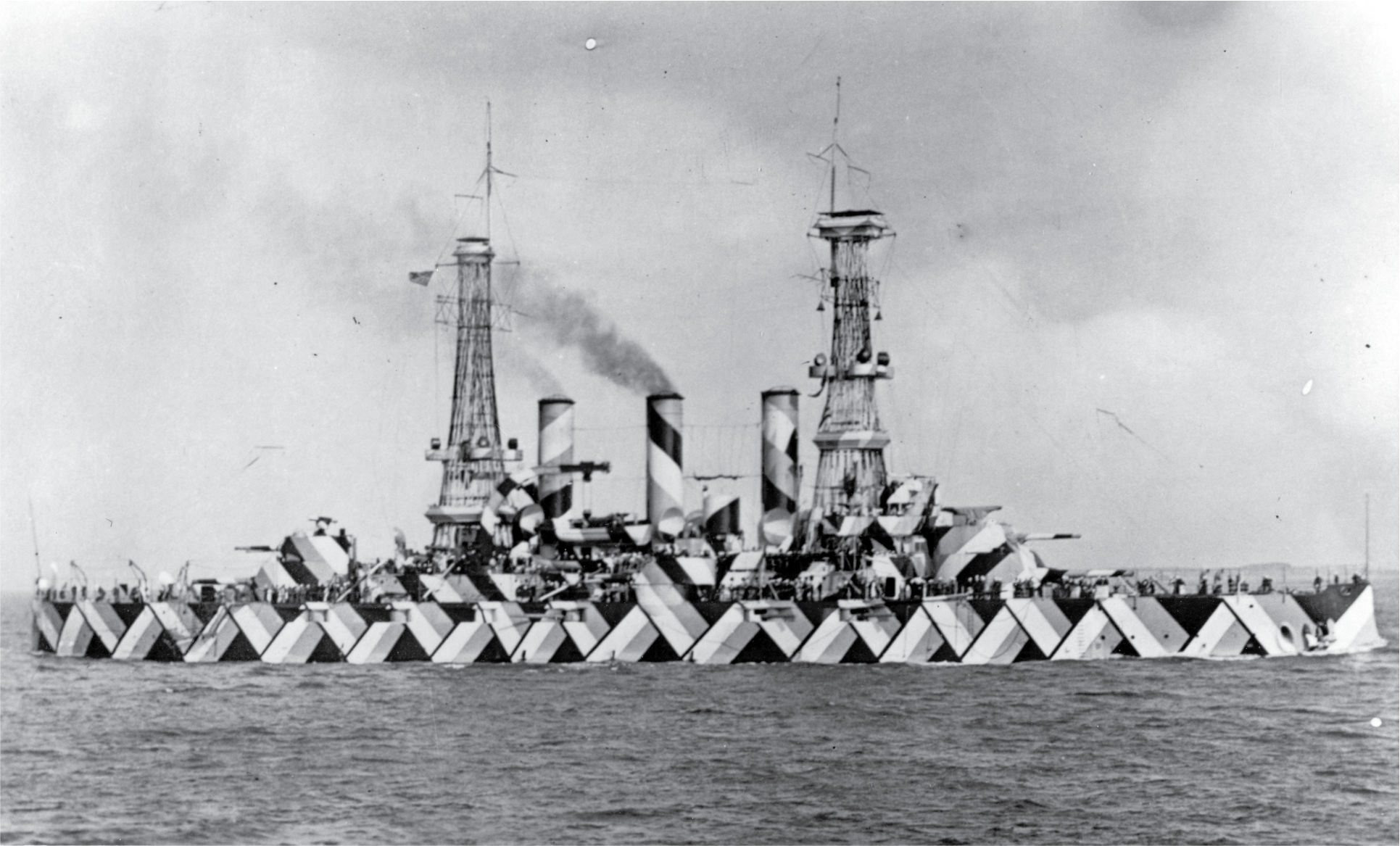
The pre-dreadnought Nebraska, seen here in her 1918 dazzle camouflage, escorted more troop convoys than any other American battleship.
Those men needed to be trained, and that also meant that much of the Navy’s existing manpower and ships had to be devoted to preparing them for service. That kept the U.S. Navy from the front lines for many months, but when they finally had their ships fully crewed, they acted with their full force. Every American major warship re-deployed to the Atlantic, with a dreadnought squadron assigned to the British Grand Fleet, another deployed in Ireland to react against German raiders, and the remaining ships at Hampton Roads ready for the same mission. The newer pre-dreadnoughts and armored cruisers would act as convoy escorts, while the older ones continued the training mission.
The extent of that effort caused me to alter my approach to Atlantic Breakout 1918. I’d initially planned to focus on the German side, the plans offered up at first by Max Hahn of von der Tann and greatly expanded by High Seas Fleet chief of staff Erich Raeder at the direction of his boss, Franz von Hipper. We still have a chapter devoted to the Hahn initiative, with a single operational scenario to accompany it, set in May 1915.
While the Germans did not undertake such a raid, it’s still a historical scenario in my eyes, as we have the convoy and merchant situation as it actually stood in May 1915. There are multiple small convoys crossing west to east bearing Canadian troops to France, each consisting of a large, fast liner and an escort (usually an armored cruiser, but one set of Canucks has only an armed merchant cruiser to keep them company on their voyage). There’s also a reaction force, but it’s just got armored cruisers as well. Hahn was right: the British were not prepared for the eruption of a battle cruiser into the North Atlantic. But Hipper, who at that time rejected the idea, was also right: there is a lot of ocean out there, and it’s a long way from home, with no easy way to re-fuel a coal-burning battle cruiser.
The second chapter (there are just two of them) leaps forward to the autumn of 1918, and the American effort to defend their troop convoys. Both sides understood that a German battle cruiser sortieing into the Atlantic was not likely to make it back home. The Americans (Atlantic Fleet commander Henry T. Mayo and William S. Benson, the first Chief of Naval Operations) felt the loss of a battle cruiser for the destruction of a convoy with 20,000 or more American soldiers would be a worthwhile gamble. Kaiser Wilhelm II disagreed, and so no such operation took place.
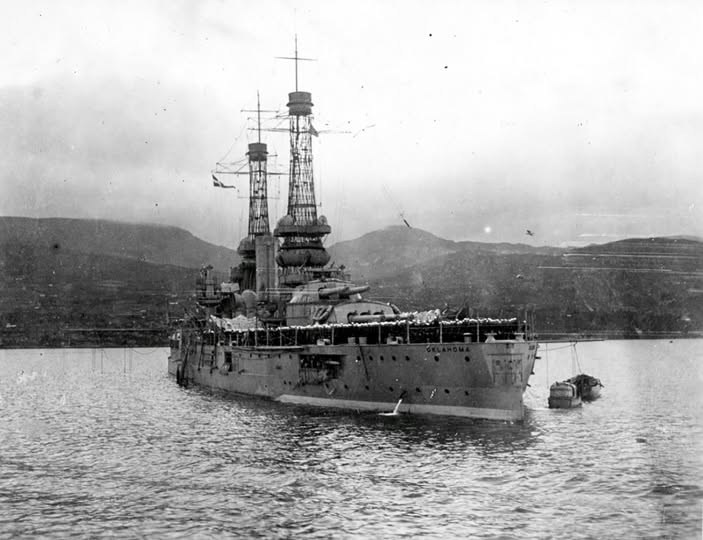
Battleship Oklahoma seen at Berehaven, Ireland during her anti-raider deployment.
Not knowing the feeling in Berlin, the Americans deployed against the threat, and that’s the basis of our second set of scenarios: two operational scenarios and five battle scenarios. Once again, the German side of these operations never took place, but the Allied deployment (almost exclusively American) is exactly that of September and October 1918. In the second operational scenario, I included Mayo’s deep desire, the Japanese squadron of four battle cruisers. That allows for a scenario of German vs. Japanese battle cruisers, which I thought y’all would like. Yes, you can match Kongo against Derfflinger.
It's also one of the foundations of animosity between the American and British naval leadership: the Americans felt that the British prevented the Japanese deployment to Hampton Roads; if those four fine battle cruisers would not serve in the Grand Fleet, they did not want them serving with the Americans instead.
William Sims, who commanded U.S. naval forces in Europe, liked his British hosts. Benson and Mayo most certainly did not, and Benson scolded Sims for giving in too easily to British demands. The Americans did not appreciate Grand Fleet commander Sir David Beatty’s disparagement of the American dreadnoughts assigned to his command, and American anger seeps through the century-plus-old correspondence. The British, the American admirals felt, were not concerned about the possible mass slaughter of American troops on their way to win the war for them. And so the Americans deployed their entire fleet strength to assure that this did not happen.
It's a great story, one worthy of a deeper treatment.
To tell it in game form, I needed more American pieces than are present in our Jutland game. We originally said that Atlantic Breakout 1918 would only need pieces from Jutland and the maps from Bismarck; to get all of the American ships in play, you’ll also need Far Side of the World, Plan Emerald, Rise of the Dragon, and Remember the Maine. I only hesitated a moment before going forward with the scenarios we have; I know a few will complain that they need multiple games or expansions for those pieces, but I felt the opportunity to craft a historically-accurate situation more than outweighed that inconvenience.
Atlantic Breakout 1918 is some of our best work. I’m very proud of the deep research behind it, and I think the game situation is also unique. If you play these things for the history, you will want this little book.
Order Atlantic Breakout 1918 Here.
Sign up for our newsletter right here. Your info will never be sold or transferred; we'll just use it to update you on new games and new offers.
Mike Bennighof is president of Avalanche Press and holds a doctorate in history from Emory University. A Fulbright Scholar and NASA Journalist in Space finalist, he has published a great many books, games and articles on historical subjects; people are saying that some of them are actually good.
He lives in Birmingham, Alabama with his wife and three children. He misses his lizard-hunting Iron Dog, Leopold.
Daily Content includes no AI-generated content or third-party ads. We work hard to keep it that way, and that’s a lot of work. You can help us keep things that way with your gift through this link right here.
|