| Race in America:
Dorie Miller, American Hero
By Mike Bennighof, Ph.D.
August 2026
 Dorie Miller mattered. Dorie Miller mattered.
On 7 December 1941, aboard the battleship West Virginia, he tried to save his captain, he did save several other sailors, and he grabbed an unmanned anti-aircraft machine-gun to fire at the attacking Japanese aircraft. A string of heroic acts, but many other sailors also became heroes on that day.
Unlike those others, Dorie Miller was Black. Limited by Navy regulations to service as a mess attendant. A servant, who on that terrible day proved himself a sailor. The Navy would award 15 Congressional Medals of Honor and 51 Navy Crosses for actions during the Pearl Harbor attack, but only one of those went to a Black man; Miller would be the first African-American awarded the Navy Cross. No Black sailor would be awarded the Medal of Honor during World War II, and only four would receive the Navy Cross.
Miller dropped out of school after his second year of eighth grade; by then he was 18 years old. He joined the Navy a year after that, in 1939, as a mess attendant. After training and a brief turn aboard the ammunition ship Pyro, he joined West Virginia in January 1940. West Virginia had a very active sports program, and Miller thrived in it, becoming the ship’s heavyweight boxing champion. At roughly 6-foot-3 and 225 pounds, he was an imposing presence. Twice he attended the summertime Secondary Gunnery School aboard the battleship Nevada; though a mess attendant by trade, he would serve as an ammunition handler during battle and learned to operate the ship’s 5-inch guns.

Dorie Miller, Navy Cross recipient.
The morning of 7 December found West Virginia moored outboard of the battleship Tennessee along Pearl Harbor’s Battleship Row. She was an imposing presence herself; at the time, along with her sisters the largest and most powerful battleship in the Pacific Fleet. When the Japanese attacked that made her a magnet for the attacking pilots; she suffered hits from seven torpedoes (at least one of which zipped through the opening left by a prior torpedo hit to explode deep within the ship’s vitals) and two bombs.
Miller’s day started at 0600, when he helped serve breakfast, and then he collected laundry. When the planes struck, he first ran to his battle station, as an ammunition handler for the portside five-inch anti-aircraft battery. The guns and their magazines had been destroyed by the first torpedo hits, and Miller headed to “Times Square,” an open area under the boat deck where two main corridors intersected and available hands gathered to await orders.
Some works claim that Miller immediately began moving wounded men, but this seems to be an embellishment. He did exactly what the situation demanded: make himself available for orders. Lt. Cdr. Doir C. Jonson, the ship’s communications officer, sought someone to help move Capt. Mervyn Bennion, the ship’s badly-wounded commander. The two set out for the signal bridge. “I had brought a colored mess attendant with me,” Johnson wrote in his report, “a very powerfully built individual, having in mind that he might pick the Captain up and carry him below.”

West Virginia burning, sometime between 0850 and 0930.
Bennion had taken a large chunk of shrapnel, probably a piece of Tennessee’s Turret Number II, through his abdomen. Chief Pharmacist’s Mate Leslie Leak tried to stem the bleeding, but Bennion continued to weaken and Lt. Cdr. Claude V. Ricketts, the secondary battery commander and senior officer on the bridge, had the captain moved away from the growing threat of fire and smoke. Miller and Leak tried to carry Bennion on a cot, off the bridge and presumably off the ship, but the cot sagged and broke. Over the captain’s objections the men moved him behind the conning tower instead, where Leak continued to treat Bennion.
With the dying Bennion secured, Lt. Frederic White called Miller over to help man the pair of .50-caliber Browning machine guns mounted aft of the bridge. Miller had never fired the weapon, but had been to gunnery school, and White quickly showed him how. “Just pull the trigger,” Miller recalled White telling him. Miller fired until his ammunition ran out; he later said that he thought he might have hit one Japanese plane.
Numerous secondary works, including an online encyclopedia, state that Miller was “officially credited” with downing anywhere from two to six Japanese aircraft. This is simply not true. So many anti-aircraft weapons fired at the Japanese that matching any of the 29 Japanese planes shot down to a particular gunner remains an impossible task. No one would be “officially credited” with any of the planes shot down.
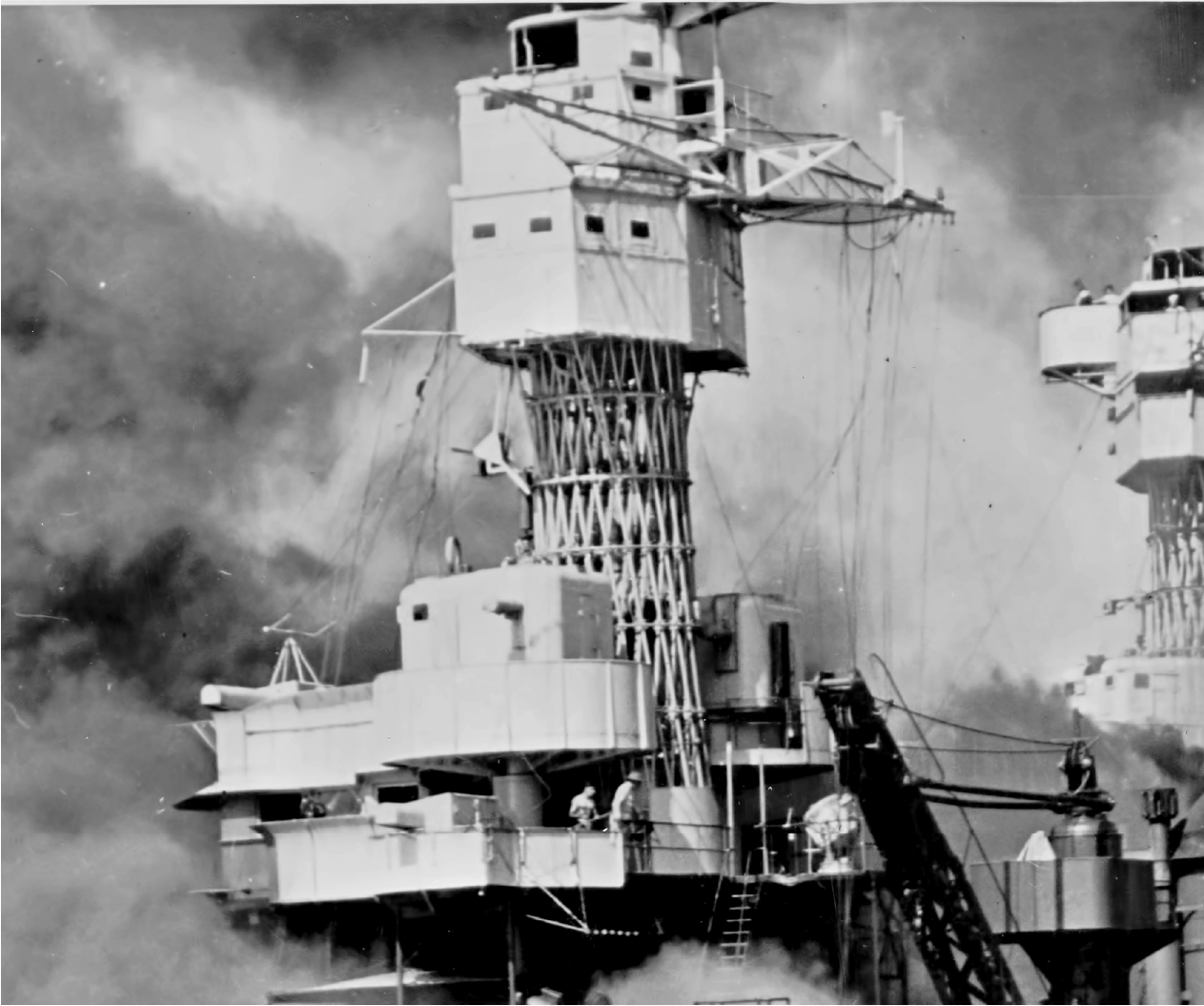
A closeup from the photo above. The two men visible in the photo are standing where Miller helped carry Bennion to temporary safety.
Meanwhile, fires and smoke made Bennion’s location dangerous. Miller returned to his captain’s side, where he and Signalman A.A. Siewart lashed Bennion to an eight-foot ladder. They could not lower hm through the smoke and flames, and then couldn’t untie the lashings. They placed him on the ship’s searchlight platform, while White and Miller went to find Ricketts and report the captain’s condition. When they returned, Rickets, White, Miller, and Siewart carried Bennion to the Navigation Bridge, away from the smoke and flames but higher still. Fires broke out in the flag and life jacket lockers, and the two enlisted men rushed to throw the contents over the side while the officers hoisted a firehose up from the main deck, but it had only a trickle of pressure.
“Mr. Ricketts,” Leak interrupted the efforts to rig ropes to lower Bennion, “the captain’s about gone.”
When Leak turned back to Bennion, the captain had died, and the men now had no purpose on the bridge. Ricketts shimmied down the fire hose, while the others climbed a rope onto the nearby boat crane and then down the structure to the main deck. White and Miller went below, where they dragged wounded sailors out of the oily water to safety.
Miller certainly acted, as Ricketts wrote in his report, with bravery and enthusiasm. But so did many other men aboard West Virginia including every member of the party trying in vain to save their captain. These weren’t just any service members, but Battleship Sailors with capital letters, the cream of the pre-war Navy. Ricketts, seeing Oklahoma capsizing just ahead of West Virginia on Battleship Row, had felt the deck tilt under his feet and realized that his ship would follow without immediate action. With Bennion’s permission, he raced belowdecks to manually counter-flood. Once he reached the valves, he found that enlisted shipfitters James F. Bobick and Murrell B. Rucker had already started the process without waiting for an officer’s order.
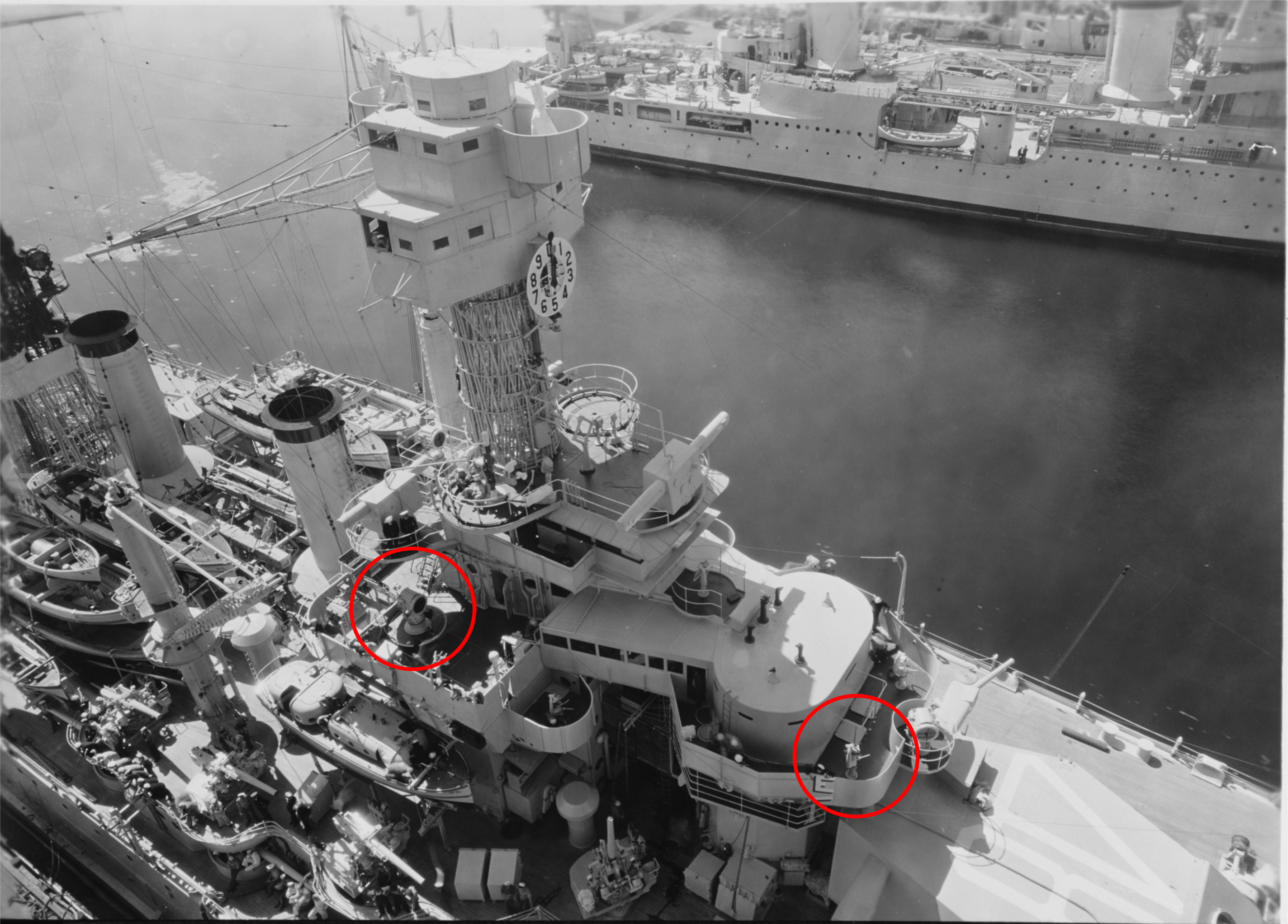
West Virginia’s bridge seen during her 1933 refit. The machine gun post manned by Miller is circled at right (the gun itself has not yet been mounted), the searchlight platform where Bennion was taken is circled at left.
Commander Roscoe H. Hillenkoetter, West Virginia’s executive officer and senior surviving officer, wrote the ship’s after-action report, dated 11 December 1941. Drawing on the written reports of Ricketts, White, and Johnson, he commended Miller by name for his actions; Hillenkoetter himself had been aft when the torpedoes struck and cut off from the bridge. His report praises Miller for his rescue work, and would become the basis for Miller’s inclusion on a list of sailors considered for commendation, but only as “an unnamed Negro.” It’s not clear who struck Miller’s name, or why, as all of the West Virginia officers name him fully in their reports.
In January, the NAACP asked President Franklin Roosevelt to award the unknown sailor the Distinguished Service Cross, an Army award, and Roosevelt passed the request to the Navy’s Awards Board. The Pittsburgh Courier, a prominent Black-owned newspaper (that would later make the 761st Tank Battalion famous) published Miller’s name on 12 March 1942. Sen. James Mead of New York read the Courier’s story into the Senate record the next day, as did Rep. John Dingle Sr. in the House of Representatives. Both Congressmen asked that Miller be awarded the Congressional Medal of Honor.
Political pressure grew, with Black organizations like the National Negro Congress insisting that the medal be awarded and attacking Navy Secretary Frank Knox for failing to do so. While Miller had been recognized by his ship’s officers, he had not been nominated for a formal award. Knox issued a commendation letter to Miller on 1 April, but not a medal. Chief of Naval Operations Ernest J. King stepped in to urge Knox to grant Miller a high-level medal, and with Roosevelt’s support Knox awarded Miller the Navy Cross, the service’s second-highest award for valor.
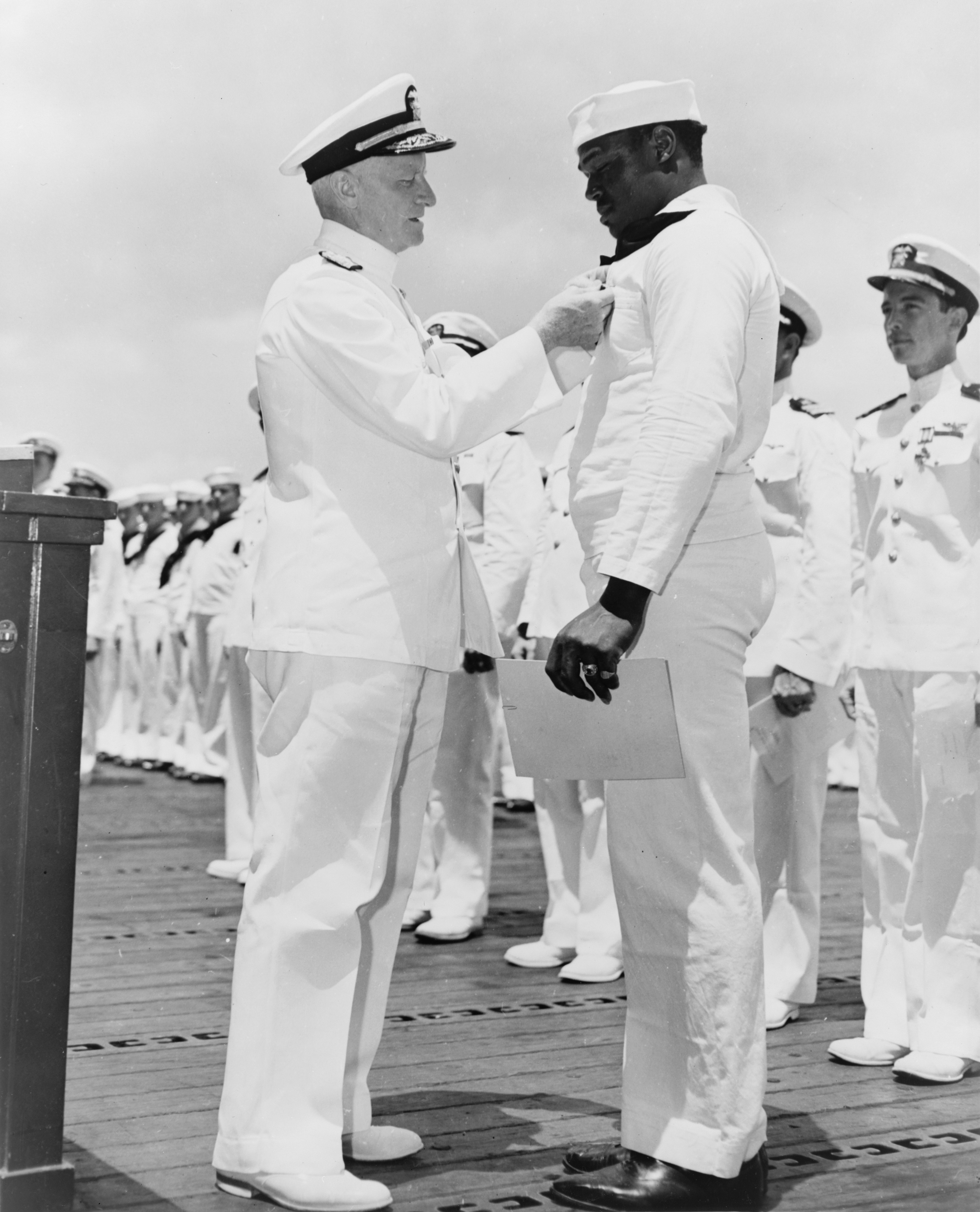
Chester Nimitz pins the Navy Cross on Dorie Miller. 27 May 1942.
Miller became the first Black sailor ever recognized with the Navy Cross. Theater commander Chester Nimitz had supported the granting of a medal and personally pinned the Navy Cross on Miller’s chest on 27 May in a ceremony aboard the carrier Enterprise, then at Pearl Harbor.
After the sinking of West Virginia, Miller had been re-assigned to the heavy cruiser Indianapolis. In August 1943 he transferred to the newly-commissioned escort carrier Liscombe Bay. In the early-morning hours of 24 November 1943, a Japanese submarine torpedoed and sank the carrier, with the loss of 644 men including Dorie Miller.
On 20 January 2020, Acting Secretary of the Navy Thomas Modly announced that the Navy’s next carried, CVN-81, would carry the name Doris Miller. While Miller’s bravery and service are undeniable, do they merit recognition on the stern of the Navy’s largest and most powerful warship? A ship as imposing in her day, as West Virginia had been in hers?
The Pearl Harbor record is filled with extraordinary acts of bravery. Aboard the capsizing Oklahoma, Chief Warrant Officer John Arnold shoved 15 sailors through an already-submerged porthole, saving their lives, but did not have the breath remaining to save himself. He received a posthumous Navy Cross. Aboard Arizona, Rear Admiral Isaac Kidd and Capt. Frank Van Valkenburgh both died when their ship exploded, along with 1,175 other Battleship Sailors; only their Naval Academy class rings were ever found. They each received the Congressional Medal of Honor.
Kidd and Van Valkenburgh died bravely. The citations speak of their courage and devotion to duty, but few would have believed that alone merited the award. The medals recognized the sacrifice of all 1,177 men who died with Arizona, an unprecedented loss for the U.S. Navy.
Likewise, the naming of CVN-81 honored far more than one man’s courage. Over 165,000 African Americans served in the U.S. Navy during the Second World War, and over 1,300 of them gave their lives for their country. Until the announcement that CVN-81 would carry the name Doris Miller, no aircraft carrier had been named for a Black man, and none for an enlisted man, either. The name is a powerful symbol, a recognition of service and sacrifice.
In early 2026, Navy documents stopped referring to the ship as Doris Miller, instead using only her hull number, CVN-81 (Doris Miller still appears in some online legacy content). In August 2026, news reports cited anonymous sources claiming that the Navy was considering re-naming the ship Donald J. Trump. (CVN-82 is to be named William J. Clinton, and CVN-83 George W. Bush.) At this writing, this has not been confirmed, but neither has the Navy or the Department of Defense denied it.
The full series is here:
• Race in America: Founded on Slavery
• Race in America: Civil War
• Race in America: Jim Crow
• Race in America: The Black Doughboys, Part One
• Race in America: The Black Doughboys, Part Two
• Race in America: Red Summer
• Race in America: Tulsa
• Race in America: Klan Scam
• Race in America: Strange Fruit
• Race in America: Canada’s Shame
• Race in America: They Said No
• Race in America: The Man Who Made Juneteenth
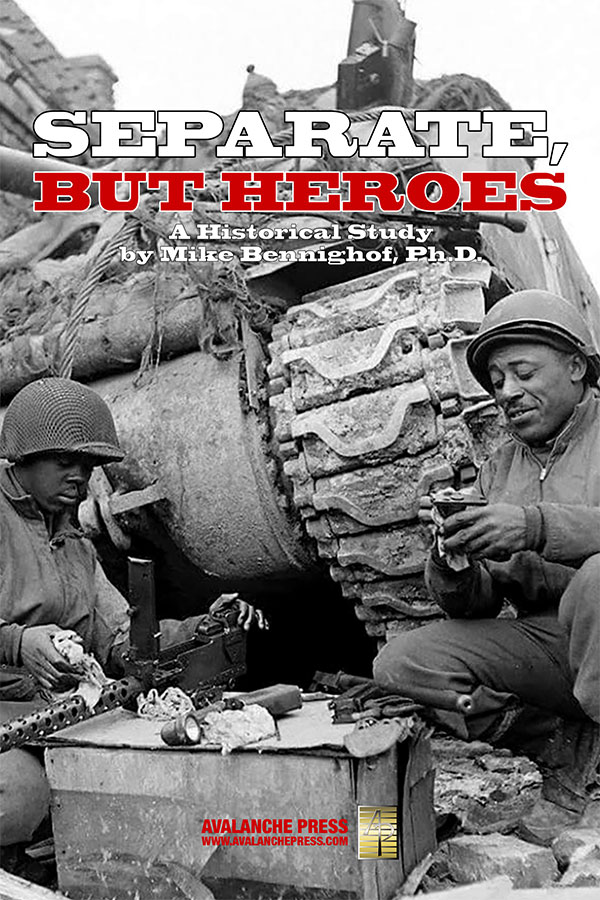
Order Separate, But Heroes Here.
Please allow an extra six weeks for delivery. Use coupon code DANA for 20-off
Sign up for our newsletter right here. Your info will never be sold or transferred; we'll just use it to update you on new games and new offers.
Mike Bennighof is president of Avalanche Press and holds a doctorate in history from Emory University. A Fulbright Scholar and NASA Journalist in Space finalist, he has published a great many books, games and articles on historical subjects; people are saying that some of them are actually good.
He lives in Birmingham, Alabama with his wife and three children.
Daily Content includes no AI-generated slop or third-party ads. We work hard to keep it that way, and that’s a lot of work. You can help us keep things that way with your gift through this link right here.
|