South Pacific:
Eastern Solomons, Part One
by Mike Bennighof, Ph.D.
June 2025
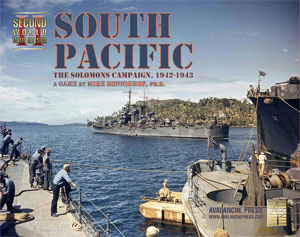 Following the Savo Island debacle, the U.S. Marines on Guadalcanal found themselves with dwindling supplies and no naval presence in the waters off their beachhead. The Japanese, for their part, found an enemy impingement within their defensive perimeter that needed to be removed before it could become dangerous. Following the Savo Island debacle, the U.S. Marines on Guadalcanal found themselves with dwindling supplies and no naval presence in the waters off their beachhead. The Japanese, for their part, found an enemy impingement within their defensive perimeter that needed to be removed before it could become dangerous.
The Japanese leadership, starting with Combined Fleet commander Isoroku Yamamoto, took a view of the situation much closer to fantasy than reality. This sort of magical thinking would dominate conduct of the campaign through the evacuation of Guadalcanal in the first weeks of 1943. They believed that the Marines could easily be ejected, and the American fleet defeated, even after repeated failures should have told them otherwise.
Most damaging to the Japanese cause, at this point they made no effort to build one or more airfields closer to Guadalcanal. Instead, their land-based planes flew all the way from Rabaul, at the very edge of their fighters’ range and beyond that of their dive bombers. They would rely on aircraft carriers to both attack the Marine beachhead (and later their airfield) and challenge American carriers. This division of tasks would be a crucial factor in the Japanese failure to re-take Guadalcanal.
The Japanese did, however, react quickly to follow up their victory in the Battle of Savo Island. Col. Kiyonao Ichiki commanded a detachment based on the 28th Infantry Regiment that had been charged with capturing Midway Island in June. When the Navy failed to defeat the American carrier fleet, the landing was cancelled with Ichiki and his men deposited on Guam. That deployment helped hide the Midway disaster from the Japanese public, and finally on 7 August they were allowed to return home. They boarded two transports and, escorted by two destroyers, set out for Japan. Imperial General Headquarters turned them around, sending them to Truk Lagoon where the Combined Fleet gathered its forces.
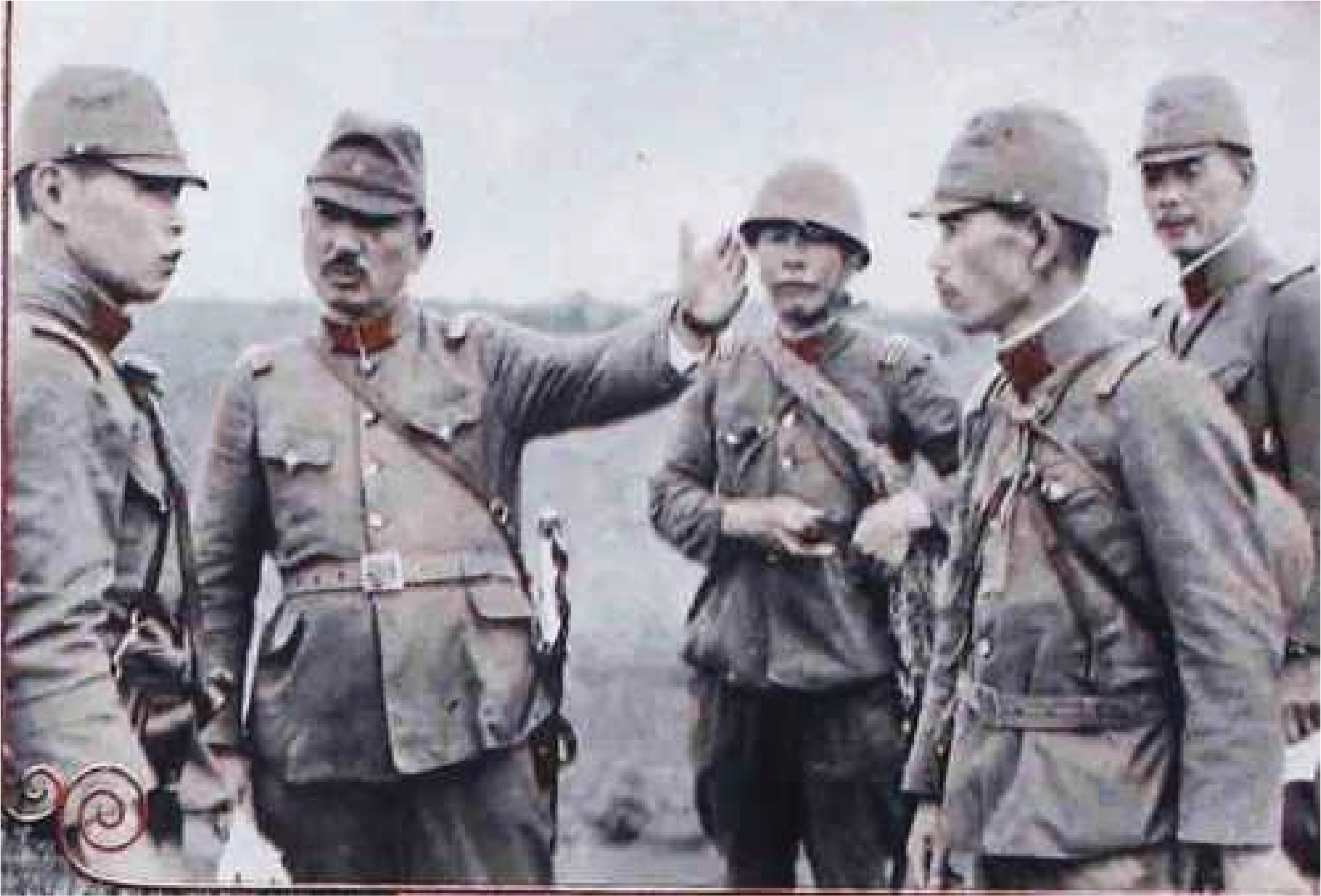
Then-Major Kiyonao Ichiki (far right) during the Marco Polo Bridge Incident, July 1937.
“Although details of the American forces on Guadalcanal are not known, they are not powerful forces,” read a combined order from the Navy’s 8th Fleet and Army’s 17th Army. “We have decided to have the Ichiki Detachment and the (5th Yokosuka) Naval Landing Force land on Guadalcanal on 18 August and quickly recapture the island.”
The plan called for Ichiki to divide his force. An advance party of 916 men, equipped only with rifles, 250 rounds of ammunition each, a week’s worth of rations and plentiful battle flags (the operational orders specified this last item) would steam for Guadalcanal aboard six destroyers. The remainder, about 1,000 men with the detachment’s support weapons, would remain aboard the two transports, adding one more transport already at Truk with 500 Special Naval Landing Force troops aboard, and follow at their best speed (8.5 knots).
Ichiki arrived on the 18th and attacked the Marine perimeter with what he had two days later following a tough jungle march; the ill-fated assault cost Ichiki his life along with those of 800 of his soldiers. On the same day that Ichiki attacked, the first American planes landed on Lunga Point airfield. The three transports bearing the rest of the Ichiki Detachment turned back. The best chance the Japanese would have to re-capture the airfield and change the operational momentum in the South Seas had already passed.
Combined Fleet commander Isoroku Yamamoto had begun preparing reinforcements even before the Americans started landing on Guadalcanal. Immediately after the Japanese realized that the Americans had come to stay, Combined Fleet staffers starting planning for air, ground, and naval reinforcements to wage a protracted campaign. The heavy cruisers Suzuya and Kumano left Burma within hours of the invasion. Major elements of Nobutake Kondo’s Second Fleet (the surface forces) left Japan on 11 August, four days later the American landings. The Third Fleet, with the aircraft carriers, left on the 16th after its commander, Chuichi Nagumo of Midway fame, begged for additional training time.
Only Carrier Division 1 would participate, with the heavy carriers Zuikaku and Shokaku, the latter newly repaired following damage at the Battle of the Coral Sea in May 1942. They would take with them the light carrier Ryujo, detached from Carrier Division 2. Carrier Division 2, with the converted liners Junyo and Hiyo (now promoted to fleet carrier status), and the new light carrier Zuiho (left behind by Carrier Division 1), would continue pilot qualifications in Japan.
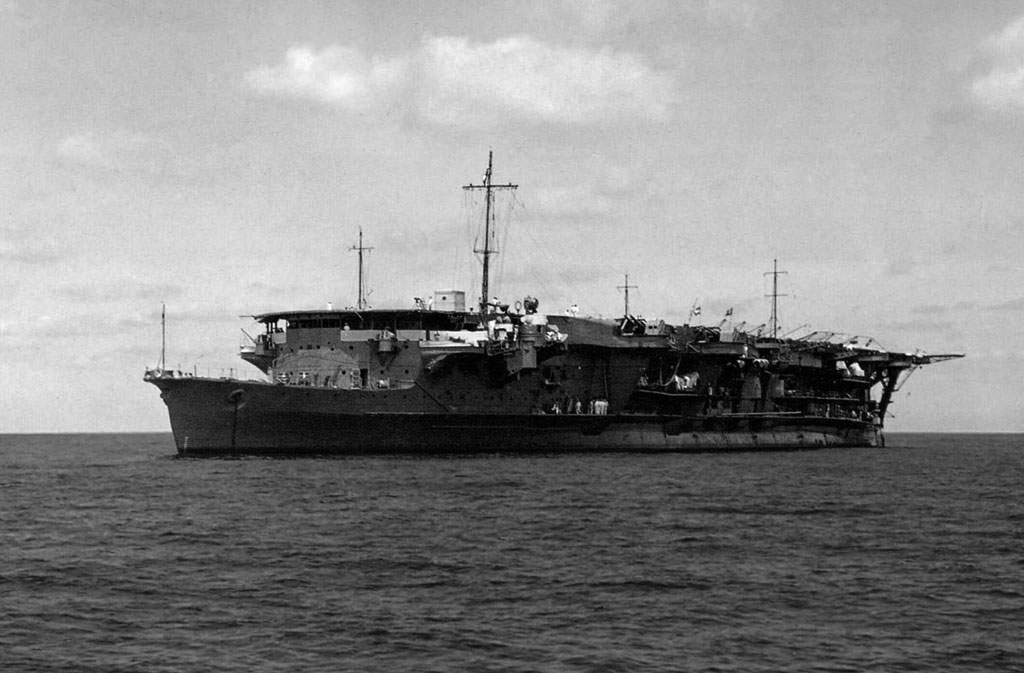
Light carrier Ryujo, seen before the war.
Both Zuikaku and Shokaku had reinforced their air groups with pilots and aircrews who survived the sinking of their carriers at Midway, but neither carried a full load of aircraft thanks to production shortages. Ryujo, in keeping with post-Midway reforms, would serve as their “fighter carrier,” with two dozen fighters and just nine attack planes in her air group. This mission suited the notoriously slower turnaround times of the Japanese light carriers, which tended to receive the officers and men passed over by the bigger ships. Among her pilots, though, Ryujo received some of the very best who had come home from Midway.
Yamamoto would use that fleet to cover a convoy operation to Guadalcanal, bringing in the rest of Ichiki’s men, a woefully inadequate force to eject the Marines and re-claim the unfinished airfield. At this point, the Japanese remained unaware that the Marines had come to stay.
While the Naval General Staff worked out new doctrine following the Battle of Midway, the fleet itself had yet to train under it. Most of the changes regarded air defense, allotting more fighters to Combat Air Patrol and expecting more participation by the carriers’ screening forces. The new handbooks were delivered by aircraft dropping them on the decks of ships on their way to the South Seas. Not surprisingly, the Japanese would conduct the Battle of the Eastern Solomons under their old, tried-and-failed methods. Nagumo kept his carriers well away from Second Fleet’s surface component (one battleship and five heavy cruisers), probably at least partially influenced by the fact that Kondo held seniority over Nagumo, and under Japanese practice would have taken command had the forces combined.
The Americans had three aircraft carriers operating south of Guadalcanal, commanded by Frank Jack Fletcher as Task Force 61, but only two fleet oilers, Cimarron and Platte. Fletcher had Enterprise and Saratoga refuel from the oilers, and sent Wasp back to top off her bunkers. She met Platte north of the American fuel depot on New Caledonia.
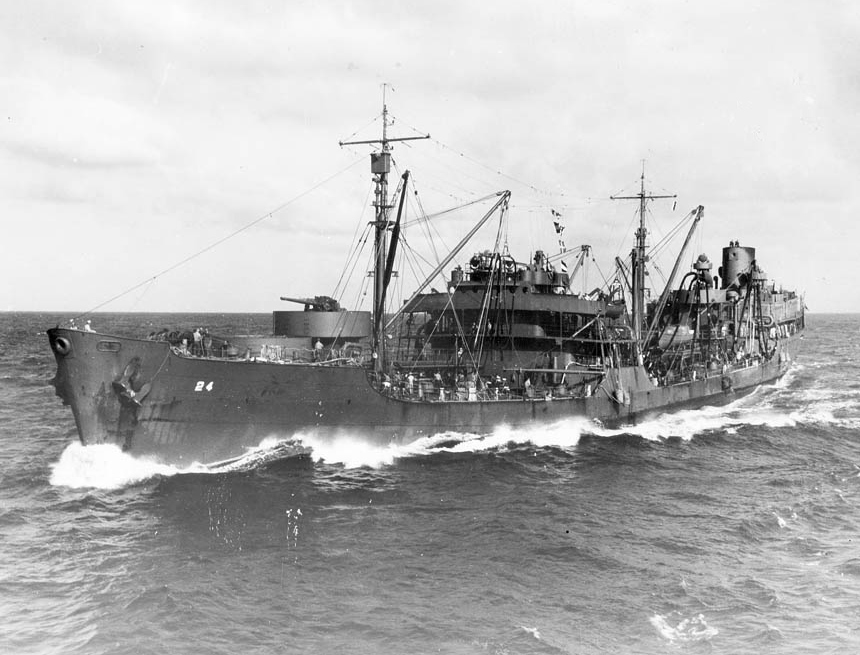
Oiler Platte comes alongside Wasp to refuel her. 24 August 1942.
Wasp had suffered engine trouble on her deployment to the South Pacific, with her black gang reporting a grinding sound from her starboard turbine. She dropped anchor at Tonga in late July for three days of improved repairs, but her engineers wished to return to Pearl Harbor to replace the turbine blades as soon as possible. In the meantime, she could not meet her top speed of 29 knots.
A fourth carrier, Hornet, left Pearl Harbor on the 17th but would not make it to the combat zone in time to participate. She had been left behind due to the lack of oilers in the South Pacific, but now moved forward so that she could replace Wasp when the latter returned for turbine overhaul.
Fletcher had to protect the Guadalcanal beachhead from Japanese attack, and also had a small convoy of his own to defend. The attack transports Fomalhaut and Athena would arrive off the landing zone on the 22nd, and theater commander Robert Ghormley told Fletcher to give them “maximum practicable air cover.”
Now aware that the Americans had aircraft stationed at Lunga Point, Japanese higher commanders interfered as well, helping to set the chaotic battlefield to come. Raizo Tanaka, commanding the Japanese reinforcement convoy and its slapped-together escort of destroyers, received contradictory orders from the theater commander and Yamamoto, sending him back and forth north of the Solomons.
On the morning of 23 August, an American PBY Catalina flying boat spotted the Japanese transport force. Fletcher ordered Saratoga to launch a strike, but the transports turned north and in the worsening weather, the Americans could not find them. Their search took them out of safe range of their home carrier, and they landed instead on Guadalcanal’s newly-christened Henderson Field. That put 31 dive bombers and six torpedo planes far away from their carrier as the two fleets drew near to one another.
During the early morning hours of the 24th, Yamamoto, casting aside the new carrier doctrine demanding concentration of force, ordered Nagumo to detach one carrier for a strike against the new American airbase. Nagumo chose his light carrier for the task, keeping the two heavy carriers together. Ryujo along with a heavy cruiser and two destroyers headed for Guadalcanal to be in position to launch a morning strike; why either admiral felt that the light carrier’s small air group could put the airfield out of action is not clear. Land-based bombers operating out of Rabaul would attack the airfield as well.
On the 23rd, American naval intelligence located the Japanese carriers at sea, possibly on their way to Truk Lagoon, with a high probability of an attack on Guadalcanal. But this could not be confirmed, and Fletcher took that doubt as enough to send Wasp away for refueling. She could only remain with Task Force 61 at some risk of running dry. While Fletcher has been criticized in some histories, and even ridiculed in some popular works, the U.S. Navy faced a shortage of tankers in 1942. Hornet had been left at Pearl Harbor for this very reason, as had the battleships of Task Force One. With only two tankers, he could not be sure that they would return with a fresh load when Wasp needed them.
That was the situation on the morning of 24 August, when the Battle of the Eastern Solomons erupted.
Order South Pacific Here.
Coming July 2025.
Sign up for our newsletter right here. Your info will never be sold or transferred; we'll just use it to update you on new games and new offers.
Mike Bennighof is president of Avalanche Press and holds a doctorate in history from Emory University. A Fulbright Scholar and NASA Journalist in Space finalist, he has published a great many books, games and articles on historical subjects; people are saying that some of them are actually good.
He lives in Birmingham, Alabama with his wife, three children, and new puppy. He misses his lizard-hunting Iron Dog, Leopold.
Daily Content includes no AI-generated content or third-party ads. We work hard to keep it that way, and that’s a lot of work. You can help us keep things that way with your gift through this link right here.
|