South Pacific:
Eastern Solomons, Part Two
by Mike Bennighof, Ph.D.
July 2025
 The Japanese had deployed with Second Fleet’s surface ships leading the carriers to the east, initially expecting to find the Americans well to the north-east of Guadalcanal. The Americans had a better idea of where to find the Japanese, and shortly before 1000, Fletcher learned that a PBY had spotted a Japanese light carrier with a small number of escorts. With most of Saratoga’s attack planes still on their way back to the carrier from Guadalcanal, Fletcher declined to launch a strike. Japanese soldiers reported the Saratoga planes leaving Henderson Field at 0930; the Japanese believed this was a strike aimed at the approaching convoy, which turned away from its track toward Guadalcanal. The Japanese had deployed with Second Fleet’s surface ships leading the carriers to the east, initially expecting to find the Americans well to the north-east of Guadalcanal. The Americans had a better idea of where to find the Japanese, and shortly before 1000, Fletcher learned that a PBY had spotted a Japanese light carrier with a small number of escorts. With most of Saratoga’s attack planes still on their way back to the carrier from Guadalcanal, Fletcher declined to launch a strike. Japanese soldiers reported the Saratoga planes leaving Henderson Field at 0930; the Japanese believed this was a strike aimed at the approaching convoy, which turned away from its track toward Guadalcanal.
At Ndeni in the Santa Cruz Islands, about 250 miles east of Guadalcanal, the small seaplane tender Mackinac sent out a half-dozen PBY flying boats in a search pattern. All of them spotted Japanese warships, though not all of their reports made it to Fletcher.
Saratoga recovered her planes just after 1100, and an hour later Ryujo’s small strike group (six bomb-armed torpedo planes and fifteen fighters) attacked Henderson Field, with little success. Seeking more clarity, at 1239 Fletcher launched 20 planes from Enterprise on search patterns, and three more to join his Inner Air Patrol, keeping Saratoga’s planes ready for a potential strike mission.
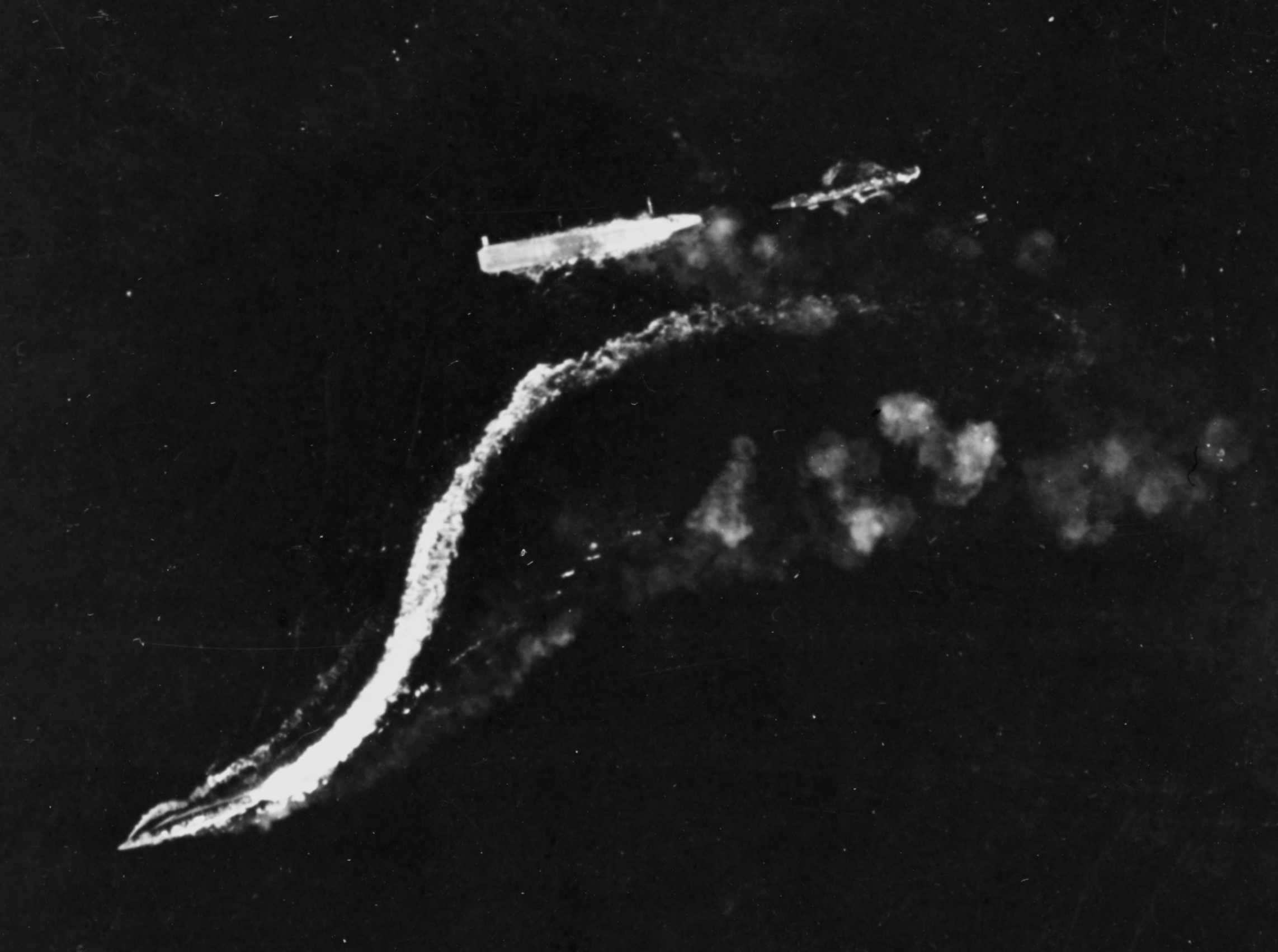
Ryujo and two destroyers under attack by B-17 bombers. 24 August 1942.
For his part, Nagumo sent out nineteen torpedo bombers on search missions, while the land-based air element at Rabaul dispatched four flying boats and Nagumo’s cruisers contributed nine floatplanes. He also had his heavy carriers prepare their strike groups; following the new carrier doctrine, the first waves would include dive bombers and fighters, with torpedo planes only joining the third, follow-up wave. Japanese torpedo planes had suffered terrible losses at Midway for little result (outside of two hits on Yorktown), and the new doctrine down-graded their role.
The Japanese caught the first break, when a floatplane from the heavy cruiser Chikuma spotted the American carriers at 1400. The crew only got off a partial report before an American fighter shot them down, killing all three men aboard, but Nagumo’s staff triangulated the Americans’ probable position.
Soon after that, with no word on the Japanese heavy carriers, Fletcher launched the Saratoga strike group at Ryujo. They were still in the air when a pair of Enterprise planes spotted and unsuccessfully attacked Shokaku. Shokaku’s new air-search radar picked them up, but her captain, Tameteru Nomoto, refused to believe the report until actual human spotters confirmed it. Neither plane managed to damage the carrier.
Fletcher now had confirmed knowledge of the Japanese heavy carriers’ position, but no means to re-direct Saratoga’s strike planes to a new target, while many of Enterprise’s attack planes were out on search patterns looking for the Japanese. Wasp had dropped Platte’s fuel hoses and turned back north to re-join him, making just 22 knots as a turbine failure now might well end in the carrier’s destruction, and she would not be within range for hours yet.
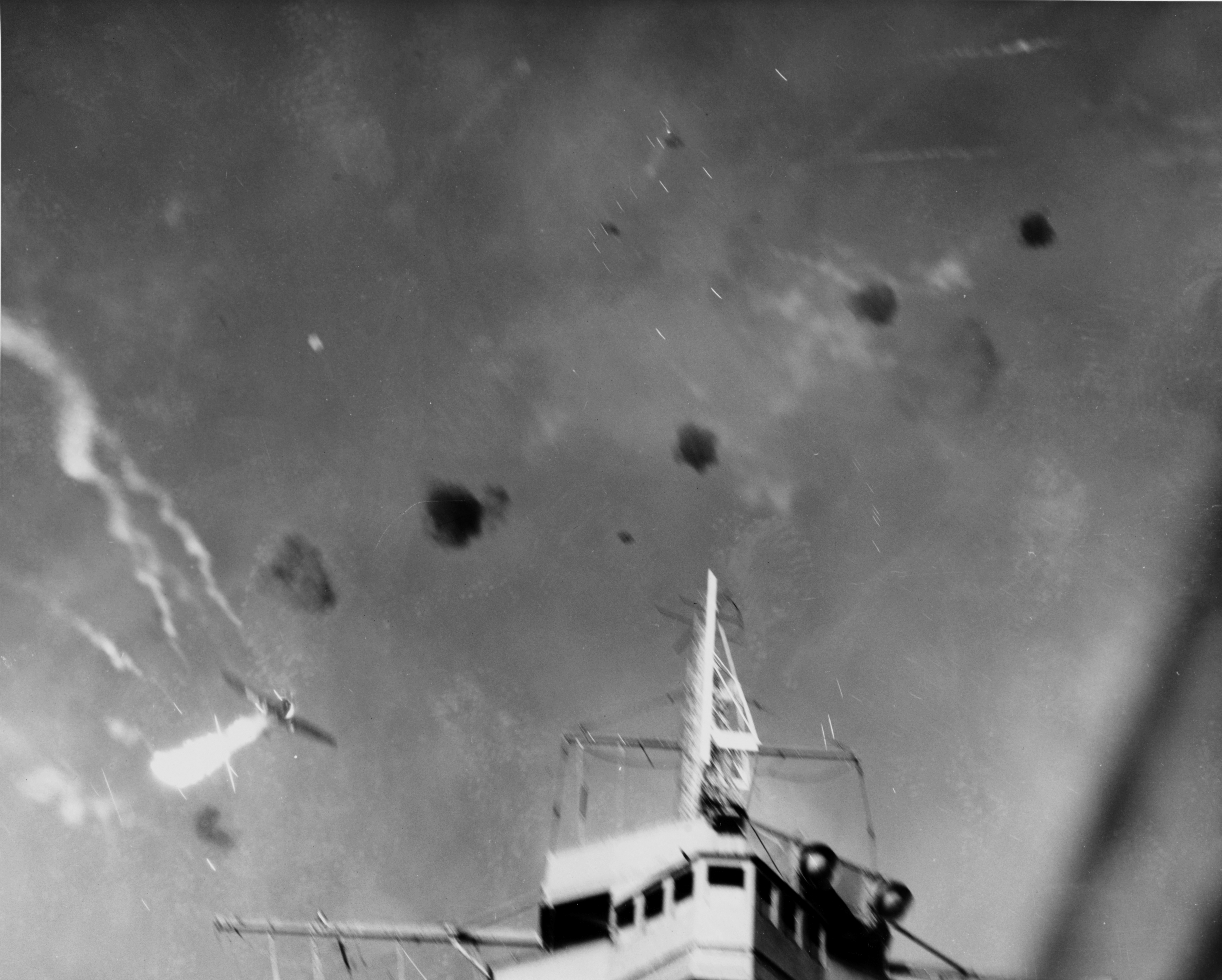
A Japanese D3A dive bomber is shot down above USS Enterprise. 24 August 1942.
Rear Admiral Chuichi “King Kong” Hara of the 8th Cruiser Division, said to be the largest man in the Japanese Navy, had command of the small task force including Ryujo, and knew that his ships had been spotted. A flight of B-17 bombers flew over around noon, dropping bombs but doing no damage, yet Ryujo’s air operations staff seemed unconcerned. They had five Zeroes in the air when lookouts screamed, “Many enemy aircraft approaching!” and quickly launched the two on deck.
Twenty-nine dive-bombers and nine torpedo planes attacked at 1550. Japanese practice still called for each individual ship to maneuver to avoid enemy air attack, and Ryujo’s Capt. Tadao Kato, a long-time naval aviator, handled his ship like a seasoned old salt. Kato successfully dodged the first ten bombs, but then his luck ran out. Four bombs struck Ryujo, along with a torpedo that smacked into her starboard side aft, flooding both her engine and boiler rooms, while large fires broke out. Her crew put out the fires but could not stop the flooding, and she finally sank stern-first four hours later with the loss of 121 men. Fourteen of her planes ditched near the escorts; seven aircrew survived. Neither side lost any aircraft in the action.
At 1602, twelve minutes after the attack on Ryujo began, Enterprise radar detected the first incoming attack wave. Strike commander Lt. Cdr. Mamoru Seki had not fought at Midway or the Coral Sea, and divided his planes to attack both American carriers. Fletcher had the astonishing number of 53 F4F Wildcats on Combat Air Patrol, which should have been more than sufficient to repel Seki’s 27 dive bombers and ten fighters. But all of the fighters, and many of the search planes, had been put on the same radio frequency. When the Japanese appeared, all of those pilots began blurting out nervous chatter, making any fighter direction impossible. Only 17 fighters actually engaged the attacking Japanese.
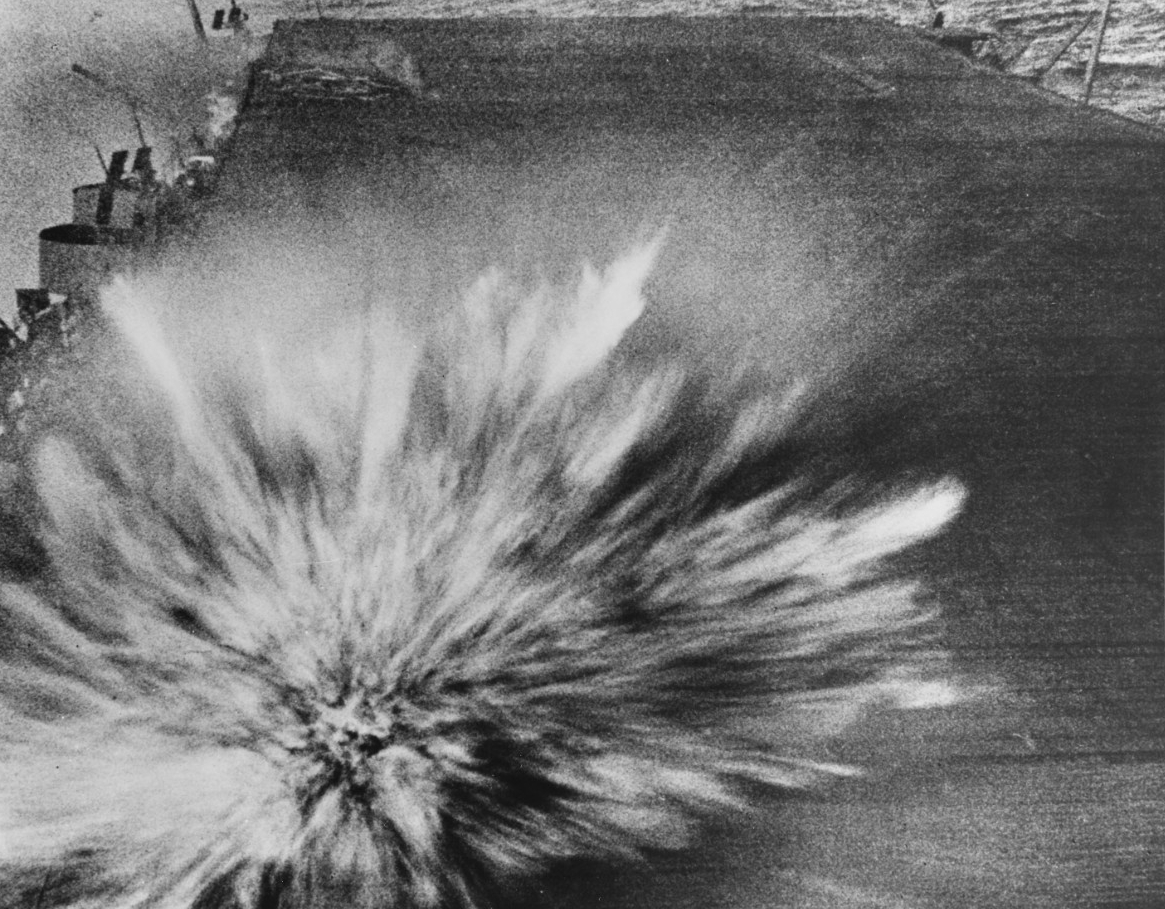
The third bomb to hit Enterprise strikes her flight deck. 24 August 1942.
Of Seki’s 27 bombers, two were shot down before they could dive, seven attacked the battleship North Carolina by mistake, and the remaining 20 went after Enterprise. Just as they began their attack, the carrier’s fire-control radar lost power. The bombers scored three hits and killed 75 sailors, but prompt and effective damage control put out the fires and kept the carrier in operation. The American fighters had recovered their wits by the time Seki’s attack runs had ended, and they flamed another 15 dive bombers, and also shot down three fighters. The Japanese downed eight American Wildcat fighters during the melee.
Starting at 1550, the two Japanese carriers began launching the follow-up strike. Lt. Sadamu Takahashi, Zuikaku’s air group commander, led 27 dive bombers and nine fighters, the planes drawn from both carriers. They flew to the spot where Takahashi had been told he would find the Americans, but the location was off by about eighty miles. In the meantime, Enterprise had suffered a steering failure and circled helplessly, a sitting duck if only Takahashi could find her.
Seki had broadcast a detailed report of his group’s encounter with the Americans, including their location. Takahashi did not hear this, but several of his aircrews did. None of them thought to pass it on to their leader. The strike group flew eastward looking for the Americans without result, then returned to the carriers.
Before the Japanese attacked his carriers, Fletcher ordered all ready strike aircraft launched to attack the stricken Ryujo. The Enterprise planes never found any targets; the Saratoga planes found the Japanese Advance Force instead and attacked the seaplane carrier Chitose, stopped dead in the water to recover seaplanes.
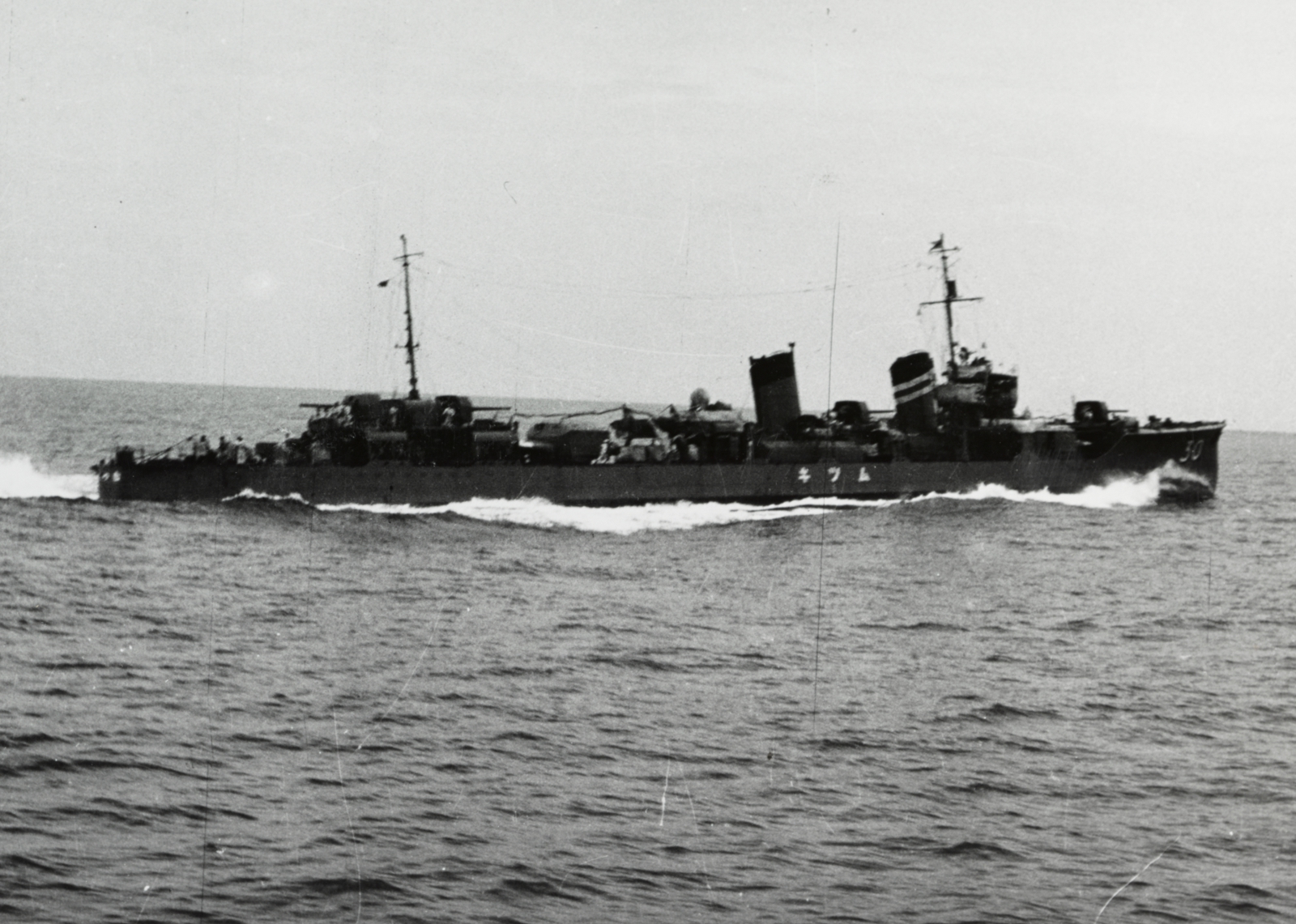
Unlucky Japanese destroyer Mutsuki, sunk by a B-17 bomber.
This starkly illustrated the great weakness of the big Japanese seaplane carriers: they could launch and service as many aircraft as a light carrier, but they could only bring them back aboard by coming to a full stop. Saratoga’s planes missed Chitose, but a pair of near-misses opened leaks and damaged her port engine, and set three seaplanes on her aircraft handling deck on fire. The destroyer Minegumo towed her to Truk.
Enterprise’s planes landed at Henderson Field, while the American carrier task forces withdrew southward to meet up with the oncoming Wasp. Fletcher ordered the seaplane tender Mackinac and her escort, the destroyer-minelayer Breese, to abandon their makeshift base at Ndeni as well. Nagumo detached his Vanguard Force, with two fast battleships and three heavy cruisers, three destroyers and a light cruiser, to seek out and destroy them. Kondo did the same with his five heavy cruisers, five destroyers and a light cruiser; he detailed the battleship Mutsu and an escort of three destroyers to return to Truk so as not to slow his mad dash.
The Japanese reached the last known location of the American carriers just before sundown, but they had long since withdrawn. They turned back, leaving just one act to play out.
Tanaka still covered the three creaking transports and their 1,500 troops with his slapdash escort: a light cruiser, eight destroyers from four different divisions, and four aged ex-destroyers rebuilt as patrol boats. Four heavy cruisers provided distant cover.
On the following morning, a flight of eight dive bombers from Henderson Field (five Marine planes, and three of Enterprise’s) set out in search of the Japanese carriers. They found Tanaka’s convoy instead, and struck immediately. One bomb severely damaged Tanaka’s flagship, the light cruiser Jintsu, and another wrecked the biggest of the transports, Kinryu Maru. While Japanese destroyers took survivors off the transport, a flight of American B-17 heavy bombers flew over and dropped their loads, sinking the transport and the motionless destroyer Mutsuki. She would be the largest enemy warship sunk in open waters by USAAF heavy bombers, though many would be claimed. The crews and passengers of both ships were rescued by the other Japanese destroyers.
With that, Yamamoto cancelled the reinforcement operation. Merchant ships were simply too slow to survive in the face of American land- and carrier-based aircraft. Future reinforcement missions would be undertaken at night, by warships fast enough or small enough to elude the Americans.
Battle Analysis
Despite some genuflection toward the lessons of Midway, Yamamoto intervened to help bring about the Japanese defeat. Ryujo had only nine attack planes, having given over most of the capacity to fighters in accordance with the new Japanese doctrine. By choosing her for the mission, Nagumo also sent away much of his fighter protection (the other carriers now operated a larger contingent of attack planes and bombers), but this error was not exposed as the Americans never made a major attack on the Japanese carrier force. Ryujo could not hope to inflict serious damage on Henderson Field with such a limited air group; by sending her on this useless mission, Yamamoto and Nagumo assured her destruction.
Some popular histories call this mission a feint, but the Combined Fleet commander clearly intended to attack the new American airbase with the land-based planes limited by heavy weather over Rabaul. Ryujo’s presence did divert the first American strike from the Japanese heavy carriers, but this was not intentional. In much the same way, Ichiki sacrificed 800 of his men, practically his entire force, throwing away the best chance the Japanese had to take Henderson Field with ground forces.
Fletcher has been criticized in popular histories for sending Wasp away to refuel, but these usually overlook the decrepit state of his third carrier and the presence of only two oilers. She would not have been able to keep up with the rest of his task force, and with only two fleet oilers available, Fletcher made the correct choice in giving their fuel to Enterprise and Saratoga. Unloading his strike aircraft on the hapless Ryujo was a mistake, that also relieved Yamamoto of his own error in sending away so much of the Japanese carrier force’s fighter protection.
The battle has been called an American victory, and in terms of losses, the balance certainly favors the United States. The Japanese lost three times as many aircraft and crews, and they lost a carrier. But neither side seized their chances for a full victory, meaning that the Solomons naval campaign would continue.
Order South Pacific Here.
Coming July 2025.
Sign up for our newsletter right here. Your info will never be sold or transferred; we'll just use it to update you on new games and new offers.
Mike Bennighof is president of Avalanche Press and holds a doctorate in history from Emory University. A Fulbright Scholar and NASA Journalist in Space finalist, he has published a great many books, games and articles on historical subjects; people are saying that some of them are actually good.
He lives in Birmingham, Alabama with his wife, three children, and new puppy. He misses his lizard-hunting Iron Dog, Leopold.
Daily Content includes no AI-generated content or third-party ads. We work hard to keep it that way, and that’s a lot of work. You can help us keep things that way with your gift through this link right here.
|