The Emperor’s Sword:
Japanese Battleships, Part Two
by Mike Bennighof, Ph.D.
July 2025
 Second World War at Sea: The Emperor's Sword is our Pacific theater equivalent to Plan Z, a massive expansion set stuffed with ships and planes that only existed as drawing-board proposals, with an alternative-history story sending them into action in thirty new scenarios. While the Long War story arc (the one including both The Emperor’s Sword and Plan Z) concentrates on cutting edge technology of the 1940’s with aircraft carriers and eventually jet aircraft, it’s also home to battleships. Giant battleships armed with huge guns. Second World War at Sea: The Emperor's Sword is our Pacific theater equivalent to Plan Z, a massive expansion set stuffed with ships and planes that only existed as drawing-board proposals, with an alternative-history story sending them into action in thirty new scenarios. While the Long War story arc (the one including both The Emperor’s Sword and Plan Z) concentrates on cutting edge technology of the 1940’s with aircraft carriers and eventually jet aircraft, it’s also home to battleships. Giant battleships armed with huge guns.
Yamato Variations
Japanese battleship construction, like that of most naval powers, took a holiday during the decade following the 1922 Washington naval accords. Design work continued, though many of the sketches from that span were lost during the Second World War. But starting in 1934, Japanese naval architects began to ponder the new battleships that would be built when the “building holiday” expired in 1936.
Knowing their American counterparts to be limited to ships that could transit the Panama Canal, the Japanese designers had a good idea of the maximum size and fighting power of their potential foe’s biggest ships. The parameters for the new battleships could therefore be set accordingly: a ship that could overwhelm anything that could squeeze through the Panama Canal. They would be individually superior to any other battleship afloat, much larger, with thicker armor and bigger guns.
Project 140, the ship that eventually became the super-battleship Yamato, went through many design stages. Kikuo Fujimoto, head of the Technical Department’s design section, took the lead for the project. He drafted a new hull form, with a bulbous bow and wide beam. Alternative designs looked at using diesels as an alternative to or in combination with more conventional turbines, but a large diesel tested in the large submarine tender Taigei failed utterly to produce the promised horsepower. The big new battleship would be driven by turbines alone.
Asahi Class
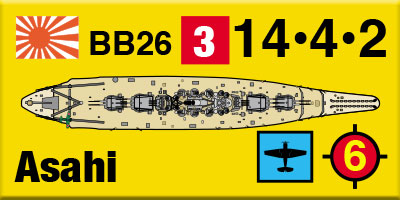
The requirements laid down by the Naval General Staff very plainly stated that the new ship would carry 460mm (18.1-inch) guns. Even so, Fujimoto sketched a series of ships
armed with 410mm (16.1-inch) guns, the same caliber that had equipped the last Japanese battleships actually built or laid down. The 410mm Type 90 would be a new, longer-barreled model, that had been proposed in the late 1920’s to arm the replacements for the Kongo-class battle cruisers.
Japanese practice obscured the existence of new, large guns by initially calling them new models of existing weapons; the 14-inch gun had been introduced under a 12-inch cover number, and the 16-inch gun had been noted as a 14-inch weapon. But in this case, the weights assigned make it clear that when Fujimoto wrote 410mm, he meant 410mm.
Design A-140-I carried ten 410mm guns in four turrets, placed in super-firing pairs fore and aft. In each case, a triple turret fired over a twin turret, helping to concentrate weight amidships. This unusual arrangement usually served to help narrow a ship’s width, but Fujimoto had designed several cruisers that suffered structural problems from their great length and poor weight distribution.
She would have come in at a stunning 65,000 tons’ displacement, with Fujimoto’s trademark spaced armor arrangement rather than the single thick slab preferred by previous Japanese naval architects. She would make 28 knots on 143,000 horsepower, and carry enough protection to be theoretically immune from her own weapons. Secondary armament would be two triple turrets with 155mm (6.1-inch) guns, and eight twin mounts for 127mm anti-aircraft guns plus two dozen 25mm light anti-aircraft guns (her vast size would have easily accommodated many more of the latter).
This design would not be chosen, and apparently was not submitted to the Naval General Staff. But in our variant history, she’s the first new battleship laid down and we included two examples in The Emperor’s Sword.
Chikugo Class
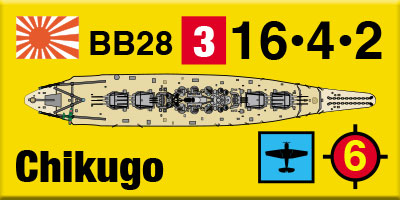
Design A-140-J3 carried the paper experiment onward, with a bigger ship carrying more guns. She would have two more 410mm guns, now in four triple turrets in the same locations as A-140-I. She was part of a series of drawings, but the rest of them carried nine big guns in three triple turrets. This ship would have been the Japanese equivalent of the American Montana.
She would have the same speed as the previous design, on a somewhat smaller hull (58,400 tons, and not quite as long). Secondary and anti-aircraft armament would remain the same. Fujimoto made up the missing weight that by scaling back on protection, counting on multiple layers to give the same effect.
This design also would not be presented for approval, and thus was never funded, much less built. But we can posit otherwise, and so we’ve included two class members in The Emperor’s Sword.
Wakasa Class
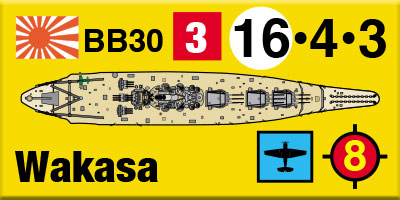
Most leading Japanese warship designers had studied in Britain, and even thought he Anglo-Japanese Alliance had been formally ended in 1922, both informal institutional ties and personal friendships remained. The Japanese had very good information on the proposed British G3 and N3 battle cruiser and battleship designs, and the much small Nelson class that derived from them. These ships carried their main armament (nine heavy guns, 16-inch for the proposed battle cruiser and Nelson, and 18-inch for the proposed battleship) in three turrets forward, with the second turret super-firing over the first and the third on the main deck level behind it. This kept the main armament in a compact zone where it could be better protected, and also made for better gunnery results.
The first designs for what became Yamato, A-140-A, followed this arrangement, with nine 460mm/45 Type 94 rifles in three turrets forward. As designed, she would have had diesel propulsion, but had she been chosen the Taigei failure would have caused a re-working to incorporate turbines instead. The initial design also included a new 50-caliber 460mm gun; the added weight and blast effects did not seem worth the higher velocity and the 45-caliber guns were used in Yamato.
The design called for 30 knots on 200,000 horsepower, which the diesels would never have supplied. She probably would have been a couple of knots slower, but would have had good protection. Secondary armament would have been a dozen 155mm guns in four triple turrets, another dozen 127mm heavy anti-aircraft guns in six twin mounts, and two dozen 25mm light anti-aircraft guns.
We have two of them in The Emperor’s Sword, their main armament slightly less effective than the real Yamato thanks to their inefficient turret layout.
The Real Yamato Class
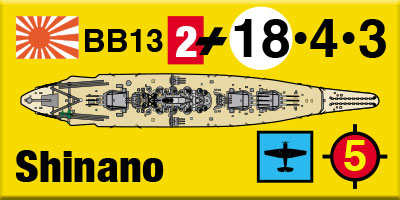
Two Yamato-class battleships would be completed and see limited action; their incredibly smooth steaming qualities made them highly desirable as flagships. Japanese sailors bitterly labelled Isoroku Yamamoto’s floating headquarters the “Hotel Yamato,” kept at anchor in Truk Lagoon throughout the fierce naval battles in Ironbottom Sound.
Two near-sisters were laid down in 1940 (Ship No. 110, later named Shinano and completed as an aircraft carrier, and No. 111, scrapped before receiving a name). They would have had fewer 155mm guns and a heavier anti-aircraft battery, based on wartime experience; since there is no wartime experience in our alternative history, they are identical to Yamato in our set. A third ship, No. 797, would be authorized but never laid down. We have all three of them included in The Emperor’s Sword as well.
Order The Emperor’s Sword Here.
Please allow an extra six weeks for delivery.
Sign up for our newsletter right here. Your info will never be sold or transferred; we'll just use it to update you on new games and new offers.
Mike Bennighof is president of Avalanche Press and holds a doctorate in history from Emory University. A Fulbright Scholar and NASA Journalist in Space finalist, he has published an unknowable number of books, games and articles on historical subjects.
He lives in Birmingham, Alabama with his wife and three children.
Want to keep Daily Content free of third-party ads? You can send us some love (and cash) through this link right here.
|