The Emperor’s Sword:
Japanese Aircraft Carriers, Part One
by Mike Bennighof, Ph.D.
January 2026
 The Imperial Japanese Navy went to war in December 1941 with six heavy carriers in its lineup, all of them belonging to the elite First Air Fleet. At the time, Japan had one additional heavy carrier under construction, Taiho, and two converted liners, Junyo and Hiyo, both of the latter nearing completion. Beyond that, a number of plans existed, but no more flattops had been ordered or laid down. The Imperial Japanese Navy went to war in December 1941 with six heavy carriers in its lineup, all of them belonging to the elite First Air Fleet. At the time, Japan had one additional heavy carrier under construction, Taiho, and two converted liners, Junyo and Hiyo, both of the latter nearing completion. Beyond that, a number of plans existed, but no more flattops had been ordered or laid down.
That’s not the case in The Emperor's Sword, our massive alternative-history expansion set for Second World War at Sea: Midway. The Japanese already have plenty of aircraft carriers in Midway (six large, two medium-sized, and four light carriers). In The Emperor’s Sword, they add nine more, all of them heavy carriers. It’s a substantial increase in Japanese combat power: this is a fleet that can stand up to the U.S. Navy, and even take the fight into American waters.
Aircraft carriers are expensive to build, and they also need airplanes, which are also expensive. Japan’s aircraft industry couldn’t provide enough aircraft to fill the flight decks they did have, and the pilot-training establishment could not have provided more aircrew to fly them in any event.
In our alternative history, Japan rules a much larger and richer empire. Productive oilfields provide the cheap fuel that allows for plenty of training time; industry blossoms with a vast market eager for modern wares. Japanese aircraft makers are able to modernize their factories with labor-saving machinery like those of the West, no longer relying on masses of cheap, semi-skilled workers. With more people achieving greater educational levels, there’s less of that cheap labor, but many more qualified young men eager to join the Emperor’s Sea Eagles.
The Airplanes
The Emperor’s Sword gives the Japanese plenty of new airplanes to fly off those new aircraft carriers. Let’s look at them.
The New Fighter
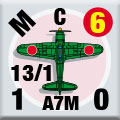 Legendary aircraft designer Jiro Hirokoshi (subject of “The Wind Rises”) began work on the A7M “Reppu” (“Hurricane”) carrier fighter in late 1940, but soon set it aside to address problems with the A6M3 model and the J2M Raiden land-based interceptor. The preceding A6M2 Zero seemed more than adequate, and work did not resume on its successor until the summer of 1942. Hirokoshi designed another very fine plane, but it required a powerful engine that was still under development. Not until May 1944 did the prototype fly; it did not do well. But equipped with a new engine, its October 1944 tests went extremely well and the Imperial Navy adopted the new fighter. But at this stage of the war, with American bombs raining down on Mitsubishi’s factories and an earthquake adding still more damage, only nine copies of the new fighter would be produced. Legendary aircraft designer Jiro Hirokoshi (subject of “The Wind Rises”) began work on the A7M “Reppu” (“Hurricane”) carrier fighter in late 1940, but soon set it aside to address problems with the A6M3 model and the J2M Raiden land-based interceptor. The preceding A6M2 Zero seemed more than adequate, and work did not resume on its successor until the summer of 1942. Hirokoshi designed another very fine plane, but it required a powerful engine that was still under development. Not until May 1944 did the prototype fly; it did not do well. But equipped with a new engine, its October 1944 tests went extremely well and the Imperial Navy adopted the new fighter. But at this stage of the war, with American bombs raining down on Mitsubishi’s factories and an earthquake adding still more damage, only nine copies of the new fighter would be produced.
In The Emperor’s Sword there’s no delay in the design work and no bombing campaign to disrupt production. The A7M is the new carrier fighter, that makes its debut in the third chapter where it gives the Sea Eagles a plane to match the deadly American F4U Corsair.
Next-Generation Attack Planes
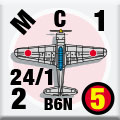
 Well before the historical attack on Pearl Harbor, the Imperial Navy sought a replacement for its standard torpedo bomber, the B5N. The plane lacked any protection for the crew or self-sealing fuel tanks, and the Navy also wanted a faster aircraft. The new set of requirements went out in December 1939, and the replacement plane, the B6N Tenzan (“Heavenly Mountain”), flew in March 1941. Problems immediately cropped up, and corrections took almost exactly two years, with production beginning in the spring of 1943. By this point Japanese carrier forces no longer had the initiative, and the new bomber had little opportunity to show its good qualities. Well before the historical attack on Pearl Harbor, the Imperial Navy sought a replacement for its standard torpedo bomber, the B5N. The plane lacked any protection for the crew or self-sealing fuel tanks, and the Navy also wanted a faster aircraft. The new set of requirements went out in December 1939, and the replacement plane, the B6N Tenzan (“Heavenly Mountain”), flew in March 1941. Problems immediately cropped up, and corrections took almost exactly two years, with production beginning in the spring of 1943. By this point Japanese carrier forces no longer had the initiative, and the new bomber had little opportunity to show its good qualities.
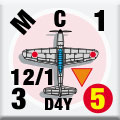
 Even before the D3A dive bomber entered service, the Imperial Navy issued requirements for its replacement, to make use of new German design practices found in the sample He118 dive bomber acquired in 1938. The D4Y Suisei (“Comet”) was very fast, though it lacked much in the way of crew protection and did not have self-sealing fuel tanks. When it could not out-run enemy fighters, it proved very easy to shoot down, but quite effective when it did survive to make its attack. The Comet entered service in 1942, with two of them present for the Battle of Midway. Even before the D3A dive bomber entered service, the Imperial Navy issued requirements for its replacement, to make use of new German design practices found in the sample He118 dive bomber acquired in 1938. The D4Y Suisei (“Comet”) was very fast, though it lacked much in the way of crew protection and did not have self-sealing fuel tanks. When it could not out-run enemy fighters, it proved very easy to shoot down, but quite effective when it did survive to make its attack. The Comet entered service in 1942, with two of them present for the Battle of Midway.
In The Emperor’s Sword, both of the new attack planes fly from the carriers of the Second Air Fleet; the Hawaii-based First Air Fleet has not yet been re-equipped.
The Ultimate Attack Plane
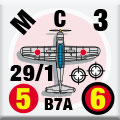 In 1941 the Imperial Navy sent out a new requirement, for a plane to replace both the D4Y and B6N, a plane that could serve as both a torpedo bomber and a dive bomber. It would operate from the projected Taiho-class aircraft carriers, which had larger elevators than previous flattops and much stronger arrestor gear, which meant that the plane could be bigger and more powerful. In 1941 the Imperial Navy sent out a new requirement, for a plane to replace both the D4Y and B6N, a plane that could serve as both a torpedo bomber and a dive bomber. It would operate from the projected Taiho-class aircraft carriers, which had larger elevators than previous flattops and much stronger arrestor gear, which meant that the plane could be bigger and more powerful.
The B7A Ryusei (“Shooting Star”) more than met those expectations. It was fast and tough, and handled like a much smaller fighter plane. Despite the increased size, it carried no more ordnance that its predecessors, but it was far more effective at delivering its load on its target.
An American submarine sank Taiho before the B7A could be deployed aboard, and the 83 B7A produced by the end of the war served from land bases. In The Emperor’s Sword, the B7A is the newly-arriving plane and equips the new carriers of the Third Air Fleet (the only ones capable of handling the big plane).
The Carriers
With more pilots and planes, there’s now a reason to build more aircraft carriers. Let’s have a look at them:
The Battle Cruisers
In our actual history, the Imperial Navy chose to convert two incomplete battlecruisers of the Amagi class into aircraft carriers, a move allowed by the Washington naval limitations treaty of 1922. One of them, Amagi, would be wrecked by the Great Kanto Earthquake of 1923 when work had barely begun, and the incomplete battleship Kaga took her place. The other, Akagi, would be completed as an aircraft carrier, serve as a testbed for design ideas and operational procedures, and after a thorough reconstruction, be lost at the Battle of Midway. The final pair, Takao and Atago, had only been under construction for less than thirty days when the treaty required their dismantling.
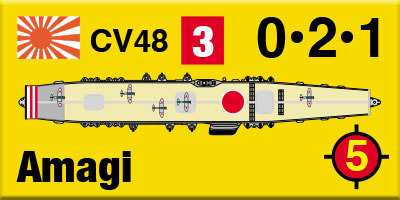
In our story, the treaty allows all four of them to be converted along the same lines as Akagi, with completion of Takao and Atago deferred until the first pair can undergo testing. Akagi and Amagi are completed as carrier with three flight decks and are rebuilt into more modern, conventional ships with a single deck; Takao and Atago have just one flight deck from the start. The background assumes that those two ships had been much more advanced when taken over for conversion.
All four of them share the weaknesses of converted older warships: a rigid construction that transmits shocks from even near-misses to the vulnerable aviation fuel storage tanks, a relatively small aircraft capacity compared to their great size, and an interior structure that is decidedly unfriendly to their crews. But their presence does allow the First Air Fleet to be formed a decade earlier than occurred in our own history, allowing the Japanese to become extremely proficient at carrier operations and the handling of multiple carriers in the same task force.
They begin the story of The Emperor’s Sword in Hawaii, making up the First Air Fleet of four carriers. They’re not at Pearl Harbor when the Americans attack, and they’re in action right away. Until the Americans return a few months later with new airplanes that their Zeroes and Vals can’t match.
Order The Emperor’s Sword Here.
Please allow an extra six weeks for delivery.
Sign up for our newsletter right here. Your info will never be sold or transferred; we'll just use it to update you on new games and new offers.
Mike Bennighof is president of Avalanche Press and holds a doctorate in history from Emory University. A Fulbright Scholar and NASA Journalist in Space finalist, he has published an unknowable number of books, games and articles on historical subjects.
He lives in Birmingham, Alabama with his wife and three children.
Want to keep Daily Content free of third-party ads? You can send us some love (and cash) through this link right here.
|