The Emperor’s Sword:
Japanese Aircraft Carriers, Part Two
by Mike Bennighof, Ph.D.
February 2026
 The Emperor's Sword is our alternative-history expansion set for Second World War at Sea: Midway. It posits a much richer and more powerful Japanese Empire, one able to match American shipbuilding and aircraft production. In other words, an excuse to put the ships and planes designed but never bult by either nation on the game table. The Emperor's Sword is our alternative-history expansion set for Second World War at Sea: Midway. It posits a much richer and more powerful Japanese Empire, one able to match American shipbuilding and aircraft production. In other words, an excuse to put the ships and planes designed but never bult by either nation on the game table.
We started a look at the additional Japanese planes and aircraft carriers in Part One; let’s have a look at the rest of them.
Sword Dragon
The first Japanese fleet carrier built as such from the keel up, Soryu, had been authorized under the 1934 Second Fleet Replenishment Plan. Most of the early plans involved some sort of cruiser-carrier hybrid, with both gun turrets and a flight deck, before settling on a conventional layout with full-length flight and hangar decks, and an island on the starboard side of the flight deck. She carried only anti-aircraft weaponry, and a capacity of 63 planes, plus nine more dis-assembled replacements. Laid down in 1934, Soryu was completed in the last days of 1937.
The Second Fleet Replenishment Plan included two aircraft carriers, but the second flattop, Hiryu, would not be laid down until July 1936. She had been projected as a sister ship of Soryu, but underwent significant design changes that both delayed construction and made her a different, one-ship class.
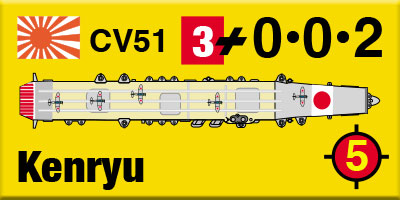
It’s somewhat different in our alternative history. Two carriers are laid down in 1934, Soryu (“Green Dragon”) and her sister, Kenryu (“Sword Dragon”), at the Kure and Yokosuka naval shipyards, respectively. As the naval limitations treaties of this alternative world are much less restrictive than those of our own, the Japanese are quite able to build four carriers rather than two in the 1934 Program, and the much richer Empire can afford the cost of both ships and planes.
One other aspect of this changed history is that the Imperial Navy has no incentive to avoid treaty limitations by building light carriers. The carrier Ryujo is never built, with Japan constructing a much more capable ship instead. The light carriers would also become the dumping ground for second-rate officers, crewmen and aircrew; in this reality, the Imperial Navy has the means to conduct much more thorough training and can draw on a better-educated populace for its officers and specialists.
Auspicious Dragon
Intended as a true sister to Soryu, Hiryu (“Flying Dragon”) would be heavily modified following the Tomozuru Incident. A Japanese torpedo boat capsized during a typhoon in March 1934, exposing stability problems in most recently-completed warships. Hiryu would have a broader beam to make her less top-heavy, added armor both for protection and to lower her metacentric height, and a higher forecastle to repel waves. The naval architects also moved her island to the port side, making her one of two aircraft carriers ever built with this arrangement (the other being Akagi).
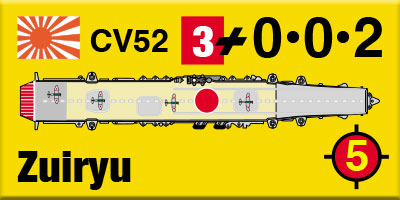
The re-design work delayed the start of construction until July 1936. Hiryu was slightly larger than Soryu but only carried one more airplane than her near sister. She had the same armament, slightly more armor, and was slightly slower (34.3 knots, compared to 34.8 knots for Soryu).
In our warped version of history, Hiryu is laid down at Yokosuka Naval Yard (as actually happened), on the slipway just vacated by Kenryu (that part did not happen). A true sister ship, Zuiryu (“Auspicious Dragon”) is laid down a month later at Kure, on the slipway where Soryu had just hit the water. They are completed in 1939 and, together with Soryu and Kenryu, form the core of the Second Air Fleet.
Red Dragon
The 1937 Third Fleet Replenishment Plan called for two new aircraft carriers, much larger and more capable than Soryu and Hiryu. The Shokaku class aircraft carriers would be the carrier equivalent of the Yamato-class battleships also authorized under the same program.
Shokaku would be laid down in December 1937 at Yokosuka Navy Yard, on the slipway occupied by Hiryu until her launch a month previously. Zuikaku was laid down in May 1938 at Kawasaki’s shipyard in Kobe, the first large carrier built in a private dockyard. They completed in August and September 1941, just in time to participate in the Pearl Harbor attack.
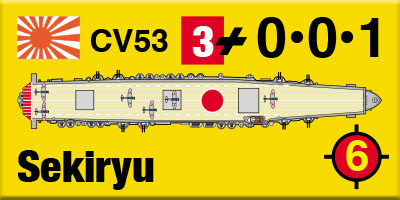
In our alternative history, there are four ships in the Shokaku class, all approved in the Third Fleet Replenishment Plan. Two sisters are laid down in 1939, on the same slipways where the first pair had been built, and completed in late 1942: Sekiryu (“Red Dragon”) and Oryu (“Phoenix Dragon”). By the time our story opens in December 1943 they are fully operational with well-seasoned crews. All four flattops are part of Third Air Fleet, and at the beginning of our tale they are in home waters, training in the Inland Sea after modifications to allow them to operate their brand-new aircraft: the A7M “Reppu” (“Hurricane”) fighter and B7A “Ryusei” (“Shooting Star”) torpedo/dive bomber.
White Dragon, Black Dragon
The Fourth Fleet Expansion Program of 1939 included two more Yamato-class super-battleships but only one aircraft carrier, an enlarged and improved version of Shokaku that became Taiho. Taiho would include the latest lessons from the naval war in Europe, including an armored flight deck like those of the latest British aircraft carriers. With her bow plated up to the flight deck (for better sea-keeping and airflow), she actually looked quit like a British aircraft carrier. She was rated for only 65 aircraft, compared to 72 for the Shokaku class.
Taiho would be laid down in July 1941, launched in April 1943, and commissioned in March 1944. In our alternative history we’ve shortened that construction time slightly, as this Japan has more abundant steel and labor during peacetime than the actual Japanese industrial base could muster under the pressures of war. Kawasaki’s Kobe dockyard built her, and while she’s sometimes described as suffering from design flaws, her end came more from poor damage control training and procedures than from the problems with her aviation fuel tanks (which were real problems, but Taiho would have survived them had her crew been capable).
Japanese plans for the carriers to follow Taiho showed the same touch of magical thinking that doomed the Empire to defeat in the actual Pacific War. One sister was included in the 1941 Fifth Fleet Expansion Program, and two additional near-sisters in the 1942 Sixth Fleet Expansion Program. That was reasonable, and in keeping with prior practice; none would ever be laid down, let alone completed. But defeat at the Battle of Midway led to an emergency program of sixteen additional aircraft carriers, modified versions of Hiryu. Three of them would actually be completed.
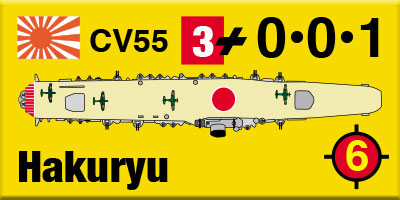
In our alternative history, the Imperial Navy orders a class of four in 1941, Taiho and three sisters. They are all ready for battle by January 1944, and are training in the Inland Sea when the Americans attack Pearl Harbor. Hakuryu (“White Dragon”) and Kokoryu (“Black Dragon”) appear in The Emperor’s Sword. Taiho herself will appear in a future game, and the fourth ship (Jinryu) in a future expansion. They are very capable ships, and along with the Shokaku class are the only Japanese carriers that can operate the new-generation high-performance aircraft. They make their appearance in the final chapter of The Emperor’s Sword, where they and their planes have a decisive impact.
Order The Emperor’s Sword Here.
Please allow an extra six weeks for delivery.
Sign up for our newsletter right here. Your info will never be sold or transferred; we'll just use it to update you on new games and new offers.
Mike Bennighof is president of Avalanche Press and holds a doctorate in history from Emory University. A Fulbright Scholar and NASA Journalist in Space finalist, he has published an unknowable number of books, games and articles on historical subjects.
He lives in Birmingham, Alabama with his wife and three children.
Want to keep Daily Content free of third-party ads? You can send us some love (and cash) through this link right here.
|